Superior Silage
Three years ago, the Natzkes began including Silostop in their covering routine. It's a clear, plastic sheeting material that helps keep air from coming into contact with stored feed.
“We were having some problems with mold 6-8” from the top a few years ago,” Natzke explains. “We were throwing away a lot of feed. Now we're holding our shrink to around 10% or less.”
He covers the Silostop with a layer of black and white 5-mil plastic to block ultraviolet light. To hold the plastic in place, he uses 3' × 6” bags filled with pea gravel along the bunker walls and tire sidewalls in the center.
After the bunkers are covered, Natzke makes it a point to check the plastic on all of them at least once a month. “If I find a tear or a hole, I'll tape it right away,” he says.
For feed-out, Natzke utilizes a silage facer.
“We usually deface the front of the pile for about an hour before we feed,” he says. “You get the drier material from the top blending in with the wetter material from the bottom. Whenever you can keep the dry matter consistent, the cows are going to benefit.”
The Schmitz family — Ray and Sylvia and their son and daughter-in-law, Matt and Heather — also emphasizes attention to detailin managing the bunkers for its 600-cow Valley View Dairy near Richland Center.
“When we first switched over to bunkers (from upright storage), we thought maybe we could be a little more lax,” says Ray Schmitz. “We found out in a hurry that's not the case. With bunkers you really have to stay on top of management.”
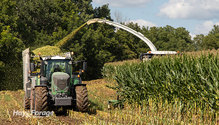
Like the Natzkes, the Schmitzes apply inoculant when harvesting both haylage and corn silage. Schmitz figures its cost at 60¢/ton for haylage and 57¢/ton for corn silage. They also emphasize proper packing (two tractors) and use a facer when it's time to feed out. The dairy has bunker storage capacity of 9,200 tons of corn silage and 1,500 tons of haylage on a dry matter basis.
Schmitz believes that good bunker management starts with putting forages into the bunker at a consistent moisture content. He looks to harvest haylage crops at 60-62% moisture; corn silage at 67-72% moisture.
“If you get it into the bunker at the right moisture, you're going to do a lot better job of packing,” he points out. “The more packing we do, the more we realize how important it is.”
For the corn silage crop, the producers start monitoring moisture levels at tasseling.
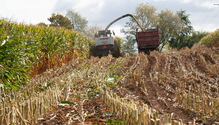
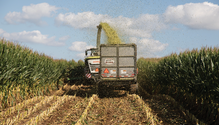
“We figure we're about 45 days away from harvest at that point,”he says. “When we're about a week or so away from harvest, we'll do a chipper test (a service provided by their local co-op). Once we get started chopping, we want to get the whole crop into the bunker in three or four days to ensure consistency. Fewer changes in moisture content and digestibility are very important for milk production.”
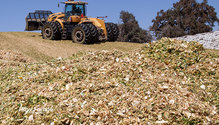
For covering and sealing,the Schmitzes use a wrap-around approach. They start by placing a sheet of white and black plastic on the floor of the bunker, roughly 4' out from each sidewall. Then they move up the bunker walls with the plastic. When packing is complete, they overlap the two plastic sheets and cover with tires.
“We've done it this way for about three years,” says Schmitz. “We used to just go over the top with the plastic. But we'd get a valley in one or two spots, and the water would manage to get down under the plastic and ruin some of the feed. This works a lot better.”
Like all top-flight dairy managers, the Schmitz family is continuously assessing management for areas where they might improve. Currently, their milk production average is around 28,000 lbs on 3X milking.
“We've heard some real good things about Silostop and will probably give it a try soon,” he reports. “We certainly don't think we have all the answers when it comes to managing bunkers. We're willing to share ideas on what's worked for us and we're more than willing to listen to others on what is working for them.”
Want to use this article? Click here for options!
© 2008 Penton Media Inc.
Top Silage Articles
advertisement
Research in Brief
The following items report on forage-related research recently presented by University experts at meetings across the country.