“Slop” is the 2025 Word of the Year, according to Merriam-Webster. The mainstream media’s definition of slop probably isn’t what comes to farmers’ minds when they hear the word, but it raises red flags about management either way, whether that management is online or on the farm.
Merriam-Webster defines slop as low-quality digital content produced in excess by artificial intelligence (AI). Think of all the fictitious photos and videos, unfounded advertising, and fake news that clogs up your social media feed — that’s slop. The dictionary’s editors say that amid the chaos of AI threats and security breaches, internet slop is generally less alarming and more mocking.
Some AI slop targets agriculture, generating unrealistic content about crop and livestock production or animal welfare. Most of the time, farmers can see right through these ridiculous posts, but the nonfarming public may not be so discerning. That’s concerning for the ag community, which represents less than 1% of the population, and it’s why more and more farmers feel called to share their stories on digital platforms to correct the misinformation that their customers might be exposed to.
Slop on the farm
With synonyms like “muck” and “sludge,” the Merriam-Webster editors also describe the word of the year as something you don’t want to touch. It brings to mind other materials with slop-like characteristics found on a farm: mud, hay waste, and manure. Considering the messes that these materials can create, it’s important to be proactive in preventing damage to pastures and hayfields. Effectively handling mud, hay waste, and manure is ultimately a form of nutrient management.
Mud. Many hay producers experienced a muddy start to the harvest season, with excess spring rains saturating soils and delaying first cutting across the Midwest and East. In cases like these, mud needs to be avoided until a clear forecast and sunny skies dry fields. Sloppy conditions and soft ground are the precursors for serious damage from heavy field equipment, and this damage can lead to more permanent issues like compaction and yield loss, especially in perennial hayfields like alfalfa.
Muddy pastures are also cause for concern as the additional effort required by cattle to trek through a sloppy obstacle course can expedite energy demands while reducing forage intake. Researchers from Penn State University have shared that 8-inch deep mud can curtail feed intake by 15%. Two additional inches of mud can bump that number up to 30%. The result is reduced average daily gains, lower milk production, and poorer animal performance overall. What’s more is that muddy pastures can carry higher pathogen loads and elevate the risk of diseases like calf scours in newborn animals for both spring- and fall-calving herds.
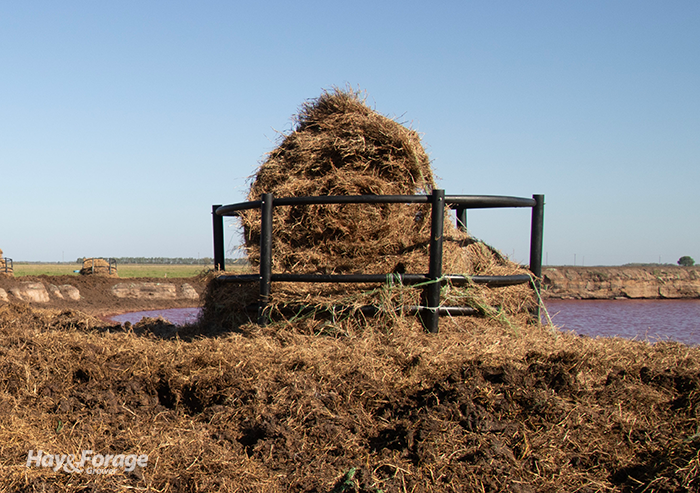
This time of year, mud creates other issues for livestock producers who corral their cattle into a sacrifice paddock and feed hay. Heavy hoof traffic around hay rings leaves soil subject to erosion and compaction. Reseeding forage here next spring will be crucial to protect bare ground and restore sacrifice paddocks as components of the larger grazing system long term. Farmers may need to take mechanical action to prepare the seedbed if hoof damage is severe. Seeding a summer annual before reestablishing perennial species in sacrifice paddocks may also be a good idea to rejuvenate the weakened land.
Hay waste. Speaking of the area around a hay ring, hay waste can turn into slop in a hurry — especially if that hay ring has a simple, open design that gives animals full access to an entire bale. This discarded material not only represents wasted feed and wasted dollars but also wasted fertilizer. Leftover hay can hold a significant amount of nutrients that accumulate in one spot instead of being distributed across a larger acreage.
Depending on production costs, or the price of purchased bales, hay waste can represent a large percentage of total feed costs. Moreover, the economic value of the nitrogen, phosphorus, and potassium in hay — as well as various other micronutrients and trace minerals — can be more than $50 per ton. However, the potential for those nutrients to benefit soil fertility won’t be realized if wasted hay is limited to the feeding area.
Manure. Manure may be the ultimate form of farm slop, nonetheless a highly valuable one. Along with wasted hay, manure accumulates around bale rings in winter feeding systems, and a similar dilemma exists as excreted nutrients and organic matter are not effectively recycled, especially when run-off from manure infiltrates surrounding water sources.
Winter feeding strategies that promote a better distribution of these nutrients include bale grazing, swath grazing, and unrolling hay. When farmers implement one of these methods and manage animals’ access to forage with rotational grazing or strip grazing, they can achieve a more uniform deposition of manure throughout a stand. In addition to benefitting soil fertility, this promotes more balanced forage growth and improves overall pasture performance in subsequent years.
Unlike the relentless AI slop that was recognized as 2025 Word of the Year, mud, hay waste, and manure can carry significant value to livestock, soil health and fertility, and your bottom line every day.