So long La Niña, hello neutral . . . for now |
| By Mike Rankin, Senior Editor |
|
|
 In concurrence with long-held expectations, the National Oceanic and Atmospheric Administration (NOAA) announced the most recent La Niña visit has come to end. In its place comes a not-so-emphatic neutral condition. Pam Knox, an agricultural climatologist with the University of Georgia, explains in a recent blog post that the ocean conditions in the Eastern Pacific Ocean (EPO) are now expected to swing rapidly to the opposite phase, El Niño, with warmer than normal sea surface temperatures expected to dominate the EPO for the rest of 2026. This change will trigger significant ramifications for the growing season. Knox explains, “This will likely cause 2026 to become the warmest year on record because of the combination of the warm pool and the rising temperature trend across the globe.” The climate summary released last week by NOAA showed that the contiguous U.S. experienced its warmest March on record. This was primarily driven by record-setting warmth in the Western states and higher than normal temperatures in most of the eastern U.S. The next El Niño could occur as early as the May through July period and is expected to affect the number of tropical storms in the Atlantic Basin. The warmer ocean waters cause the Pacific jet stream to move south of its neutral position. With this shift, areas in the northern U.S. and Canada are drier and warmer than usual. Around the Gulf Coast and Southeast states, El Niño periods are wetter than usual and have increased flooding. 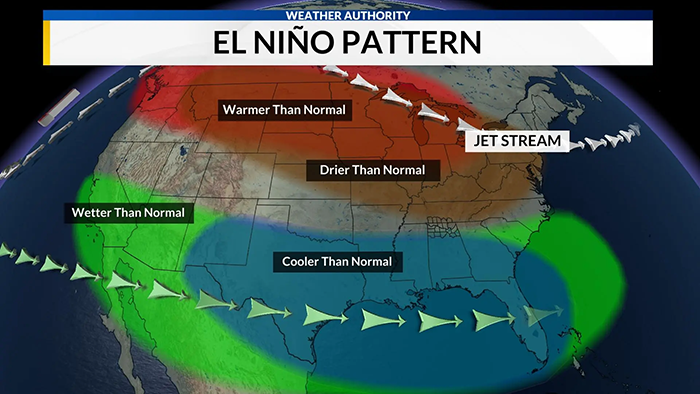 Recently, there has been a lot of discussion about the possibility of a “Super El Niño” occurring this year, but Knox notes that the Climate Prediction Center (CPC) gives this only a one in four chance, which suggests a moderate to strong El Niño is more likely. Climate models forecasting the exceptionally warm ocean temperatures needed to generate a Super El Niño are known to overpredict ocean temperature rises in the spring, so while a very strong El Niño is possible, it is not at all certain, Knox opines. |
