 Photo by: Matt Poore
 In recent years, regenerative agriculture has become a popular topic in our industry. The idea is to improve your production system using the principles of soil health, which include reducing soil disturbance, keeping the soil covered with plant residue, keeping living roots in the soil year-round, elevating both plant and animal biodiversity, and integrating livestock.
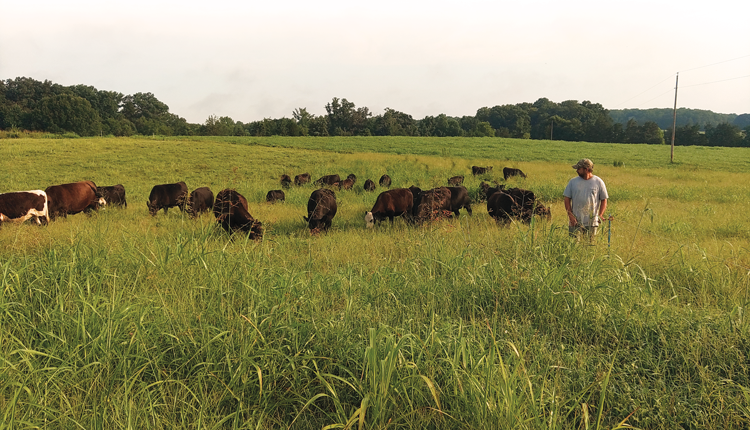
Regenerative grazing with beef cattle has a jump start on this concept as most beef production systems are based on perennial forages and inherently integrate livestock. The fundamentals of good grazing management include limiting the length of grazing events, leaving residual forage, and allowing for long rest periods. These get us on the road to regeneration by building soil health.
Regenerative grazing requires a different mindset in which farmers accept the fact that most agricultural systems — in this case, pasture — are in a degraded state. Many farmers use inputs such as fertilizers and herbicides as a crutch to solve problems that continue to recur. The regenerative mindset is to move the system back toward a functioning ecosystem that can self-perpetuate with help from only our management and the grazing action of the cows. Once you have a healthy and diverse plant population, elevated soil organic matter, and a high level of nutrient cycling, it is possible to be productive without those expensive inputs.
Unfortunately, it is not so simple, and it can take a long time to get to this long-term goal. In the ideal situation, you might already have all the pieces in place to make no-input grazing happen. But if your system is heavily degraded to begin with, you might never get the system to regenerative status.
I frequently read suggestions in social media groups for beginner graziers that strongly recommend never using any herbicides, fertilizers, or other inputs. After 45 years of managing a farm, I realize that it is critical to use all the tools available to steer your system in the right direction. It was possible for me to create a self-perpetuating ecosystem, but it didn’t happen without some important inputs along the way.
We have many tools that can help us get on the right path, but farmers need to understand how and when to use them. The first step is to soil test and correct nutrient deficiencies, meanwhile scoring the condition of each of your pastures. Pasture Condition Scoring is a highly recommended method developed by the Natural Resources Conservation Service (NRCS), and there are guides and worksheets available.
Soil pH is a critical factor in soil health. Eventually, organic matter will help buffer acids produced in the soil, but if your soil is initially acidic, then it will be necessary to use lime to raise soil pH. Moreover, legumes are core components of a pasture system because they fix nitrogen from the atmosphere, but most legumes are sensitive to low soil pH, so correcting those levels is crucial.
It is also common to find pastures and hayfields that have been overgrazed by continuous grazing with little to no fertilizer applied for decades. If the levels of phosphorus and potassium are at rock bottom, then you need to bring those nutrients back into the system. This can be done with commercial fertilizers or alternative sources like poultry litter or hay, but without some type of input, soil fertility will be slow to improve. Again, use a soil test to guide your applications, but understand that with very low nutrients in the soil, a high level of nutrient cycling cannot occur.
Wipe out weeds
Another common problem in degraded systems is that the plant populations may not be what you want. Tough invasive weeds like nimblewill, dog fennel, and blackberries are difficult to remove without some action on the farmer’s part. Learn to identify your plants, and if you have strong populations of undesirables, you might benefit from the use of an herbicide. Don’t think that all “weeds” are bad, and that you need a pure stand of grass. Good plant diversity means having a balance of grasses, legumes, and nonleguminous forbs. But there are poisonous plants out there, and some that have little value in a grazing system.
In some cases, plant populations will be so bad that a complete renovation might be the best approach to achieving a healthy ecosystem. Implementing pasture renovation may involve the use of a broad-spectrum herbicide and some selective broadleaf herbicides when desirable grasses are developing in a stand. After the grasses are up and healthy, the addition of nutritious legumes and forbs like plantain and chicory can build a diverse plant community.
Mowing is an underappreciated method for improving pastures, and it is especially helpful with brush and tree species. If common sense tells you to mow following a grazing event, do it.
Back to the basics
Essentially, there is no one-size-fits-all solution to developing a regenerative system without several inputs. Every situation is different, so don’t believe a “never” or “always” approach. Understand your tools, apply them strategically to get the effect you are after, and then put them on the shelf after they are no longer needed.
Regenerative grazing is an exciting new frontier for us. It is possible to produce a lot of forage and beef per acre without the use of traditional inputs, but there will always be situations where the strategic use of these inputs might be beneficial. Be especially wary of new inputs marketed to farmers that have not been proven by science or seem too good to be true. They usually are.
In the end, the most critical aspects of regenerative grazing are to move animals frequently, allow long rest periods, and match your livestock to their environment. If you do those things and use inputs strategically, but sparingly, good things will generally happen.
This article appeared in the January 2026 issue of Hay & Forage Grower on page 18 and 19.
Not a subscriber? Click to get the print magazine.