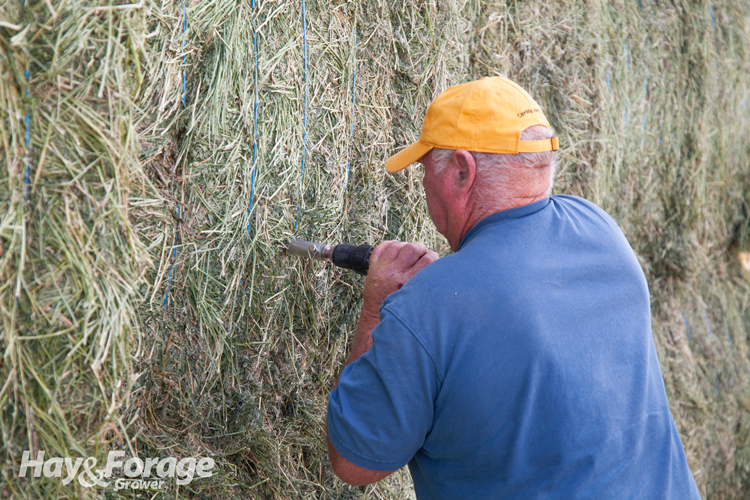
Recently in Kentucky, forage testing has generated discussion as a new testing location was opened in Bowling Green. The state Department of Agriculture is closing their forage testing facility, so the University of Kentucky (UK) Regulatory Services is adding this service to the milk, feed, and fertilizer testing services they already provide. I have been working with the team at UK to bring our forage testing program online. This effort has brought to my attention several things that are worth reviewing.
Why test forage?
Obtaining a nutrient profile on your forages allows you to strategically feed hay based on the nutrient requirements of livestock and minimize supplementation. Many of our cool-season forages harvested for hay generally have sufficient protein to support most production phases of beef cows, with the exception of early lactation. The average crude protein (CP) for 2,539 hay samples analyzed in Kentucky hay contests from 2019 through 2025 for all forage types was 11%. The protein needs for dry, gestating cows are between 7% and 9% CP, while cows in early lactation may need 9% to 12% CP.
Energy from stored cool-season forages is generally more limiting for beef cow production in the Southeast, particularly for fall-calving cows that are reaching peak lactation when hay is fed. A forage quality test report may provide energy values as total digestible nutrients (TDN) and/or net energy for maintenance, gain, and lactation (NEm, NEg, and NEl, respectively). Forage testing laboratories utilize the nutrients measured in the proximate analyses or near-infrared spectroscopy (NIRS) scan to calculate the energy values. A variety of equations are utilized to calculate these energy values.
In 2010, we reported results of a survey of 26 forage laboratories that indicated 12 different approaches to calculate forage and feedstuff energy values. The Penn State NEl-acid detergent fiber (ADF) and the OARDC/Dairy NRC summative equations were the most common.
As the team began considering the energy equations for our new forage testing program at UK, I reached out to a few laboratories to learn what energy calculations were being used since our survey was from over a decade ago. Two private laboratories shared their approach for calculating energy, with both using the 2001 Dairy NRC summative approach; however, these labs had different approaches for calculating net energy values. The third contact, a university laboratory, utilized a variety of equations based on ADF that are specific to forage or feedstuff type.
Why does this matter?
We use energy values to make supplemental feeding recommendations based on the forages’ ability to meet nutrient requirements. As an example, consider alfalfa that was reported to contain 18.5% CP, 46% neutral detergent fiber (NDF), 36% ADF, 7.6% ash, 7.7% lignin, and 48-hour NDF digestibility of 45%.
Using a common TDN equation based on ADF alone, the calculated TDN is 55%. Based on the 2001 summative Dairy NRC equation, the TDN would be 60%. A modified summative equation calculates the TDN as 62%. Did we just create energy? No, those energy values were simply calculated differently.
Consider a beef cow with a peak milk yield near 20 pounds per day. Forage would need to contain approximately 60% TDN to meet the cow’s energy requirements. Depending on the equation utilized, a nutritionist could recommend supplementing calories or conclude that no supplement is necessary.
I share this only for informational reasons, not to say one forage testing laboratory is better than another. In the past, I have had individuals reach out after they sent samples from the same hay lot to different laboratories and received different energy values on the reports. They wanted to know why the values were not the same.
Recognize that splitting samples can introduce sampling error and lead to analytical differences between samples. Also, when you choose to send samples to a different laboratory, it is worth knowing the approach they use to calculate energy values. When similar samples are sent to different testing labs, key in on the values for dry matter, CP, NDF, ADF, and ash, as these values should be relatively similar, too.
Keep in mind that forage test reports provide us with information on the nutrient content in forage — these reports don’t compute directly to an animal’s biological response. A hay test won’t give you information about whether the forage is musty or moldy, which can reduce intake. The energy values are calculations, so I suggest that farmers send samples to the same laboratory and learn how the energy values relate to the biological responses observed in their livestock over time.
For instance, beef cows offered hay with a net energy for maintenance (NEm) value of 0.52 megacalories per pound may not maintain body condition as you expect based on a nutrient requirement table. Keeping notes to rule out low intakes, unseasonably cold temperatures, wet and/or muddy conditions — along with the forage testing information — will allow you to learn how to make supplementation adjustments based on the forage test energy value. Reach out to your local extension office or nutrition consultant for additional information on forage testing and for advice about using your forage test results. Happy hay feeding, and be sure to test your hay!
This article appeared in the February 2026 issue of Hay & Forage Grower on page 28.
Not a subscriber? Click to get the print magazine.