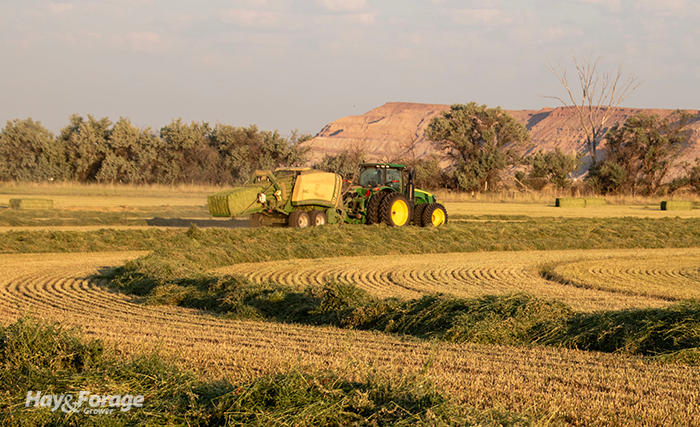
Last year marked the third year of the hay market downturn across the country. In the Western states, Josh Callen explained how shifting dynamics throughout the region and overseas have kept hay prices from coming up for air after being suffocated since 2023.
At last week’s Northwest Hay Expo in Kennewick, Wash., the author of The Hoyt Report admitted he thought 2025 was going to be a recalibration year with better hay prices on the horizon. That seemed to be the case in early spring until the trade war with China broke out in April. Callen suggested the hit to U.S. hay exports was a defining market factor for Western producers, along with dwindling demand from domestic dairy farms and unfavorable weather patterns.
Poor export demand. Through October, U.S. hay exports to all trade partners in 2025 were down 12%. Hay exports to China took a larger hit, down 25%, with the majority of that hay being alfalfa. Callen said the series of events in the trade war with China were reflected in Western hay prices as export sales can be a big contributor to farmers’ bottom lines.
“Financial challenges in the export industry lead to challenges in cash flow,” Callen said. “It’s been a very challenging few years, and this one was especially hard.”

In addition to tariffs, China’s demand for U.S. alfalfa hay has been tempered due to its declining dairy cow numbers. After overbuilding its dairy industry several years ago, China has realized a smaller than expected demand for milk, and therefore, the country needs less hay. Additionally, data suggest Chinese dairy farmers are including more corn silage in their rations, limiting their demand for U.S. alfalfa even further.
Low milk prices. Class III milk prices in the U.S. dropped off significantly by the end of 2025, which Callen attributed to an oversupply of milk from a growing national dairy herd. With more mouths to feed but less money to feed them, dairy farmers are seeking out other low-cost commodities on the market.
“As long as these milk prices are lackluster, it’s hard to see the dairymen pushing feed markets in a meaningful way,” Callen said.
He added that trade disagreements between other countries have affected the supply of livestock feed ingredients. For example, an influx of Canadian canola oil was redirected from China to the U.S. last year, slashing the price of canola meal for dairy farmers and encouraging a greater inclusion rate in cow rations. Callen added that low corn and soybean prices also influence decision-making on dairy farms and create competition with hay.
“In the dairy world, they are looking at a spreadsheet of commodity prices, and they are adjusting their rations based off of that,” he said. “It would be supportive for alfalfa prices if some of these other grain markets start to come back up.”
Drought. Drought conditions and other weather patterns inevitably have an impact on hay production every year. Callen said the inverse relationship between hay supplies and market prices could be chalked up to a chicken-or-the-egg scenario, but drought-induced depressions in hay stocks have historically favored price increases across the West. According to USDA, hay stocks have climbed in years prior; however, the most recent Dec. 1 hay stock report was down for the 11 Western states.
“If we are looking at flat to higher hay stocks coming out of the winter, we probably aren’t going to have the greatest of prices,” Callen said. “But if this number keeps trending down, that could definitely help prices.”
Water availability in irrigated systems will continue to have a hold on Western hay production, with some farmers opting to replace hay acres with other crops. Callen noted states within the Colorado River Basin are currently renegotiating water allocations to the upper and lower regions of the basin.
“There could be more restrictions there — it’s definitely something to watch for,” he stated.
The equine market is one bright spot for Southwest hay producers who are sending shipments east. Callen said retail prices for small square bales of high-quality alfalfa intended for horses have been promising.
“A trend that I could see continuing is if retail hay became more of a niche market,” he affirmed. “There’s more labor involved in it, but the recovery of that market has been a little better.”
Other hay specs
Despite a depressed take on alfalfa hay, Callen had relatively good news to share on the grass hay front. Low alfalfa hay prices encouraged Western farmers to seed more acres to timothy in 2024 and 2025. Even though prices didn’t see a significant improvement, domestic demand for timothy was good and trending higher, and there was less of a discount for lower quality hay. There was also better business for grass hay exports.
“Timothy was one of those where demand was better into South Korea and Japan, so that helped eat up those extra acres that went in,” Callen said. “Going into next year, demand looks like it’s going to be pretty good as well.”
According to Callen, stronger demand from South Korea for Western grass straw was up last year, too. That was largely driven by the Asian country’s own poor straw harvest and a weaker supply from Spain.
With that said, Callen admitted it’s hard to see much change happening for Western producers in the near future, with little indication of anything moving the needle for hay prices.
“It seems like it’s going to be another tough year going forward,” he concluded. “I think it will be important to look for niche markets, and retail hay looks to be one of them.”