The hay export market has historically carried a lot of weight for Western producers. Figuratively speaking, that remains true, as hay exports affect Western market prices and contribute to the cash flow of many farms. Literally speaking, though, the volume of alfalfa and grass hay leaving West Coast ports continues to slide, and U.S. exporters are handling much lighter loads.
Blaine Calaway is the chief operating officer of Calaway Trading Inc. in Ellensburg, Wash. The family-owned trading company has been in business for nearly four decades, weathering its share of market highs and lows. Farmers are aware of the current hay export market crash, Calaway said, and the state of things isn’t necessarily surprising. But that doesn’t make it any easier to absorb the shock that depressed export demand has on domestic hay production.
“It’s important to talk about how hay exports tie into hay prices here,” Calaway said.
Changing demographics
Calaway categorized U.S. hay importers into two categories: primary, mature markets that we have had long-standing trade relationships with, and newer, emerging markets that have less of a track record. Of the largest consumers of all types of U.S. hay, Japan and Korea fall into the former category, but the demographics of those two countries are changing.
According to Calaway, the average age of Japanese dairy farmers is north of 60. Moreover, the number of milk cows there is declining, and total milk production in Japan has been on a downward slope for several years. Similar observations have been made for Korea. “If you’re looking out to the future of hay exports there, there can be some concern,” he said.
China, on the other hand, is more of a newcomer on the hay export scene. Calaway said Chinese demand for U.S. hay experienced unprecedented growth between 2009, when its annual import volume was just shy of 20,000 metric tons (MT), and 2022, when hay exports to China peaked at more than 1.4 million MT. During that time, the country began building up its dairy industry and singlehandedly consumed the majority of alfalfa hay leaving our nation’s ports. But things haven’t panned out for milk production there, and hay exports to China have dropped off fast.
“The Chinese dairy industry has been hemorrhaging head count,” Calaway said. Statistics are hard to confirm, and many growers and exporters are skeptical of reported numbers, but the point is that consumer demand for dairy in China is dragging. “That's one of the factors driving the decline in the Chinese market,” Calaway contended.
Another factor is the strain on our nation’s relationship with China after last spring’s trade war. In some cases, in the midst of trade negotiations, hay that was already on its way to China had to be redirected to other countries. “When that happens, it is typically considered distressed cargo because it was never bound for those markets,” Calaway explained. “This drives prices lower in the new destination markets, which can create temporary disruption in pricing and movement of existing contracts or new business.”
Additionally, China has other options when it comes to sourcing product, along with every other country importing hay. “We’re not the only show in town when it comes to hay exports,” Calaway said. Canada and Australia may be two of our nation’s oldest competitors on the global stage, whereas rookies in the hay export game include Romania, Pakistan, Sudan, and Argentina. Spain and Italy have surfaced as key hay suppliers from time to time as well.
“We see hay from all over the world going into the Chinese market,” Calaway said. “The reality is that they are getting a lot of that product cheaper than from the U.S., and a lot of that has to do with exchange rates.”
Strong dollar
Demand is dwindling, production costs are up, and break-even prices are not being met — but Calaway said the real hindrance of moving hay overseas is the exchange rate.
“It takes more Japanese yen, Korean won, and Chinese yuan to equal U.S. dollars and then buy the product,” he said. “Other markets have advantages to price their product more competitively. We’ve seen volumes move to those markets because of that.”
Trade deals with Middle Eastern countries don’t carry the same consequences. “Those markets are pegged to the dollar; it doesn’t matter what the dollar does, their markets stay the same,” Calaway explained. “We’ve seen the Middle East be a little more stable for exports, if not growing for a little bit.” Even so, it’s not nearly enough growth to pick up the slack from larger customers.
Hay export outlooks often identify emerging markets with potential to throw their hats in the ring, and all eyes have been on India as a new home for U.S. hay. However, Calaway is cautious of how lucrative business with the foreign country will be considering its stringent trade policies.
“I think there is huge potential for U.S. alfalfa in that market, but there are things that need to change to be able to allow that,” he said.
Undesirable inventory
Bringing it back to U.S. soil, Calaway said Western hay in storage is shaping up to be less than ideal, and he expects some inventories to be gone before the new crop is harvested. Over the past few years, many farmers have taken alfalfa acres out of production and seeded more of their ground to timothy in hopes that grass hay would offer better returns. While export demand for grass hay is relatively good, growing conditions haven’t been so rosy.
“Even with more acres, there was less yield,” Calaway said about the 2025 Western grass hay crop. “Timothy inventories will be cleaned out.”
He empathized with farmers selling hay at prices that don’t cover production costs, pointing to low commodity prices stealing demand from dairies that are wrestling with meager milk checks.
“If dairies are not making money, they have to look at the ration and say, ‘What can I feed that will be the cheapest,’” Calaway said. “That doesn’t give support to the alfalfa farmers in the area. The dairies aren’t buying alfalfa, and if they are, it’s not at a price that growers want to sell it at.”
He also sees current farm gate prices creating ripple effects on crop management decisions.
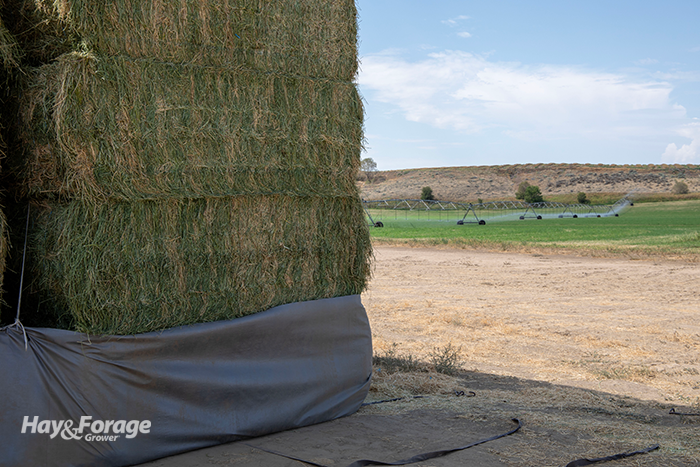
“When it gets tough, growers cut costs anywhere they can, just like any business would,” he said. Where alfalfa continued to be cut and baled last year, farmers may have neglected the use of hay tarps or scaled back on crop inputs. From an exporter’s perspective, this creates challenges in quality control, especially since foreign markets expect an extremely clean product.
“Taking care of the crop and storing it properly gives you the option to take it to any channel you want, whether domestic or export,” Calaway asserted.
With that said, agricultural markets are cyclical, and although this low has lasted longer than what the hay industry is accustomed to, Calaway believes the pendulum will eventually move in the other direction. “The one thing that U.S. hay producers do better than so many other producing markets is quality,” he said. “As we continue to focus on what we do well, there will be a return, and we will see things swing back to favor U.S. forage products.”