High forage dairy rations are an excellent nutritional strategy for optimizing production while controlling feed costs. High-quality, homegrown forages provide a cost-effective foundation for rations that support milk production and profitability. However, high-forage diets also present challenges, including reduced digestibility and long forage particles that raise the risk of sorting at the bunk.
Building a successful high-forage ration begins with good crop management, but once forage inventory and quality are set, other ingredients and practices can help maximize the value of those forages. Feeding molasses is one tool that can support this goal. When used appropriately, molasses can reduce sorting behavior and support rumen function. As with any feed ingredient, however, the benefits depend on good management, and molasses is not a magic bullet.
Reduce sorting behavior
There are three rations on every dairy farm: the ration balanced by the nutritionist, the ration delivered to the cows, and the ration the cows actually eat. At every step between formulation and consumption, opportunities exist for error. These errors may include weighing or mixing inconsistencies, but cows themselves also widen this gap when they sort against long forage particles.
Sorting is a particular concern in forage-based rations, where longer particle size enables cows to select concentrates and fine particles. When sorting occurs, the nutrient profile of the ration consumed by the cow no longer matches what was formulated. Sorting often shows up first in subtle ways at the feedbunk. Refusals may become forage heavy over the course of the day as cows preferentially consume finer particles immediately after feed delivery. Using a Penn State Particle Separator is one way to quantify the level of sorting that occurs by comparing the particle size distribution of refusals with that of fresh feed. Addressing sorting at the bunk helps ensure that cows receive a more consistent diet throughout the day, supporting stable rumen function and more predictable milk production.
The economic impact of sorting is well documented. A 2017 analysis from the University of Guelph found that every 10% refusal of long particles reduced milkfat percentage by 0.15 points and milk protein percentage by 0.05 points. Similarly, a 2013 analysis from the same researchers reported that every 2% bump in refusal of long particles at the group level reduced fat-corrected milk production by approximately 2 pounds per cow per day. Therefore, preventing sorting can improve income over feed costs without affecting ration expenses, allowing producers to capture more value from the feed that is already in their inventory.
Feeding molasses is one strategy producers can use to reduce sorting. Molasses-based liquid feeds help bind ration ingredients together and reduce the separation of fine particles from forage. Water can sometimes serve a similar purpose — but there are some caveats. For instance, when total mixed ration (TMR) dry matter is below 60%, adding water can increase sorting and promote feed heating, especially in warm weather. In contrast, molasses can be added across a wide range of ration dry matter content without impacting spoilage risk. Research has consistently shown that adding molasses to lactating cow diets can improve dry matter intake, reduce sorting, and influence feeding behavior throughout the day. Similar responses have also been observed in dry cow diets.
Unlock fiber digestibility
Although both starch and sugar are highly digestible energy sources, they do not function the same way in the rumen. Starches and sugars differ in their structure and influence rumen fermentation differently. Unlike starch, dietary sugars typically do not reduce rumen pH, and, in some cases, may slightly raise it.
Sugars can also improve fiber digestion when they replace a portion of dietary starch. Fiber-digesting bacteria rely on readily fermentable sugars as an energy source, meaning that sugars can help “unlock” additional digestibility from forages already present in the ration. This effect is particularly valuable in high-forage diets, where maximizing fiber utilization is key to maintaining intake and production. In these situations, sugars provide readily available energy to fiber-digesting bacteria, supporting more efficient rumen fermentation without relying solely on additional starch. Rather than increasing grain inclusion to drive energy intake, sugars enable producers to better utilize the fiber already present in the ration, thereby helping to maintain intake and performance while preserving the benefits of a forage-based feeding strategy. Research suggests that the sweet spot for added sugar is approximately 5% of diet dry matter.
Good management
As with any feeding strategy, molasses cannot compensate for poor management. To realize the benefits of molasses supplementation, both feed management and cow management must be considered.
Stocking density plays a role in milkfat synthesis, particularly through its influence on de novo fatty acid production. To support optimal performance, avoid excessive overstocking and aim to keep stocking density at or below 110%. Provide at least 18 inches of bunk space per cow to reduce competition and sorting pressure. Other management practices can further support consistent intake, including separating first-lactation cows from older cows when possible, feeding at least twice a day, and pushing up feed frequently.
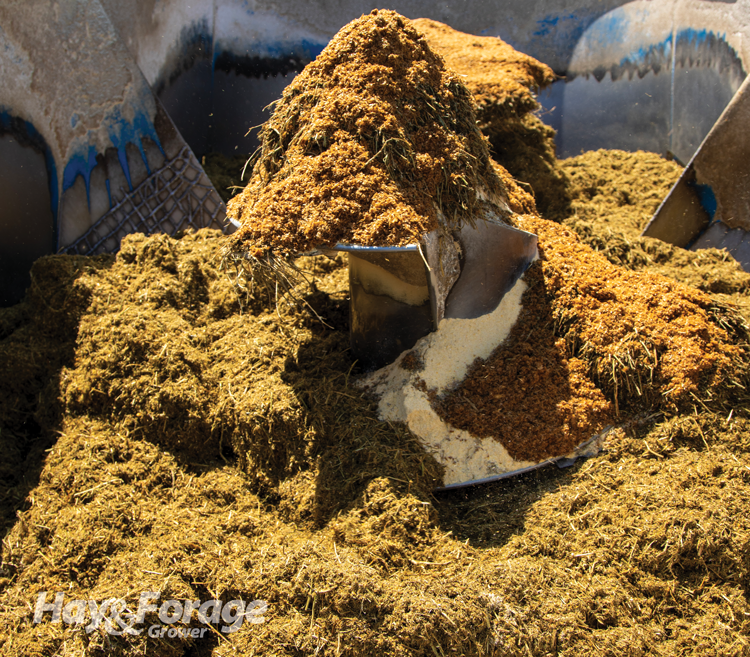
Feed mixing is also critical when adding molasses to the ration. Add liquids early in the mixing process and distribute them evenly across the ration rather than being applied in a single location. Avoid dropping liquid feeds directly onto mixer screws, and routinely check the mixer walls for buildup to ensure uniform incorporation.
When paired with sound feeding and cow management, molasses can complement high-forage diets by reducing sorting, adding fermentable energy without heightening the risk of acidosis, and improving fiber digestibility. For producers aiming to capture more value from homegrown forages, molasses can be a practical tool, provided that it is used thoughtfully. Work with your nutritionist to determine whether molasses fits your ration and to identify an appropriate inclusion rate, typically targeting around 5% of total dietary sugars.
This article appeared in the February 2026 issue of Hay & Forage Grower on page 10-11.
Not a subscriber? Click to get the print magazine.