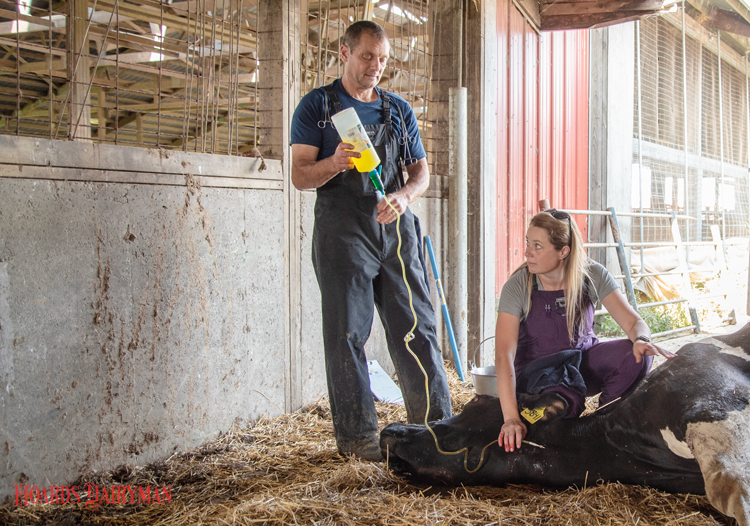
Ketosis is defined as a metabolic state in which a shortage of carbohydrates and protein requires cows to use body fat to fuel body function. While it has long been a common disease in U.S. dairy cattle, clinical ketosis is much rarer than it was in the past, primarily due to aggressive pre- and postcalving treatments on well-managed dairy farms.
When ketosis does occur, it is most common seven days precalving when ration dry matter (DM) intake declines, and for roughly 14 days postcalving when the energy demands of rapidly increasing milk production exceed the energy available from DM intake.
Regardless of the fact that fewer dairy cows are showing signs of clinical ketosis, it is likely that subclinical ketosis saps the productive capacity of cows, especially in early lactation. Thus, we must know the extent of ketosis in a herd and identify the cows that require supplementary attention.
A by-product of body fat mobilization is beta-hydroxybutyrate (BHBA), which accumulates in blood if body fat mobilization is so rapid that it cannot be cleared faster than it is produced. High levels of BHBA in the blood make it abnormally acidic, leading to loss of water, sodium, and potassium. As a result, animals can experience abdominal pain, confusion, and a lack of muscle function. Blood BHBA levels are often used as indicators of ketosis. Opinions differ, but the consensus seems to be that 1.2 to 1.4 millimoles of BHBA per liter of blood is indicative of ketosis, and if 15% of a group exceeds this value, then action should be taken. But is this BHBA level correct?
One of the most common reasons farmers aim to prevent subclinical ketosis in dairy cows is to minimize the reduction in feed intake that accompanies it, since this will have a direct and immediate impact on milk production. The level of BHBA that is associated with a reduction in milk production is the point at which ketosis becomes clinically important.
To investigate this, researchers collected blood samples from 260 multiparous cows at 11 days prior to calving to zero days in milk (DIM) and at two to 15 DIM. The study was at a well-managed dairy over several months. Data were clustered into several blood BHBA groups according to the measured levels ranging from zero to 4.8 millimoles per liter.
Blood BHBA levels prior to calving were consistently low, with group averages of 0.5 to 0.6 millimoles per liter. The highest individual value was 1.2 millimoles per liter. In contrast, BHBA levels postcalving peaked at about six DIM with declines thereafter.
However, these general patterns mask BHBA-level variability among individual cows. Values in close-up cows were tightly clustered, whereas fresh cow values were highly variable. If blood with 1.2 millimoles per liter BHBA is accepted as the cutoff for subclinical ketosis, then no close-up cow in the study had subclinical ketosis precalving. But 40% of fresh cows had subclinical ketosis postcalving.
If individual fresh cows have clinical or subclinical ketosis, this would reduce milk production due to high body fat mobilization. It would also have negative impacts on metabolic function from high levels of blood BHBA. However, there was no association of blood BHBA levels on fresh cow milk production until it exceeded about 2.7 millimoles per liter. Based on this BHBA level, only 7% of fresh cows in the study would classify as clinically ketotic.
The point at which cows become ketotic may be well above the generally accepted blood BHBA level of 1.2 millimoles per liter. Indeed, in this group of 260 highly productive dairy cows, the percentage of ketotic cows declined from 40% to 7% when 2.7 millimoles BHBA per liter was the accepted level, which is when fresh cow milk production was reduced.
There are many reasons to monitor fresh cows for ketosis, but it seems possible that the true BHBA indicator of ketosis for multiparous cows in early lactation could be higher than the conventional consensus of 1.2 to 1.4 millimoles per liter.
This article appeared in the January 2026 issue of Hay & Forage Grower on page 28.
Not a subscriber? Click to get the print magazine.