The author is an extension forage and cover crops specialist at Michigan State University.
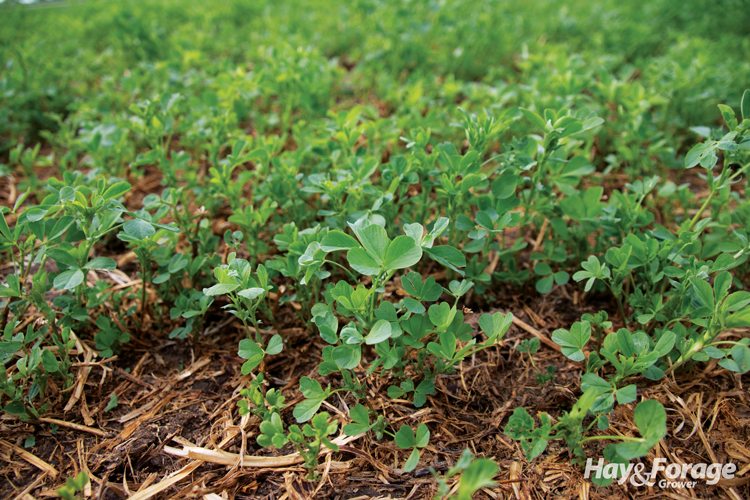
Although I write this looking out the window at a white, frozen landscape, it will soon be spring and time to plant crops, including alfalfa. Alfalfa can be challenging to establish due to its small seeds and sensitivity to soil conditions. However, good establishment sets the foundation for years of profitable perennial forage production, and it requires a plan long before the planter heads to the field.
Select a suitable site. Alfalfa is particular about its growing conditions, so the first critical step in successful establishment is choosing an appropriate site. Alfalfa can grow successfully in a variety of soil types, but good drainage is absolutely essential. Waterlogged soils promote root and crown diseases, which can impair seedling establishment and reduce stand life. Alfalfa will not maintain roots in permanently saturated soil. Branched root varieties have slightly better tolerance of marginal drainage than tap-rooted varieties because they maintain more root mass near the surface, but even the best branched root variety can’t overcome a wet, heavy soil.
The long taproot of alfalfa is one of its agronomic strengths, but it needs deep, fertile soil to take full advantage of this trait. Site factors that can limit effective rooting depth include saturated soil, but also bedrock, compacted soil layers, and acidic subsoils. Alfalfa performs best when soil pH is near or above 6.8. Below that, rhizobial bacteria struggle to survive and nutrient availability declines. Acidic subsoil also elevates the solubility of aluminum and manganese to toxic levels that prune alfalfa roots. Soil acidity can be corrected by lime application, but it takes time for lime to effectively change soil pH. Test soil the year before planting a new alfalfa field so that lime can be applied at least six months before anticipated seeding. A soil test also allows time for soil phosphorus (P) and potassium (K) levels to be adjusted if needed.
Avoid planting new alfalfa into fields that recently grew alfalfa. Alfalfa plants release natural compounds that can kill or weaken new alfalfa seedlings, also known as alfalfa autotoxicity. These compounds remain in the soil after termination of an old stand. If alfalfa is replanted too soon, the new crop may fail to establish or exhibit reduced lifetime yields. The breakdown of toxins is dependent on the amount of toxins present, rainfall, soil type, and tillage, and it may take up to two years on dry, moderate to heavy soils under no-till.
Consider herbicide history for any new alfalfa site that previously grew row crops. Many herbicides used in corn and soybeans have labeled residual soil activity for 18 months or longer after application. The risk of herbicide carryover may persist past the label limit if growing conditions inhibit chemical breakdown. Damage for long-acting herbicides may look like emergence failure or weak seedlings that die after emergence. Review herbicide labels and field records from the past two to three years to prevent unpleasant surprises.
Choose the right variety, seed coating, and seeding rate. Select alfalfa varieties with appropriate disease and pest resistance traits for your region and farm history. For long-term stand persistence, yield, and forage quality, consider fall dormancy, winter survival, plant morphology traits like crown depth and root structure, and quality traits like improved digestibility, reduced lignin, or multifoliolate leaves. The Roundup Ready trait can simplify post-planting weed control.
Most commercially available alfalfa seed is coated. Coatings are materials like clay, lime, and binders that help seed flow through planters and attract water to start the germination process. These are often combined with seed treatments such rhizobial bacteria to jump start nitrogen fixation, fungicides to prevent seedling disease, and tiny amounts of nutrients to aid seedlings.
Coated seeds weigh more than uncoated seeds, which raises the perpetual question of whether bulk seeding rates should be increased to ensure the recommended rate of 12 to 20 pounds per acre of pure live seed gets planted. Because coatings and treatments are designed to boost establishment rate per unit of seed, adjustment is usually not needed if the seed is fresh and handled correctly. Likewise, fresh coated seed does not usually require additional inoculation with rhizobial bacteria.
Regardless of coating, seed alfalfa at the higher end of that range if seed quality is compromised, planting conditions are less than ideal, or when broadcast seeding. However, many research studies confirm that planting more than 20 pounds per acre of pure live seed does not improve lifetime stand yield because overcrowded seedlings simply thin themselves out.
Set the planting date. Alfalfa planting dates are largely dictated by geographical location and local growing seasons. Growing seasons have been shifting, and in some places, dates for traditional planting windows may have changed by as much as two weeks.
In most regions, alfalfa has two potential planting windows: spring and late summer to fall. Spring plantings can usually commence as soon as the soil can be worked, with attention to the expected last freeze date. Alfalfa seedlings are tolerant to up to four hours of temperatures as low as 24ºF to 26ºF until they reach the second trifoliate stage, which is when they become much more susceptible to frost damage.
Advantages to spring seeding are the potential for harvest in the seeding year and presence of adequate soil moisture to get seedlings established. Disadvantages are greater pressure from weeds, insects, and diseases at the critical early stages of seedling development.
Prepare the field. Proper seedbed preparation is essential for good emergence. Alfalfa seeds must absorb more than their own weight in water before germination. Good seed-to-soil contact ensures the seed can take up enough moisture to sprout. In tilled systems, a firm and level seedbed is essential, and this is achieved by cultipacking. If the heel of your boot sinks more than a half-inch into the soil before planting, the seedbed is too soft.
In no-till or reduced-tillage systems, residue management is critical. Too much residue can make it difficult to get correct seed depth placement with a drill. Existing vegetation should be killed at least two weeks before seeding alfalfa to reduce competition. Ideally, vegetation is killed the season before planting to allow some residue decomposition.
Starter fertilizers with P and K support early root growth. Up to 40 pounds per acre of nitrogen (N) may be helpful at planting in soils with less than 2% organic matter, but any more N is undesirable because it reduces rhizobial colonization. If fields have problematic weeds, control them before alfalfa is seeded; herbicide options become more limited once alfalfa is in the field.
Plant and protect. Calibrate seeding equipment to account for variations in size and weight of coated alfalfa seed, which affect seed flow rates through drills. If the seeder is not properly calibrated, the seeding rate may be much higher or lower than intended.
Alfalfa seeds are tiny. If planted too deep, seedlings may not have enough energy to reach the soil surface. Place seeds one-quarter to one-half inch deep in most soils, and up to 1 and 1/2 inches deep in light, sandy soils. A good rule of thumb is that about 10% of the seed should be visible on the surface. If not, it is likely the seed was placed too deep. Always check the planting depth after a short test pass with the planter.
The critical period for weed control in new alfalfa begins after the unifoliate leaf emerges and continues through the seventh trifoliolate leaf stage. Herbicide options for conventional alfalfa are limited and should be targeted to the specific weed species present. Roundup-Ready technology provides a simple solution to post-planting weed control when glyphosate-resistant weeds are not present. Even if weed pressure is low, apply glyphosate no later than the third to fourth trifoliate leaf to remove nonresistant alfalfa seedlings from the stand.
By selecting an appropriate site, preparing the field carefully, choosing the right seed and planting depth, and controlling weeds early, farmers can set the stage for years of high-quality forage production. Careful attention to establishment is one of the most effective ways to ensure a productive and profitable alfalfa stand. •
This article appeared in the March 2026 issue of Hay & Forage Grower on pages 14 and 15.
Not a subscriber? Click to get the print magazine.