The author is a soil scientist with the USDA Agricultural Research Service in Raleigh, N.C., and past president of the American Forage and Grassland Council.
Soil organic matter is a vital component of many soil functions. Whether you have naturally low inherent organic matter such as in the southeastern United States or high inherent organic matter like prairie soils in the Upper Midwest, how you manage your farmland has implications for the power of that soil organic matter to enable soil to function effectively.
Important soil functions include: producing abundant forage biomass; effectively cycling nutrients within an ecosystem; supplying water, nutrients, and plant-growth promoting compounds; storing carbon, nitrogen, and many other elements; providing physical stability to support animal and vehicle traffic; protecting water quality by retaining nutrients and absorbing precipitation; serving as a reservoir of biodiversity of countless bacterial and fungal species; enabling animal habitat for belowground critters like earthworms and dung beetles and for ground-nesting birds and roaming mammals and insects; and buffering against toxic accumulation of heavy metals and synthetic chemicals. Most of these functions are greatly enhanced or sufficiently mediated by the content of organic matter in soil. However, what is less clear is whether relatively recent deposits of organic matter contribute the same as organic matter deposited over centuries and millennia.
Long-term testing
A common approach to assess land management impacts on soil organic matter is to sample a parcel of land at about five-year intervals over a couple of decades. The long interval is needed since there are inherent spatial variations that could mask temporal changes in soil organic matter when assessed at shorter time intervals. The long-term nature of significant changes in soil organic matter is one reason why there are relatively few estimates of how land management changes organic matter. The process takes resources and commitment, and repeating observations for the many unique soil types around the country has not been a priority. An additional hindrance to our understanding is the many different types of grassland management that need to be considered to make a full assessment. Therefore, the soil science community has much work to do regarding land management effects on soil organic matter.
A novel approach has recently been developed to get more rapid and potentially more reliable estimates of changes in soil organic matter with multi-decade management, such as what is practiced on many of your farms. This approach relies on deeper soil sampling at multiple depths to quantify the natural depth stratification of soil organic matter. A key feature of this approach is that soil organic matter derived from contemporary management during the past several decades can be separated from organic matter derived solely from soil-formation factors (pedogenesis) over the past several thousand years. An important assumption in this calculation is that contemporary management does not appreciably influence soil organic matter properties below the surface foot of soil. Many plant root systems are concentrated in the upper foot of soil, and so there is an ecologically based foundation for this assumption.
Carbon comparisons
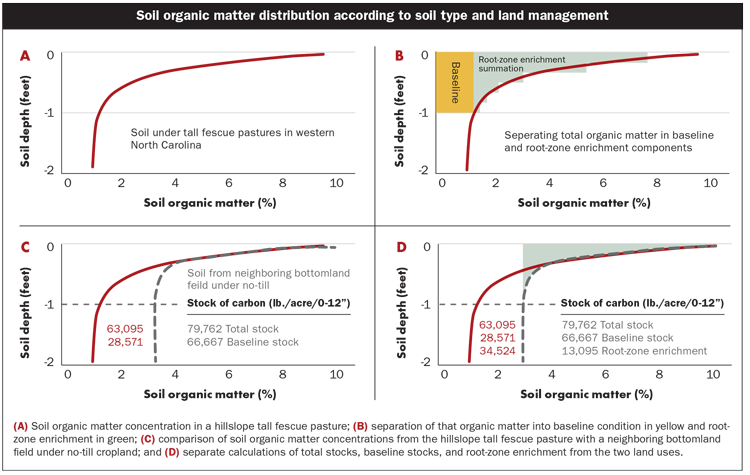
The figure illustrates a typical nature of soil organic matter distribution and how soil type and land management play a role in changing this distribution. Soil carbon was measured and reported as organic matter; soil organic matter is composed of 58% carbon. When determining the carbon concentration at a 12-inch depth, a baseline condition attributable to historical pedogenic factors is ascertained. Subtracting this baseline condition from the total distribution of soil organic carbon leaves an estimate of root-zone enrichment of soil organic carbon, which is attributable to contemporary management that has influence in the zero-to-12-inch layer.
This comparison of two neighboring fields shows soil organic matter was similar near the soil surface; however, the baseline condition was vastly different between cropland and grassland. The bottomland field was endowed with more than twice as much soil organic carbon. It would be unfair to make the land-use comparison of recent management based on total organic matter stock alone since the bottomland field had a clear advantage with inherently more soil organic matter deeper in the profile due to historical deposition.
Soil organic matter accumulates near the soil surface, and this observation allows us to make distinctions between historical and contemporary changes in soil organic matter. Taking stock of soil organic matter will help you understand how much was inherent from pedogenic processes versus how much was enriched during the past several decades. In future columns, I will explore in more detail the results of soil type and management on root-zone enrichment from different investigations. •
This article appeared in the March 2026 issue of Hay & Forage Grower on pages 26-27.
Not a subscriber? Click to get the print magazine.