The author is a beef cattle specialist for Texas A&M AgriLife Extension based in Overton, Texas.
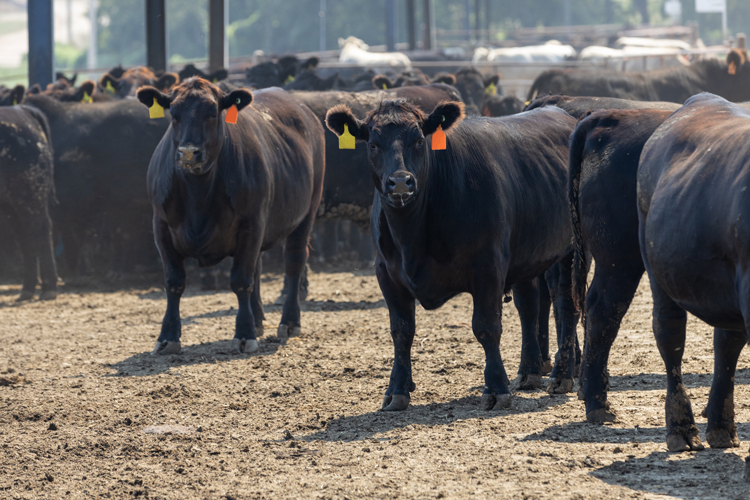
Did your cows come through the winter as well as you expected? Did you have to supplement more than you were planning? Poor animal performance and elevated feed costs can be the result of a misleading forage test. This article will focus on hay specifically, but the concepts discussed apply to all types of forage, including hay, silage, and baleage.
Not all hay tests are the same, and unfortunately, some hay tests can be misleading. Hay tests that don’t accurately estimate the total digestible nutrients (TDN) can result in lower than expected animal performance and greater feed costs. The TDN value indicates the amount of energy a feed can provide animals. It is also used to calculate other measurements of energy, including net energy for gain and net energy for maintenance.
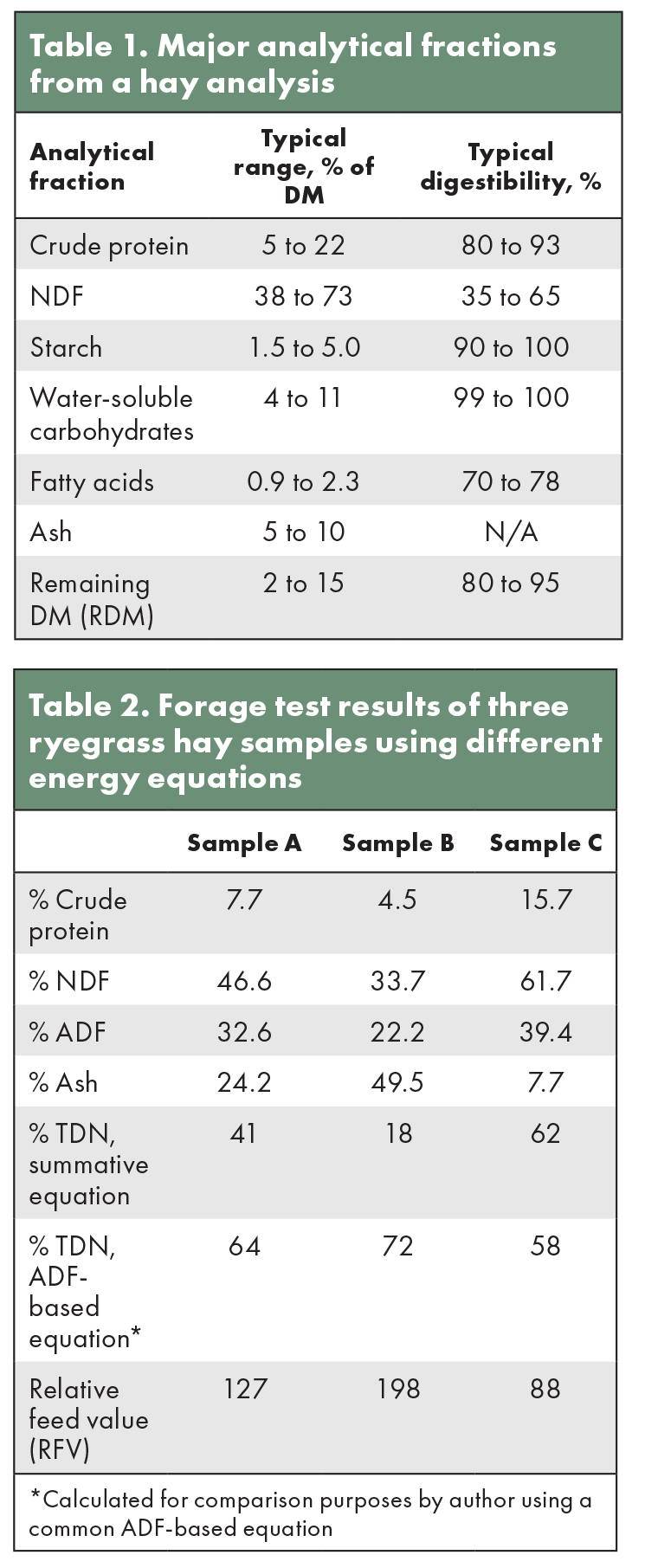
To better understand differences in hay tests, it is valuable to look at the major analytical fractions reported on one. Table 1 shows these analytical fractions, typical ranges for each fraction, and their expected ranges of digestibility.
Fiber and ash
Neutral detergent fiber (NDF) represents the largest analytical fraction found in most hay. Additionally, the variability in digestibility of NDF is greater than any other fraction. These two factors generally have more impact on the TDN value of a hay sample than anything else. Top forage testing labs offer packages that can provide a good estimate of NDF digestibility.
The ash fraction contains minerals found in hay, as well as any soil contamination. The ash fraction doesn’t supply any energy to the animal, but it is critical when determining energy values and evaluating hay sample results.The remaining dry matter (RDM) is not measured but calculated by difference. It represents any dry matter that is not accounted for in the other six measured fractions listed in Table 1. The RDM value is not shown on hay tests but is used when calculating energy values.
Summative equations and those based on acid detergent fiber (ADF) are two methods that forage testing labs use to estimate TDN. These methods can result in drastically different TDN values for the same hay sample. Summative equations should be used instead of acid detergent fiber-based equations when estimating TDN. There are multiple reasons for this.
Acid detergent fiber-based equations work off the premise that less ADF means TDN will be higher. One problem is that ADF-based equations do not account for ash content. Although the ash fraction does not contribute energy, it does affect the concentration of the other nutrients. High ash levels result in lower ADF, which then overestimates the TDN value of hay. Another problem with ADF-based equations is that they do not account for differences in NDF digestibility. Several factors influence NDF digestibility, including temperatures during the growing season, forage species, and genetic variation within the same species.
Don’t be fooled
Table 2 shows a comparison of three samples of ryegrass hay tested at the same lab using a summative equation to calculate TDN. Notice the difference between the TDN calculated with a summative equation compared to the TDN calculated with an ADF-based equation.
Sample C is the best of these three samples and feeding it would likely result in optimal animal performance. However, if these samples were sent to a lab that used an ADF-based equation to estimate TDN, the results would be misleading and suggest that sample B has the highest energy level when, in fact, it has the least amount of energy.
Relative feed value (RFV) can also be misleading when comparing hay samples. In this example, it suggests that both samples A and B are good quality when they are actually extremely low quality.
Before sending in a hay sample for a forage test, talk to a nutritionist to find out what labs utilize summative equations and which tests are the most appropriate for your sample.
This article appeared in the March 2026 issue of Hay & Forage Grower on page 30.
Not a subscriber? Click to get the print magazine.