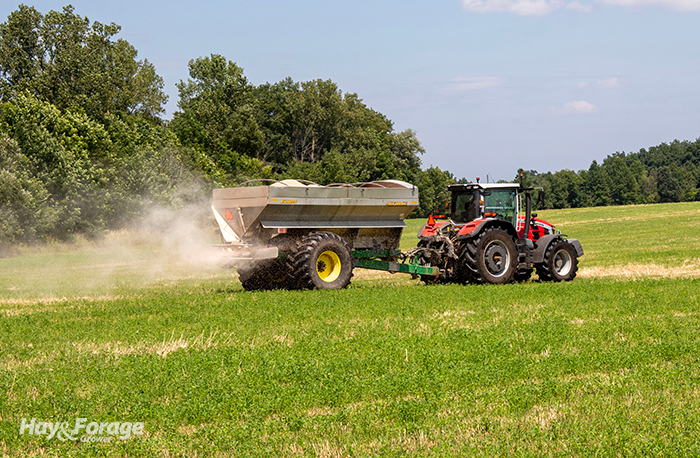
During this period when fertilizer prices are rising with each passing day, those in the hay business have cause for restless nights. Most hay crops remove large amounts of nutrients from the soil, although the quantity and types of nutrients removed will vary with forage species.
As the cost of fertilizing hayfields becomes more prohibitive, University of Kentucky (UK) soil scientists Ricardo Ribeiro and Edwin Ritchey are receiving more of the following questions:
Can I skip an application?
How much can I reduce rates?
Can manure or other products replace commercial fertilizers?
“These are reasonable concerns, but they reinforce the importance of soil‑test‑based nutrient management that prioritizes the best return on fertilizer investment rather than across‑the‑board cuts,” the soil scientists write in a Kentucky Forage News article.
With each ton of hay harvested, nitrogen (N), phosphorus (P), potassium (K), and sulfur (S) are removed from the system, reducing soil fertility and subsequent forage production. “In most hayfields, especially those testing in the low to medium range, nutrients removed at harvest need to be replaced to sustain yield and forage quality,” Ribeiro and Ritchey assert. “Fields testing high or very high may supply adequate nutrients for some time without additional inputs, but these situations are less common and still require monitoring.”
Fertilizer decisions need to be guided by soil testing to determine when and where nutrient application adjustments can be made. A strategic approach must be taken to keep soil fertility from declining to the point where yields, forage quality, and stand persistence are compromised.
“Adequate nutrient supply supports regrowth between cuttings, helps maintain crude protein through nitrogen and sulfur availability, and improves stand longevity,” the UK soil scientists note. “Insufficient fertility often results in inconsistent hay quality, making hay harder to market and less predictable for buyers.”
Test for the best
“Soil testing remains the most cost‑effective fertility tool available,” Ribeiro and Ritchey assert. “Regular testing identifies which nutrients are limiting and which applications can safely be reduced or skipped.” In essence, a dependable soil test may actually give you science-based permission to cut back on applied fertilizer.
In Kentucky established hayfields, the recommended approach is to collect 15 to 20 soil cores per sample, sample to a 4‑inch depth, and test every two to three years. Each state has its own set of soil sampling recommendations, so follow your own state’s recommendations to ensure valid results. For example, some states require that you sample at a 6- to 7-inch depth.
Maintaining soil pH is one of the most cost-effective means for optimizing a soil fertility program. Availability of applied nutrients is impacted by the pH of the soil. Alfalfa requires a soil pH of 6.8 or higher to ensure a high level of nitrogen fixation and to avoid aluminum toxicity. Most grasses and/or clovers are productive at a pH of 6.4 or higher.
Monitor your N, P, and K’s
Macronutrients need to be assessed independently based on the forage species being grown. Established alfalfa generally needs no N because it fixes its own. Conversely, grasses and mixed stands require adequate amounts of N to be productive, especially if legumes comprise less than 25% of the stand.
“Early spring N applications typically provide the best economic return, while later-season applications require more careful evaluation,” the UK soil scientist explain. “Potassium is especially critical in alfalfa hay systems due to high removal rates. Maintaining adequate soil K is essential for persistence and winterhardiness. Phosphorus applications should be driven entirely by soil test results.”
Many soils are already high or excessively high in P, especially where fields have a history of manure applications. Given current fertilizer prices, modest short-term reductions in P applications may be possible on soils testing in the medium to high range, which is a level where yield responses are unlikely, but fertilizer additions are still made as maintenance applications. This strategy should only be implemented as a temporary cost-saving solution. Repeating this approach year after year in the same field will ultimately draw down fertility to a yield-limiting level.
“Reducing P rates by one‑third to one‑half can cut costs without immediate yield loss, but this strategy should be used cautiously, monitored closely, and avoided on soils testing low or in the lower part of medium range,” Ribeiro and Ritchey contend.
Fertilizer options
Conventional fertilizer sources usually provide the best option when evaluated based on the cost per pound of available nutrient. The soil scientists suggest that when fertilizer prices rise, it’s tempting to chase “miracle” products, but careful evaluation is critical. These key points can help you make smarter choices:
• Check the actual nutrient content. Know how much N, P, K, and S each product delivers per unit. Labels can be misleading if marketed in unconventional forms.
• Compare cost per pound of nutrient. Some specialty blends or slow-release products may seem convenient, but they are often more expensive per unit of nutrient than traditional fertilizers.
• Match applications to real need. Base decisions on soil test results rather than perceived deficiencies. Overapplying nutrients you don’t need is a waste of money and can harm the environment.
• Consider manure and by-products. They can supplement nutrients effectively if their nutrient content is known, but variability is high, so don’t assume all sources are equivalent. It’s prudent to test manure and by-products as you would the soil.
“Ultimately, thoughtful product choice is less about chasing every new option and more about applying the right nutrients, at the right time, in the right amounts, based on a known soil nutrient status,” the authors conclude. “Optimizing hayfield fertility isn’t about applying less fertilizer, it’s about applying nutrients more strategically.”