For many people in the dairy industry, the phase-out of brown midrib (BMR) corn is akin to losing the four-wheel drive option in a pickup truck. Sure, the pickup will go most places, but there will be terrain limits.
The loss of BMR hybrids has nutritionists and dairy farmers concerned about production limits, especially for early lactation cows. Since the announcement that BMR corn had entered hospice care, there’s been a lot of discussion of how that void will be filled — or at least tempered. One of the options being floated is high-cut corn for silage, which isn’t a new concept, but a practice that may now garner more attention.
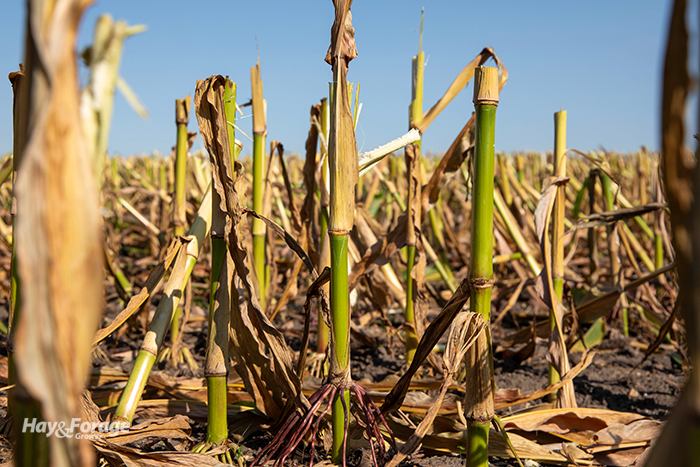
Leaving more lower stalk in the field at harvest has several effects. First, silage yield will be reduced in relation to how high the corn is cut. Second, overall fiber digestibility will improve as more of the least digestible lower stalk is left for the soil microbes to deal with. Third, a higher percentage of the harvested plant will be kernels, which will raise the starch concentration and energy density of the feed. Finally, high-cut corn silage will be somewhat lower in moisture compared to a traditional cutting height.
“If you’re considering raising the cutting height, you need a plan,” asserts Cole Diepersloot. “Either grow more acres or find other strategies to offset the yield loss. Cutting high is not an isolated decision.”
Diepersloot, who is a forage specialist and dairy nutritionist with Vita Plus, encourages dairy farmers to think carefully about the trade-offs associated with high-cut corn silage — especially the lower yield that will require more corn acres to compensate for. Of course, most BMR hybrids were also inherently lower in yield compared to higher-performing conventional hybrids.
Diepersloot emphasizes that corn maturity at harvest impacts the effects of high-chopped corn. “The biggest improvement in fiber digestibility came from high-dry matter silage, which makes sense because stalk digestibility declines as plants mature.”
While completing a meta-analysis of cutting-height studies during his graduate school years, Diepersloot notes that he found starch concentration improved most in the low-dry matter silages that were greater than 68% moisture. “This was something we didn’t expect, and we think that stay-green genetics may be influencing those results,” he explains.
As the options stand now, there is nothing that will mimic BMR corn hybrids in the dairy ration from a fiber digestibility standpoint. In addition to high-cut silage, there is also promise that new short-corn hybrids will bring with them higher fiber digestibility than conventional hybrids; however, the industry is still in the early stages of developing short-corn hybrids for silage.
Diepersloot concludes that high-cut corn silage will probably not feed the same as BMR silage, but the trade-offs between nutritive value and yield are real, and farmers will need to weigh them carefully.