Winter cereals serve the role of utility player for supporting the production of meat and milk. Planted in the fall, they can be grazed in late fall and/or spring, harvested as silage, or simply terminated once they’ve served their role as a winter soil protector. They may not be the primary — or even secondary — forage resource on most farms, but they still are used widely throughout the U.S. for many different reasons.
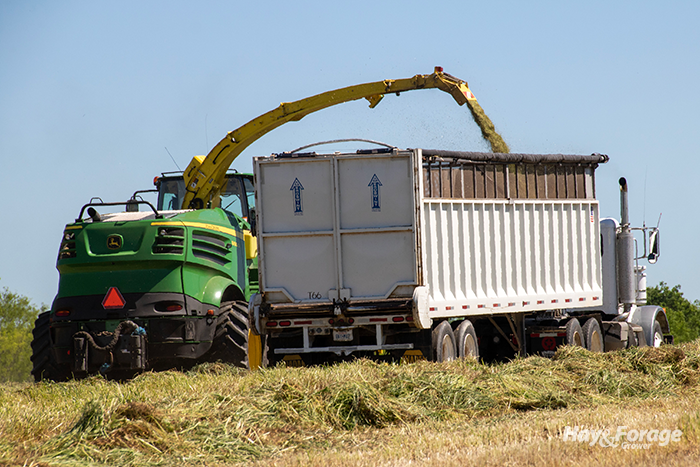
Winter cereals can provide both high quality and high tonnage for those who choose to chop the crop and store it for silage or make baleage. Moreover, harvest of winter cereals is early enough to allow those acres to still be planted to another crop such as corn.
Anyone who has grown winter cereals for silage can tell you there are two primary harvest challenges — getting it cut at the right maturity and chopping at the right moisture. These challenges are shared whether you are growing winter rye, winter wheat, or winter triticale.
A narrow harvest window
Once cereals reach the boot stage, maturity to reproductive (heading) stages progresses rapidly. With this rapid progression comes an equally swift drop in forage quality. It’s not uncommon to see winter rye, for example, go from a feed suitable for lactating cows to a forage barely suitable for growing heifers in a matter of days.
This rapid decline in quality occurs when there are usually other field operations that require attention, such as corn planting or herbicide applications. A winter cereal nearing the boot stage needs to be monitored closely and prioritized.
It’s also not unusual to be in a spring rainy period about the time winter cereals need to be harvested for high quality. The choice then becomes one of delayed cutting or the risk of having the crop rained on while it wilts.
For high-quality dairy feed, the optimum harvest stage for cereals is mid- to late boot. This is when the flag leaf has emerged and unfolded but before seedheads are visible. The window to hit this stage is short — a matter of a few days.
Nutritionists typically recommend that neutral detergent fiber (NDF) values be less than 55% for cereal forages fed to dairy cows or beef stockers. As is the case with most forage species, if temperatures are cool, optimum forage quality will be maintained longer than if temperatures are warm to hot.
Delaying harvest past the boot stage will dramatically boost forage yields, but quality will suffer. In some cases, this may be acceptable if heifers or beef cows will utilize the feed.
Moisture matters
Regardless of maturity, cereal forages harvested above 65% moisture will be low in water-soluble carbohydrates and are notorious for going through a clostridial fermentation.
A clostridial fermentation is easy to diagnose with fermentation analysis done by a reputable laboratory. Generally, clostridial fermentations are characterized by higher levels of acetic, propionic, and butyric acids. The silage will also have higher ammonia concentrations. Often, but not always, the silage pH will be higher than normal.
Clostridial silages are usually unpalatable to livestock. The silage will have a pungent, unpleasant odor. As a result, dry matter intake will be depressed.
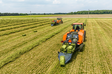
Winter cereals are typically cut early in the growing season and are slow to wilt to an acceptable harvest moisture. For this reason, spread the forage out as wide as possible when cutting. This puts more of the wilting crop in contact with the sun, enhancing the dry-down rate.
Even with a wide swath, further swath manipulation with a tedder is beneficial to speed up drying. Minimizing time from cutting to chopping or making baleage helps preserve forage quality.