Decade is not a long duration in the scope of a lifetime, but a lot can happen in a span of 10 years. That’s certainly been the case for St. Marys, Ohio, farmer Jordan Settlage, who started his foray into the dairy business in 2014. He’s had to scale some mountains, but today’s version of Settlage & Settlage Farms appears set for success.
Although Settlage is a sixth-generation farmer, not all his previous ancestors shared his love for milking cows. His father, John, is one of them, but he also didn’t discourage his son and has provided valuable insight and help along the journey. “This would have been a lot harder road to travel without my dad’s support,” Settlage said.
“In the fifth grade, I told my dad that I wanted to milk cows,” Settlage recalled during a Hay & Forage Grower visit to the farm last August. “In fact, I wrote a report for school that year outlining my desire, and I still have the paper.” He repeated his dairy aspiration request to his father in the eighth grade, but John told him to go get a job working at a nearby dairy farm, then he could decide if that was what he truly wanted to do. Settlage did just that and worked for a neighbor through high school and, at times, was left to run the farm by himself when the owner and his family were gone. It was a trial-by-fire experience, but Settlage never got discouraged or lost his desire to begin dairy farming at home.
Settlage had another desire beyond milking cows; he wanted to serve his country. After high school, Settlage enlisted in the Army and served for over three years as a combat soldier, including a deployment to Iraq. He doesn’t regret his time in the military, but said he was ready to come back to the farm when his service time was over, and like a lot of veterans, there was period of adjustment and healing.
A meager, organic start
Settlage came home from the Army and returned to working for his previous dairy farm employer while also attending college. In 2014, at the age of 26, Settlage told his dad that it was time to milk cows on the home farm. He bought the components of an existing milking parlor, disassembling it himself. “I pulled into the yard with a trailer of what looked like a $10,000 pile of scrap iron,” he chuckled. “We reassembled the components into a swing parlor with the help of a local dairy service provider, and we still milk in it today.”
Settlage started with seven cows he had raised from calves. “It took about three hours to milk those cows the first run through the parlor,” Settlage recalled with not-too-fond memories. “Soon after we started milking, we signed on with Organic Valley Milk Cooperative and began our transition to an organic, pasture-based farm in the fall of 2015. It was a challenging time during those years. My timing was terrible as milk and crop prices had crashed and our crop yields suffered during the transition. It seemed like every move we made came at the wrong time, but we made it through.”
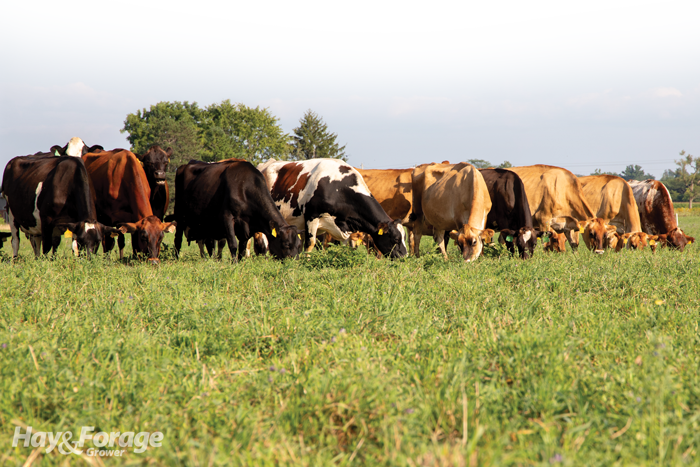
During the past 10 years, Settlage has grown the herd to 320 cows. About half of the mostly Holstein and Jersey-crossed herd calves in the fall and the other half in the spring. Settlage uses both artificial insemination with sexed semen and bulls to get the cows bred. In 2025, the conversion was made to an all-grass farm with cows never receiving any grain.
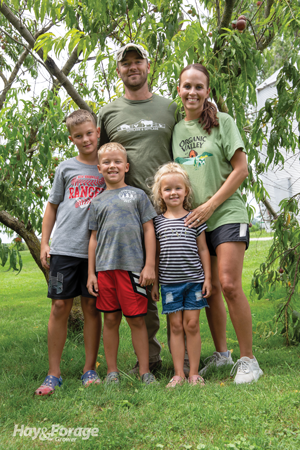
In addition to building a dairy herd, he has also grown his family. Settlage and his wife, Dana, have three children they want to raise with an appreciation of farm life. Their oldest son is already raking hay.
A unique aspect of the operation is that cows are milked 10 times per week on 16- to 19-hour intervals, so milking times vary each day of the week. Settlage landed on this system after experimenting with several schedules that either demanded too much labor or resulted in an unacceptable drop in milk production. The current labor crew consists of Settlage and two full-time employees. John continues to be a great help to his son, taking care of many day-to-day tasks and hauling bales on those busy haymaking days. Settlage recently served as a mentor and employer for a young woman who was in the Dairy Grazing Apprenticeship Program and graduated last summer.
Nonnegotiable quality
The backbone of any successful grass-fed dairy operation is to provide cows with high-quality forage year-round. During the growing season, cows are on pasture and fed a small amount of total mixed ration (TMR) consisting of baleage and mineral (6 pounds of dry matter per day). That amount jumps dramatically in the winter when the herd consumes 14 to 20 baleage bales per day and mineral in their TMR. Settlage houses his cows in a compost-bedded pack barn. The manure pack is routinely mixed with a carbon source and stirred. In spring, the bedded pack is placed into a windrow and turned several times before being applied to the land.
Hay is made from 240 owned or rented acres of alfalfa or alfalfa-grass mixtures. Cows have access to about 400 acres of pasture, and hay is made on some of that ground as forage availability dictates. Most of the hay acres are cut and harvested as baleage. Settlage has a custom harvester bale for him, using a new McHale Fusion 4 baler that wraps on the go. The baler is equipped with a precutter, which makes it easier to mix in a TMR. He also puts up a small amount of haylage in silage bags or on a pile. All the mowing, raking, and bale hauling is done by Settlage. The 3,000 wrapped bales that are made each year are meticulously labeled with the cutting and field that they came from. All the forage is quality tested.
“We get four or five cuttings per year and have a goal of 200 relative forage quality for every harvest,” Settlage explained. “We don’t always hit it, but that’s the target. We like to cut, rake, and wrap on the same day if we can. When you can get it off the field in a day, within 48 hours the field is greening back up. Sometimes it takes two days to get it off for first cutting. Usually, the moisture is around 50%, but we’ve wrapped both drier and wetter than that,” he added.
Settlage cuts hay with a 21-foot Vermeer pull-type mower with no conditioners. Hay is cut leaving a 4-inch stubble and laid flat to enhance dry down time and encourage a fast regrowth. The soil fertility of his hayfields is maintained with manure and compost. Settlage has experimented with some foliar nutrient applications but hasn’t seen any advantages to date.
Pastures have evolved
When Settlage first seeded row-crop ground with pasture mixes, he started with a diverse mix of alfalfa, red clover, white clover, ryegrass, orchardgrass, meadow fescue, Kentucky bluegrass, chicory, and plantain. Ten years later, his pastures have changed in composition, but not all paddocks matured with the same species mix. Some are now still heavy with alfalfa while others are nearly all grass.
Settlage grazes his cows from April to sometime between Thanksgiving and Christmas. Cows get a new paddock, which are subdivided with polywire, after every milking. He plants winter triticale to help supplement his fall grazing and then will cut it for baleage in the spring. Summer annuals are also planted from time to time, but the more common approach to beat the summer slump is with irrigation.
Settlage has both K-line irrigation pods and a traveling gun. Barnyard runoff water from a holding lagoon and well water are applied through the traveling gun, while only well water is used with the K-line system that he bought secondhand in 2023. “The key to using the pods is to be irrigating before the grass is water stressed,” Settlage asserted. “It’s hard to play catch up with them. We’ve seen huge regrowth advantages by getting the water on early.”
Hay, pasture, and dairy cows — three components that are the legs of the stool on any grass-fed dairy operation. Perhaps no farm business has such a heavy reliance on an abundance of high-quality forage; it’s grown on every available acre. Insert an organic farming model and the management needle jumps another notch or two. Settlage seems to have met the challenge. A dairy aspiration that was documented and launched in a fifth-grade homework assignment has now become reality. Settlage readily admits that the road hasn’t always been easy, but worthwhile dreams and endeavors seldom are.
This article appeared in the March 2026 issue of Hay & Forage Grower on pages 20-22.
Not a subscriber? Click to get the print magazine.