There seems to be a new spring trend in alfalfa fields — earlier and more abundant alfalfa weevils. Along with this comes earlier and more damage.
As growing seasons expand on both ends, alfalfa fields that rarely if ever experienced alfalfa weevil damage now play host to these critters on an annual basis. Where alfalfa weevils have historically been a frequent problem, their arrival is coming much earlier.
In Iowa, a state that used to border the alfalfa weevil problem, extension entomologists Ashley Dean and Erin Hodgson warn that adult weevils have already emerged from their overwintering sites to lay eggs in alfalfa stems.
The Iowa State University entomologists explain that the warmer-than-normal temperatures in 2026 have spurred weevil activity. Entomologists at Kansas State University and the University of Nebraska have initiated the same rally cry.
“Alfalfa weevil egg hatching begins when 200 to 300 growing degree days, using a base of 48°F, have accumulated since January 1,” Dean and Hodgson explain. “Based on accumulated growing degree days, alfalfa weevils are currently active throughout southern Iowa and likely present in other areas as well.”
Growing degree days (GDDs) can easily be tracked for many states using these pest forecasting maps and comparing benchmark GDDs to the map. If you choose the nearest weather station on the right side of the webpage, you can see forecasted GDDs in your area for the next two weeks.
Alfalfa weevil eggs that are laid in the fall or winter rarely survive Midwest winters; however, there are winters where eggs do survive, and this causes a prolonged feeding period.
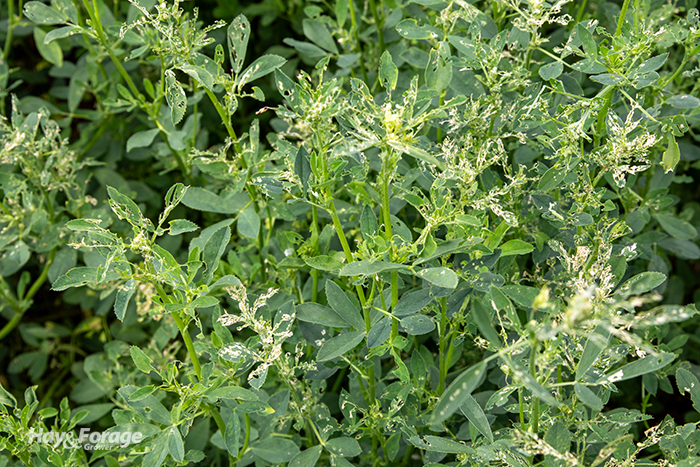
Newly hatched larvae feed on terminal leaves. First-instar larvae feeding appears as pinholes in the leaves. Maturing larvae move down the plant and begin feeding between leaf veins, which often results in leaf skeletonization. The greatest amount of larval activity occurs around 575 GDDs.
A heavily infested field often appears frosted or silver as the foliage begins to die. Adults cause less plant injury than larvae, feeding only along the leaf margin and leaving irregular notches. Usually, the most severe injury occurs in the initial alfalfa spring growth, but under the right circumstances, the early second cutting regrowth can be subject to damage. Where the latter occurs, fields will be slow to green up after first cutting because new growth is being consumed nearly as fast as it develops.
States have different thresholds for determining when it is best to begin spraying for weevils, but treatment thresholds are based on weevil number, plant height, treatment cost, and hay value. In some cases, it may be more prudent to cut a little early, monitor the regrowth, and apply insecticide as needed.
Consult your state’s recommendations for scouting and determining the economic treatment threshold. The time to start is now.