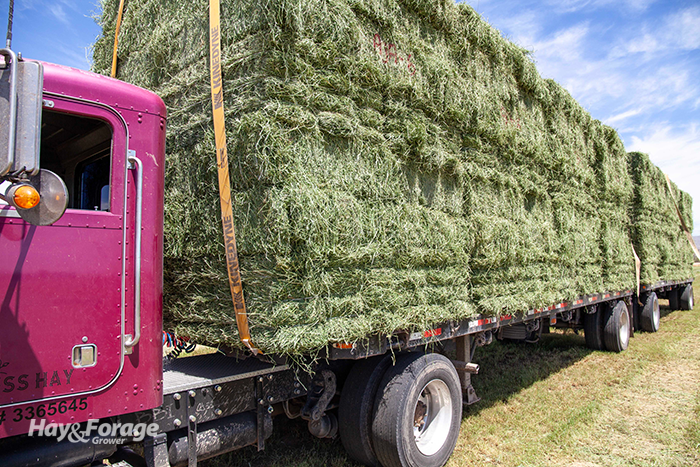
Hay buyers are like snowflakes — no two customers are alike. Their preferences revolve around the type of livestock they are feeding, the stage of production those animals are in, and their capacity for handling and storing bales. There may be many boxes to check to keep customers happy, but having a target demographic and catering toward specific needs is the key to repeat business.
At last month’s Alfalfa and Stored Forage Conference in Russellville, Ky., three panelists shared their top priorities when buying and selling hay for horses, dairy cattle, and sheep. According to the panelists, horse owners want clean hay and good service, dairy producers need high-quality and year-round supplies, and sheep farmers want consistency.
Fast, simple service
Krista Lea is an agriculture extension specialist with the University of Kentucky. In addition to her day job, she and her husband board horses, and she buys a load of hay as often as every two weeks in the winter.
Lea said forage quality doesn’t need to be fancy for the retired riding horses that occupy most of her stalls, but hay must be clean, green, and packaged in small, lightweight square bales.
Luckily, her hay supplier is a nearby farmer who can provide the type, size, and number of bales Lea requires on a regular basis. Their communication is simple — usually via text message — which is an added benefit to Lea who usually orders hay on the go.
“I don’t have time to go look at hay,” Lea said, considering her full-time work schedule. The hay supplier also delivers and stacks bales in the barn for her, so she can come home and start feeding horses without delay. “He knows exactly how many bales fit in my barn.”
Avoiding weeds like foxtail in hay is a must to prevent ailments like mouth ulcers. Lea said she has only been dissatisfied with weedy hay one time, which she brought to the supplier’s attention and was immediately offered a discount. A reliable product, convenient packaging, and home deliveries are what horse owners depend on, and Lea said those are services she is willing to pay extra for.
Dairy requires high quality
Compared to horses, dairy cattle have much higher forage quality requirements. Based on past experience, Kentucky haymaker Dennis Wright said dairy farmers have historically been his favorite customers to work with.
“All they want to know is what the hay tested — what is the nutrient value — so they can mix it in their feed. It’s very clear cut; it’s not subjective,” Wright said.
Even so, the demand for large square bales of dry hay can be a problem for him. “We don’t have a big square baler, and they don’t like the rolls,” he said about his dairy customers.
One solution to this was to start baling and wrapping alfalfa at about 40% moisture. Wright said the baleage was a hit among several local dairymen. Even so, trucking costs are the biggest limiting factor of selling baleage since a greater percentage of the individually wrapped bales is water. Generally speaking, the only other challenge he has with a dairy-centric demographic is that hay demand often fluctuates around milk prices.
“The problem with dairies is they buy a lot more hay when milk prices are good, and they don’t buy much hay when milk prices are low,” Wright said.
Sheep can be picky
Dave Kessler is a farmer in Springfield, Ky., who grazes 300 ewes on about 400 acres of cool-season forages. He only feeds hay in the winter when weather conditions are less than ideal for grazing stockpiled pastures. But even with a small hay demand, he is privy to his flock’s preferences.
“Sheep are not little cows. They are ruminants, but they have a different mentality and different physical characteristics,” Kessler said. “Cows have big stomachs, big mouths, and they can go out there and tear into a bale. If it’s palatable, they are going to eat it.” Sheep, on the other hand, are much more selective and will meticulously sort hay to find the best forage.
“What we really look for is consistency,” Kessler said about his hay-buying parameters. “It can be grass hay, but if there is a little bit of stemmy johnsongrass in there, that stuff is coming out and going on the ground.”
His sheep don’t necessarily need high-quality hay, but Kessler prioritizes total digestible nutrients (TDN) over protein content to meet animals’ elevated energy demands in the winter. “If you’ve got a good grass hay with decent TDN on it, they are going to do fine,” he said.
A nutritionist’s perspective
To round out the panel discussion, Bob Colemen offered some insights from both a hay buyer and a hay seller perspective. After decades of working as a livestock nutritionist, he has observed what makes the hay business tick on both sides of the equation.
“As a nutritionist, I would dearly love if everybody bought hay based on nutrients like dairy producers do,” Coleman said. That doesn’t mean every animal needs dairy-quality hay; it means livestock requirements vary by species and stage of production, and purchasing decisions should revolve around those requirements. “I think I’ve met one horse in my career that needed a protein level in their hay above 14%,” he quipped.
On the flip side, Coleman empathized with haymakers who struggle with bale consistency. As weed pressure, field conditions, and weather patterns change, forage growth and species composition fluctuate.
“If the fields can change, the bales can change,” Coleman said. “How do we get it as consistent as we can? How do we make the best product that we can?”
Circling back to Lea’s testimony, Coleman affirmed the value of on-farm hay deliveries. “There are a lot of people out there who would like to buy hay, but they need it delivered,” he stated. When hay is sold in advance and held for months before being delivered, though, he encouraged haymakers to justify their service with a storage fee.
“I think that’s fair for the hay producers, and it’s reasonable for the hay buyer,” Coleman said about sharing overhead costs. “We’ve got to remember one thing — hay is a commodity.”