We spend a lot of time in life finding the “right match.” That match could be a person, place, or thing. When something doesn’t work out, people often say, “It just wasn’t a good match.”
On the farm, a lot of decision-making involves finding the right match. Here, that match might entail the backbone of an entire production system or simply the best pair of work gloves. It can also involve what we choose to feed cows.
What differentiates hay from many other commodities is that there is typically extreme variability. Corn is corn, but hay isn’t hay — at least from a compositional perspective. Hay runs the quality gamut of excellent to very poor, and most successful farmers and ranchers manage that variability to their advantage.
“The objective of a hay-feeding program is to match the forage resources to the nutrient demands of the cow herd and avoid under- or over-supplying energy and protein,” explains Kansas State University’s Justin Waggoner in a recent Beef Tips newsletter.
The extension beef cattle specialist suggests a good starting point to managing a hay inventory is to sort hay bales into “lots.” Individual hay lots are differentiated by forage type (for example, grass, alfalfa, or forage sorghum) and then by cutting, field, or source.
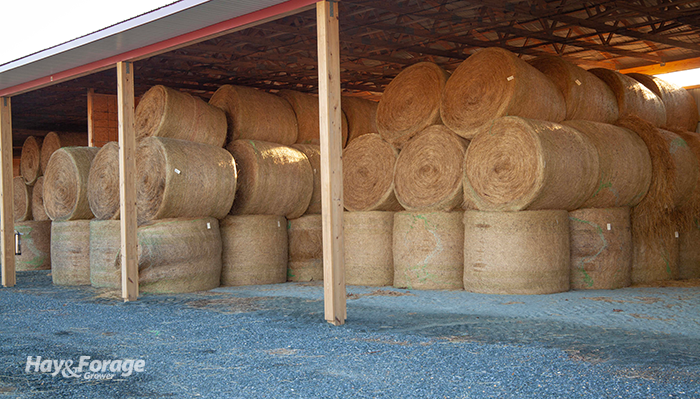
Ideally, stack hay by lot and label them so they can be easily identified. Spray paint is often used by farmers to identify individual lots of hay. These lots are the “units” of hay that will be sampled and submitted to a laboratory for analysis.
“Any ‘high-risk’ forages that may contain weeds or elevated concentrations of anti-nutritional components such as nitrates or molds should be segregated,” Waggoner asserts. He generally recommends that any potentially high-risk forages be stacked in a predetermined area — away from other hay — so they are easily identified.
Once lots are determined, each one needs to be tested. Waggoner cites a general rule is that 20% of the bales in a hay lot should be sampled using a forage probe, which takes a core or cross-section of the bale. Using a forage probe ensures a consistent sample with the same leaf-to-stem ratio. Improper sampling accounts for the most common source of forage-testing error.
Make the match
Once the results of the forage analysis are known, Waggoner recommends placing each lot into one of four feeding categories based on its forage quality and the approximate nutrient requirements of beef cows. These four management categories are as follows:
1. Low-quality hay. Forage contains less than 7% crude protein (CP) and an acid detergent fiber (ADF) value greater than 45%. Mature grass hays and crop residues are common for this category. These forages are often used to replace dormant native range, and in some cases, can meet the nutrient requirements of bred cows post-weaning. Energy supplementation may be required, especially if the forage neutral detergent fiber (NDF) content limits intake.
2. Moderate-quality hay. Forage contains 8% to 15% CP and approximately 40% to 45% ADF. Cool-season grass hays, cereal-grain hay, and forage sorghum fit into this category if harvested on time. These forages match the nutrient requirements of second and third trimester gestating cows.
3. High-quality hay. Forage contains more than 16% CP and approximately 31% to 40% ADF. Alfalfa and most legume hays are often represented in this category. The nutrient content of forages in this category is sufficient to meet or exceed the nutrient requirements of cows during most production phases. These forages are often used to supplement grazed forages or fed in combination with lower quality forages to meet cow requirements. High-quality hay is best utilized postcalving when cow nutrient requirements are greatest.
4. High-risk hay. Forage that contains potentially dangerous or toxic levels of nitrates, molds, or other anti-quality factors. The concentrations of these compounds are high enough that they must be diluted to safe levels. These forages may be fed in combination with other feedstuffs, or intake must be limited. Consulting with an extension specialist or nutritionist is advised when feeding hay in this category.
“Strategically managing hay quality comes down to the old adage of ‘don’t guess . . . test,’” Waggoner concludes. Armed with an accurate forage analysis, beef producers can then make the most of their forage inventory by matching their hay’s nutrient concentration to appropriate livestock class requirements.