When my son was in high school, we gave him our old high-mileage minivan to drive. On one particular evening, he arranged to meet his date in a grocery store parking lot and then leave from there to go see a movie. On his way to the grocery store, he heard a rattling noise coming from the right front quarter of the vehicle. After picking up his girl, they drove on, ignoring the unnatural noise.
The pair didn’t trek far before the front right tire and rim ejected from the vehicle, rolled up over the curb, across a front yard, and hit a driveway-parked car broadside. The resulting dent in the parked car was matched only by the dent in my wallet.
Ignoring a problem situation doesn’t make it go away; it’s one of life’s many lessons.
Over the past couple of decades, one of the challenges that has plagued agriculture, and forage production in particular, has been extreme weather. The U.S. seemingly sets new average temperature records with each passing year while precipitation comes and goes in virtual waves of rain events.
As forage producers, Chris Teutsch said we shouldn’t just ignore these changing weather patterns. While speaking at the 2025 Kentucky Fall Grazing Conferences, the University of Kentucky Extension forage specialist offered his suggestions for keeping pastures productive during dry times.
Even though annual precipitation has been on the rise in places like Kentucky, Teutsch noted that short-term droughts have also been more common. For example, this past August was the driest ever recorded in Kentucky, which made it challenging to stockpile forages. The forage specialist said that dry late summers and falls have been a recent trend.
“The interesting thing about drought is that they always seem to come as a surprise, and they shouldn’t be,” Teutsch asserted. “Drought is a part of our agricultural landscape, but they rarely kill a well-managed pasture. Unfortunately, not all pastures fall into this category.”
Teutsch thinks of drought as the “straw that breaks the camel’s back.” He explained that other factors such as species selection, stocking rate, soil fertility, and grazing system must be optimized to survive a drought. If not, the accumulation of stresses coupled with drought can do permanent damage. “We can’t predict or prevent a drought, but we can manage to mitigate its impacts and promote recovery,” Teutsch said.
Get stocking rate right
A drought-resilient grazing system starts with a sustainable stocking rate that offers acceptable performance on both a per animal and per acre basis. “In Kentucky, common stocking rates range from 2 to 4 acres per cow-calf pair,” Teutsch stated. “If your management isn’t that good, you’ll likely be closer to 4 acres; if you’re really on top of things, then you’ll be near 2 acres per cow-calf pair.”
The longtime extension forage specialist also emphasized the importance of adequate soil fertility — adjusting soil pH for the species present and maintaining a medium level of phosphorus and potassium. These simple practices help to eliminate pasture stress and ensure pastures will quickly rebound once rain finally curtails drought conditions.
“Perhaps one of the most effective drought management strategies is to implement a rotational stocking system,” Teutsch stated. “By resting pastures and keeping a 4- to 5-inch plant residual, we maintain a healthy and deeper root structure, preserve plant carbohydrates, enhance photosynthesis, reduce soil moisture loss, encourage compensatory growth, and create a much cooler microclimate at the soil surface.”
Include drought-tolerant species
Some forage species will tolerate drought better than others. Alfalfa, for example, has a deep root system and can reach water deep in the soil profile. If your soils allow it to be grown, consider including alfalfa as a part of your pasture mix.
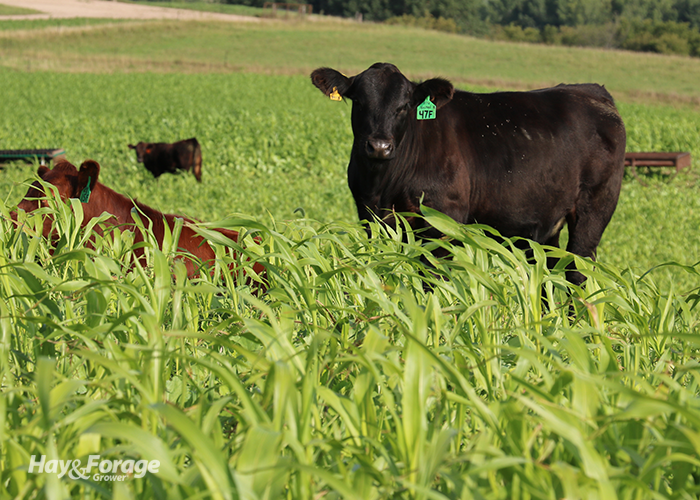
Perhaps the best approach to bolster a forage base during drought is by incorporating warm-season grasses, which produce about twice as much dry matter per unit of water available during the summer months compared to cool-season grasses. Annual warm-season grasses such as those in the sorghum and millet families can help maintain productive animal gains throughout the summer. Some beef producers designate a small portion of their pasture base to these species on an annual basis.
Another option to help weather the drought storm is crabgrass, which is an annual but acts like a perennial because it is a prolific reseeder. Teutsch promotes crabgrass because it’s easier to manage than the sorghums and fits well as a double crop with winter annuals.
Establishing perennial warm-season grasses such as the bluestems, indiangrass, and eastern gamagrass is another approach to help mitigate a forage shortage caused by drought, but these take longer and are more difficult to establish.
Act rather than react
Being prepared for a short-term drought is much preferred than simply reacting to one. Feeding stored forage, pulling cattle off pastures, weaning early, or the dreaded DEFCON 1 approach — destocking — are reactionary strategies to be avoided, if possible. That said, changing weather patterns have annually forced these practices into play more often than used to be case.
There will be drought conditions next year — don’t be surprised. Tighten your lug nuts now before the wheels fall off.