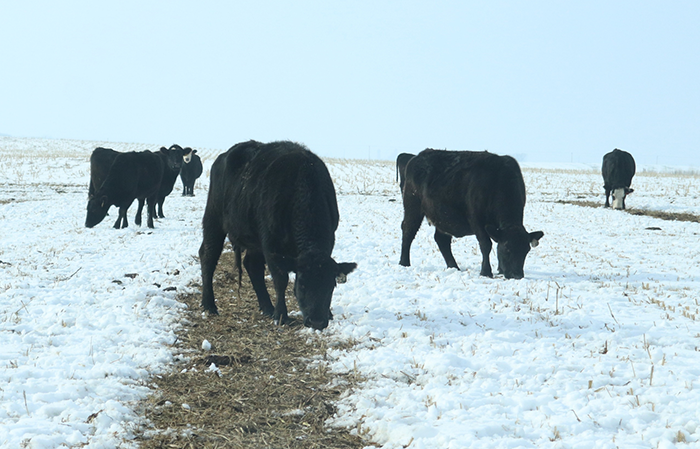
Grazing cattle on snow-covered windrows may seem a bit obscure, but windrow grazing has shown to be an effective way to lower winter feeding costs. The practice essentially offers the best of both worlds when it comes to preserving high quality in harvested forages and eliminating expenses from baling and handling. Windrow grazing generally works best in regions where winters are cold and snowy.
In a recent episode of the University of Nebraska-Lincoln (UNL) “BeefWatch” podcast, extension beef systems educator Aaron Berger interviews Myra Hipke, who runs a cow-calf operation with her husband near Stuart, Neb. Hipke grazes livestock on a combination of cool-season pastures, native rangeland, and summer annuals like sorghum-sudangrass, which she also utilizes for windrow grazing this time of year.
Hipke has been windrow grazing for several years after being inspired by other beef graziers to think outside the box about forage management. Under the right conditions in her region of northern Nebraska, she said annual forages like sorghum-sudangrass can be incredibly productive — sometimes to a fault. She doesn’t always have time to make hay when forage quality is at its highest in the summer or graze it fast enough to effectively utilize all of the forage.
Moreover, sandy soils with low organic matter discourage Hipke from removing so many nutrients from the field in the form of hay. Windrow grazing, on the other hand, is opportunity to return some of those nutrients to the soil and reduce fertilizer applications.
In addition to sorghum-sudangrass, Hipke has windrowed and grazed cover crop mixes in the past, but the former species tends to be more cost-effective. Considering the price of seed, drilling, harvesting, and all other inputs, she said windrow grazing sorghum-sudangrass costs her about $150 per acre. From there, not having to operate the baler or handle bales in the winter makes a significant difference on her balance sheet.
“Of course, in the good years when I get more tonnage, those numbers are even better,” Hipke said.
How she does it
Her goal is to graze dry cows on windrowed forage after calves are weaned in December. To time forage growth and harvest correctly, she waits to plant sorghum-sudangrass as late as possible without sacrificing total yield.
“I like to plant it around the last week of July,” Hipke said. “We’ve seemed to always catch a rain to get it up and going, and once you get that, those warm-season annual grasses can take a beating from hot, dry conditions and still grow well.”
Before cutting sorghum-sudangrass, Hipke calculates forage yield to determine what size her paddocks should be. Then, once forage is cut in late fall before the first snowfall, she uses step-in posts and solar-powered polywire to create breaks in the field. She tries to install as many temporary paddocks as possible with the amount of polywire she has available before the ground freezes.
“When the crop is still standing, I try to do some clipping to estimate how many tons per acre we are going to have,” she explained. “Then, I work backward to find how many acres to give cows about a weeks’ worth of feed at a time.” She typically windrow grazes for about 30 days.
Hipke used to have portable waters in the windrow-grazed pastures but has since installed a pipeline to supply water to two permanent tanks. “Now, we don’t have to walk the cows a long way for water, and it’s more reliable water through the winter than what we were using before,” she said. “That has worked out really well.”
Research from UNL shows that cows will dig through snow to get to windrowed forage, and Hipke has noticed her animals tend to selectively graze around thicker stems. Even so, she said there hasn’t been any negative effects on subsequent crop growth in areas where windrows lay and residual is trampled.
Frozen fence lines
Like many other field operations and forage feeding practices, Hipke said navigating the weather remains the biggest challenge for successful windrow grazing. In addition to untimely rains during planting and harvest, there have been times when sleet or heavy, wet snow has frozen to the polywire. “I’ve had to walk every foot of polywire that we have using a gate handle to strip ice off the fence to get it tightened back up again,” she said. “That’s not pleasant.”
Even so, the positives of lower production costs and better livestock stewardship generally outweigh the negatives.
“The reduction of labor and not having to start a tractor to feed cows are probably the biggest pros,” she said. “There is something extremely satisfying about going out there where the cows are waiting for you, opening that fence, and watching them go out and start grazing. Their behavior has been enjoyable to learn and observe.”
For farmers interested in windrow grazing, Hipke suggested testing out different fencing gear and getting comfortable with making temporary paddocks before committing to a big investment. “You don’t have to buy all of the fancy stuff to get started grazing with polywire,” she said. “There are ways to do it that are less expensive, and then you can upgrade as you go forward.”
Overall, she encouraged listeners to experiment with a windrow grazing system that works for them and to trust the learning process. “Don’t be afraid to try it,” she said. “You can talk to others and can get new ideas, but in the end, you’re going to learn a lot by getting your hands on it.”