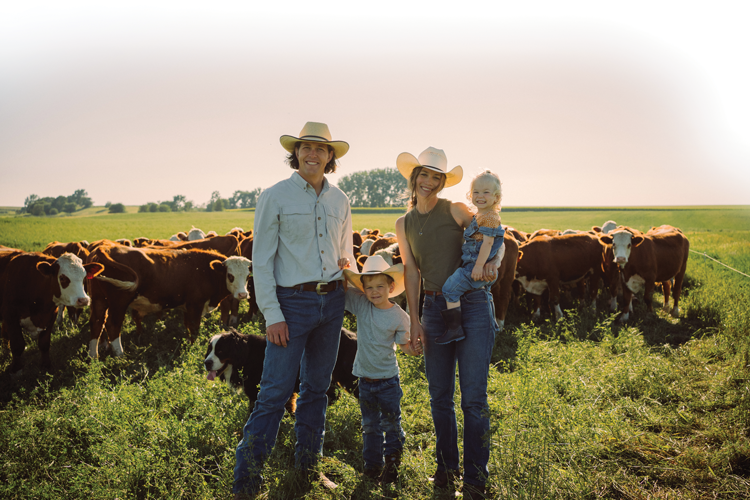
 Photo by: Jean Ubben Photography
It all started with the Seattle Seahawks.
That’s where the story behind Grand View Beef begins, anyway.
Knute and Amanda Severson met in Seattle the summer they both interned for the Seahawks. He was a horticulture major at Iowa State University who landed an internship with the football field’s turfgrass team, and she was a hospitality and events intern who had already graduated with a strategic communications degree from Washington State University.
Both working what they considered their dream jobs at the time, the Iowa farm boy and the Washington state native hit it off as friends, which evolved into a relationship, but then they broke it off at the end of the football season when Knute returned to college. Fast-forward to Amanda’s post-graduation job search and a job offer that landed her in Iowa, and the couple realized it was meant to be.
Knute grew up on his family’s century farm in Clarion, Iowa. His parents, Troy and Beth, introduced Horned Hereford cattle to the row-crop operation in 1996, and although they prioritized a high standard of animal husbandry, they were never interested in selling meat directly to consumers. Knute and Amanda, on the other hand, had a vision for direct beef sales and bought their first steer from Troy and Beth when they moved back to Clarion and got settled on their own slice of the home farm in 2017.
The next year, the couple raised a dozen cattle, finishing half of the herd on corn and the other half on pasture. When they brought meat from both groups to the farmers market, there was clearly a preference for the pasture-raised beef.
“We had people walk away from the table when we told them the cattle were corn-finished,” Knute recalled. “When my wife and I met, we went to farmers markets in Portland, San Francisco, and Seattle, and it was very evident that grass-finished beef was the popular thing. So, we did some consumer research, and it felt like there was a really big demand that was not being met.”
From that point forward, the Seversons went all-in on selling 100% grass-fed, grass-finished products under the Grand View Beef label, buying more calves and growing their number of market-ready animals by about a dozen head every year. In 2025, their finishing herd size jumped to more than 100, and the couple sold beef to customers as close as small-town Clarion and as far away as the East and West Coasts — even Alaska and Hawaii.
Although their dream job descriptions have changed since their stints with the Seahawks, those early experiences laid the foundation for their roles in the beef business today. Knute handles farm operations, including forage seedings and pasture moves, and Amanda manages all things sales and marketing, running their website, hosting farm-to-table events, and maintaining an engaging social media presence that lets viewers behind the scenes of farm life and cattle grazing.
“It’s less about sales and more about trying to connect with the consumer and provide them with transparency,” Knute said about building the Grand View Beef brand online. “If you’re a consumer, you want to know where your food comes from and who your farmer is, and that’s just kind of our avenue for it. That is one of the things we are most proud of.”
Uncommon ground
As they’ve grown their business, the Seversons have also grown their pasture base. To do so in the middle of row-crop country, though, the couple had to go against the grain — literally. Roughly 300 acres of their total system — which includes both their finished beef and cow-calf operations — was previously corn and soybeans.
“There was definitely some rumbling in the community, like, ‘Who is this idiot who moved back and is selling grass-fed cattle and turned corn and beans into pasture?’” Knute chuckled. But the beef farmer wasn’t fazed. Another 300 acres of the grazing system is anchored in perennial pasture, and he seeds 300 to 500 acres of annual forages every year.
The spring grazing season begins in April when cattle are turned out on cereal rye and triticale that Knute plants after row-crop harvest the previous fall. Then, the herd grazes perennial pastures containing orchardgrass, smooth bromegrass, tall fescue, festulolium, and alfalfa into midsummer.
Once these cool-season species hit their slump, cattle rotate through sorghum-sudangrass and a highly diversified cocktail mix including turnips, radishes, millet, cowpea, and chickpea. These pastures are part of a three-year rotation that rolls into corn, followed by soybeans, and then a crop of fall oats. After an initial pass through the warm-season annuals, Knute stockpiles some of the paddocks and utilizes them through January — sometimes longer.
“Don’t get me wrong, it’s not the same nutrient content that it is in September when it’s still growing and the plant is alive and well. But there is usually enough forage out here that will give the steers enough sustenance as long as I give them a little alfalfa hay with it,” he said, overlooking a partially grazed stand of sorghum-sudangrass last summer. In general, it takes 18 to 20 months to finish steers on forage after the Seversons buy them in as weaned calves.
Just south of the pastures is the barn and feed yard where Knute gives the herd a blend of alfalfa baleage and dry hay in the winter. He has about 130 acres of dedicated hayfields to fulfill these seasonal needs; however, baling generally goes against his farming philosophy.
“If you can avoid baling hay, do so,” Knute said. “Stockpiling forage is the best-case scenario because you don’t have any costs. You don’t have to cut it, you don’t have to bale it, and you don’t have to haul it.”
More than meat
According to their analytics, Grand View Beef is well above industry standards when it comes to repeat customers, and the couple sells goods that run the gamut of beef and by-products. In addition to grass-fed hamburger patties, steaks, snack sticks, and roasts, they sell specialty cuts, bone broth, and dog bones. Six years ago, grass-fed beef tallow was virtually a waste product. Now, it’s the fastest selling item on their website.
“It just flies off the shelves,” Knute said about beef tallow, which can be used for anything from deep-frying chicken to skin care and candle making. Although many customers report learning about Grand View Beef by word-of-mouth, he attributes a large percentage of online sales to search engine results when people look up the niche products like beef tallow that can be found in their catalog.
Similar to others buying cattle in today’s market, though, the Seversons have been skating on thin profit margins. Their calf prices have nearly tripled in the past several years; what used to cost $800 in 2019 cost $2,200 in 2025. They can adjust their product prices slightly to reflect inflation, but they ultimately accept that they’re playing the long game and grass-fed premiums might not pay off until the next market cycle.
From a forage perspective, their biggest challenge is finding affordable farmland to expand, especially since Knute is the only neighbor turning row-crop acres into pasture. “Wright County, Iowa, is highly productive,” he said.
And then there are the inevitable pivots and occasional redirections that must be made when establishing forage and rotating cattle. For instance, Knute learned the hard way that grazing alfalfa can be risky despite the bump in protein it provides in mixed pastures. After the herd experienced a high frequency of bloat last summer, he vowed to eliminate alfalfa from perennial pastures and seed more acres to summer annuals moving forward, utilizing these stands earlier in the summer and stockpiling more of them for the fall and winter.
“I feel like we still learn something every day about the best way to get animals fat and the best way to manage ruminants on 100% forage,” Knute said. “They’re not meant to eat grain, but trying to get them buttery fat on 100% forages without grain has proven to be a difficult thing to do.”
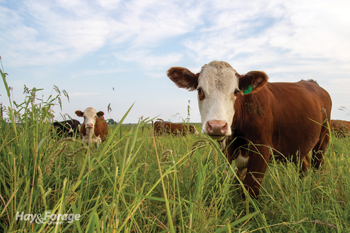 The Seversons started farming with a single steer in 2017 and have grown their grazing herd to roughly 300 head.
 There have been some setbacks and learning curves, but the Seversons stand by the benefits of grazing cattle, whether those pluses are seen on their balance sheet or measured below the soil surface.
“Your equipment costs are less, your input costs are less, you get manure out of it, and you’re increasing your soil health,” Knute said. “The drawbacks are that it’s something different. It’s just hard for a lot of people in agriculture to be comfortable with doing something different.”
Looking ahead, the couple aspires to scale their business beyond their home farm and sell enough meat under the Grand View Beef label to feed a football stadium — or two.
“I would love to have 10,000 head of cattle,” Knute said, painting a picture for the future of the operation. This would involve sourcing livestock from farmers across the country with similar values and grazing systems. Just like the Seversons connect their customers to agriculture through social media and storytelling, they want to connect producers to consumers by doing the legwork of branding and marketing. Their goal is to bridge those gaps on both sides of the table, and they believe the missing link is a hearty serving of grass-fed beef.
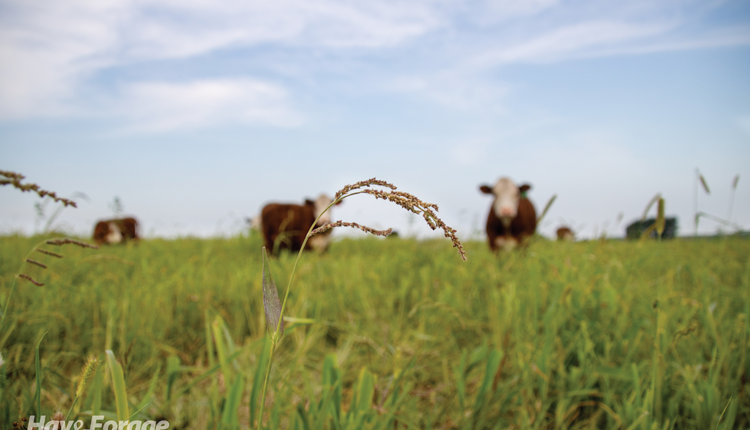 In addition to establishing perennial pasture on what used to be corn and soybean fields, Knute seeds 300-500 acres of annual forages every year.
 This article appeared in the January 2026 issue of Hay & Forage Grower on page 14 to 16.
Not a subscriber? Click to get the print magazine.