As each year winds down and we approach a new one, we tend to reflect on the previous 12 months. This year is no different, with the top moments in sports, music, or news filling year-end headlines. In agriculture, there has also been no shortage of newsworthy events.
This past year brought record forage and grain yields for many and dismal yields for others. Mother Nature dictated crop performance, with excellent planting conditions early on for those who experienced record yields. Unfortunately, on the other end of the spectrum, excessive rainfall forced hay crop harvesting and corn planting delays on many farms.
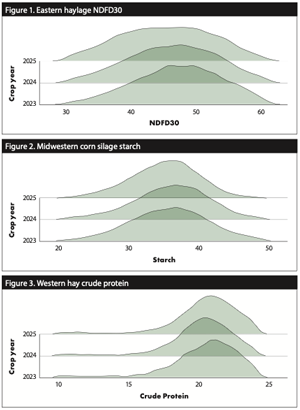
Let’s review 2025 forage production for growers in different regions across the U.S. To put this summary together, I referenced a publicly available nutrition history app from Rock River Laboratory based in Watertown, Wis. I also included graphs of key forage analysis metrics that were observed in each region compared to data from the prevous two years on the opposite page.
Eastern states
Haylage production was a challenge this year due to early season rains. Protein and lignin levels were similar year-over-year; however, neutral detergent fiber digestibility (NDFD) was muted and energy levels were hampered. In corn silage, starch content was largely down and lignin levels were up. The net result was a dip in total digestible nutrient (TDN) levels.
Midwestern states
The Midwest experienced a wholesale contrast to the Eastern U.S. growing season, with favorable early season conditions followed by a wetter mid-season. Resulting haylage protein and fiber were similar year-over-year, while fiber digestibility and ash were up a tick from last year.
The net result was slightly higher TDN in haylage. Corn was planted during an ideal stretch, and record yields were matched up with average quality. This year’s silage crop presented similar starch levels as old crop, with elevated lignin and mixed fiber quality. The Midwestern corn silage crop is a fascinating beast, with mixed energy potential. The variation is beyond what is normal.
Western states
The Western hay crop had higher protein this year, thanks to better growing conditions and moisture. The fiber digestibility was equivalent to last year’s, but ash content was notably down, and TDN was up.
Western corn silage starch levels were up slightly, and ash levels were down — similar to the hay crop. Corn silage fiber digestibility was similar year-over-year, and TDN levels were average. The decline in ash content in Western forage is distinct and likely due to less blowing dust and soil under wetter conditions.
On the horizon
In the absence of BMR corn, there is new demand for alternative corn hybrids to bridge the gap in fiber digestibility between what BMR hybrids offer versus conventional corn. I anticipate this will be an increasingly hot topic in 2026.
In the September issues of Hoard’s Dairyman, I covered strategies that growers can pursue in the absence of BMR corn. I discussed how to evaluate corn silage quality and benchmark economic performance. The gold standard to compare hybrids or practices is evaluating them based on the cost per ton of digestible silage produced. Short corn hybrids with a brachytic dwarf mutation are an intriguing option for us to evaluate in future trials.
Short corn may offer agronomic and quality advantages over conventional seed. In theory, more leafy tissue with equivalent grain yield compared to conventional corn hybrids would result in greater TDN and energy.
Over the next two years, we’ll get first-hand experience with short corn hybrids for silage. And thanks to my Italian colleague, Andrea Bellingeri, and his dairy producer clients, we have a glimpse into how short-corn silage TDN stacks up relative to conventional corn silage.
In dairy producer-led Italian field trials beginning in 2023, researchers collected data without support from the seed industry. The quality and yield outcome was fantastic, with short corn producing significantly higher TDN yield per hectare on Italian dairy farms. Without diving into these trial outcomes in detail, I’ll admit I’m looking forward to gaining more experience with short corn performance for silage in the U.S.
Reflecting on 2025, it was another tumultuous growing season, with forages ranging in yield and quality to a great extent across all regions. As we pivot to the new year, let’s continue pushing forage production forward with new technologies and innovations.
This article appeared in the January 2026 issue of Hay & Forage Grower on page 24 and 25.
Not a subscriber? Click to get the print magazine.