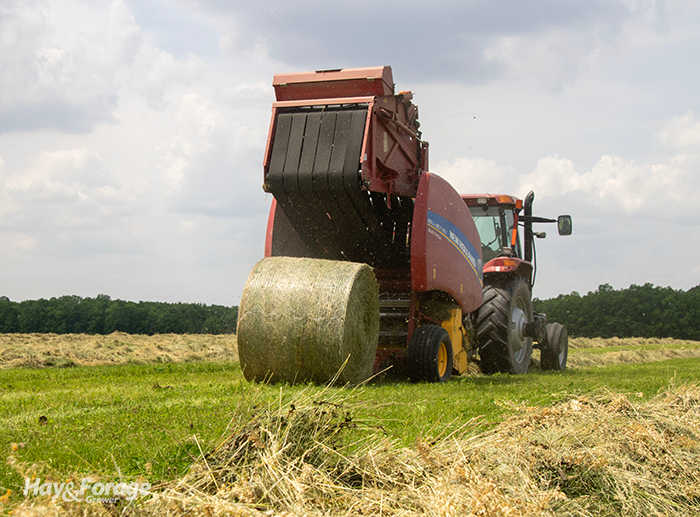
Carson Roberts is determined to convince beef producers to stop making hay. In a recent episode of the I-29 Moo University forage webinar series, the state forage specialist with the University of Missouri suggested that haymaking has several hidden costs, many of which are tied up in equipment ownership and usage. Other haymaking costs are less quantifiable and often go unaccounted for.
To begin, Roberts said many beef farmers assume weaning weight is the primary factor of profitability, but research shows weaning weight only makes a small contribution to the financial success of a cow-calf business. Others might think growing their herd size will boost farm revenue, but Roberts contended that herd size is an even less significant factor. Rather, feed costs are what set apart the most and least profitable beef producers.
“The people who are making the most money are spending the least on their forages,” Roberts said, and this has inspired a large portion of his research. “Really, what it boils down to is the cost of stored forages.”
Despite regional differences in forage production and weather patterns, Roberts said one thing in common among the three states he has lived and worked in — Minnesota, Missouri, and Mississippi — is that farmers routinely feed hay for up to 130 days a year. Whether it’s during the winter, to make it through the summer slump, or to compensate for a lack of stockpiled pasture, Roberts has observed that most feed costs on all beef farms come from hay feeding, which he suggested makes up a larger piece of the production cost pie than it used to.
Even if the routine of hay feeding stays the same, it becomes more expensive as input costs, interest rates, and inflation go up. What used to be a necessary evil — making hay to feed cattle when grazing isn’t an option — is now just downright evil from a financial perspective, and Roberts suggested it may no longer be necessary for beef producers to do so themselves. He offered several reasons to explain why.
Skyrocketing equipment costs. “There are some key differences between what is happening today and what happened in the past that make it no longer viable to be producing your own hay,” Roberts said. Considering the beef market and machinery costs in 1975, Roberts suggested that the price of a new round baler back then was equivalent to approximately 14, 500-pound calves. In today’s world, a farmer would have to sell about 27 calves at market price for the same type of equipment.
“Our equipment costs have outpaced our calf prices about 10-to-1 in a regular year, which is a pretty staggering number,” Roberts said.
But how often are beef producers buying new hay machinery? Not often, which Roberts said is a fair argument. Even so, he demonstrated how assets that are tied up in older, used equipment can still amount to significant machinery ownership costs per acre.
Overequipped farms. The steep costs of individual pieces of machinery get multiplied when farmers have excess haymaking equipment scattered across a farm. That could be different tractors dedicated to different harvest machines; many models of the same piece of equipment; or balers, rakes, and mowers that simply go unused. All of the extra nuts and bolts can negatively affect farm profitability.
“Go and walk around your farm and take pictures of all the equipment that you have that is dedicated to making hay,” Roberts said. “Even with the bare minimum of equipment, that cost adds up quite readily.”
Roberts showed how expanding hay acreage to boost equipment usage doesn’t make much of a dent in total production costs. Spreading expenses over higher yields from better forage management has a stronger positive influence on production costs, but the most practical solution to capture higher profits is to scale back on machinery if a farm is overequipped.
Oversupply of hay. Hay supplies fluctuate over time, and farmers may not always find themselves in a situation of oversupply. This is often influenced by growing conditions, with drought playing a large role in how much forage is available to harvest and store. But considering the current state of the hay market, Roberts suggested farmers can likely buy moderate-quality bales that are cheaper than what it would have cost to make them.
“If you’re trying to decide whether you should make hay, buy hay, or do a mix of both, average out the value of your hay over several years and see how well you’re measuring up with market prices,” he said. Another reason to consider buying bales instead of making them is that you cannot always control the quality of hay that you make, but you can control the quality of hay that you purchase.
Various other advantages. There are other factors that weigh on the decision to stop making hay on farm, such as the potential agronomic and economic benefits of expanding your grazing system and the fact that farm labor is becoming increasingly difficult to find. Roberts encouraged the audience to consider other ways in which they could spend their time if they were to scale back or eliminate haymaking from their operation.
“Think about all those things that you could do in the summer that you couldn’t do otherwise,” he said. Some suggestions were developing more efficient fence and water systems, practicing new rotational grazing methods to improve herd management, and doing market research to diversify your operation and boost farm revenue. Having more freedom to go to grazing meetings, conferences, and workshops could also be a plus for farmers who have been interested in those events but haven’t had the time to attend them in the past.
“The one that speaks to me the most is spending more time with family,” Roberts said. “I can’t tell you how many times we missed out on family reunions during the summertime because we were busy making hay.”