Farmers must have hope that the tiny seeds they sow will develop into productive plants; hope that new practices will have positive impacts on their land, livestock, and bottom lines; and hope for future growing seasons despite uncertainty in what lies ahead. Hope is the driving force for many agricultural endeavors, including Jon Nelson’s transition from row-crop farming to a grass-fed, grass-finished beef operation. In more ways than one, it is the foundation of JNelson Farms in Hope, Mich.
Nelson was getting tired of fixing equipment after riding in tractors for much of his life. He was equally agitated by the amount of herbicide and fertilizer required to control pests and maintain yields in his corn and soybean fields. Aside from row cropping, he worked an off-farm job and raised a few head of cattle.
At the time, Nelson and his wife, Tammy, had taken up CrossFit — an exercise routine including box jumps and burpees that is not intended for the weak of mind or heart. It was at the gym where Nelson heard about the benefits of grass-fed beef from the health-conscious members of the CrossFit community. Considering his waning passion for row-crop farming and a growing interest in expanding his herd, he was intrigued. After doing some research on pasture-based livestock production, he decided to go all in.
Nelson contacted Michigan State University Extension and asked if it would be possible to cash flow his farm by fencing in the fields, establishing forage, and grazing cattle. The answer was yes, if done properly, and that phone call was the first of many interactions with extension specialists, like-minded farmers, and regenerative graziers. Nelson spent the next year attending every pasture walk, field day, and grazing workshop within a reasonable driving distance. Then, he started building fence. In 2011, he had converted about 20 acres of the home farm from row crops to pasture. By the end of the following year, the entire 220-acre operation was seeded to grass and rotationally grazed.
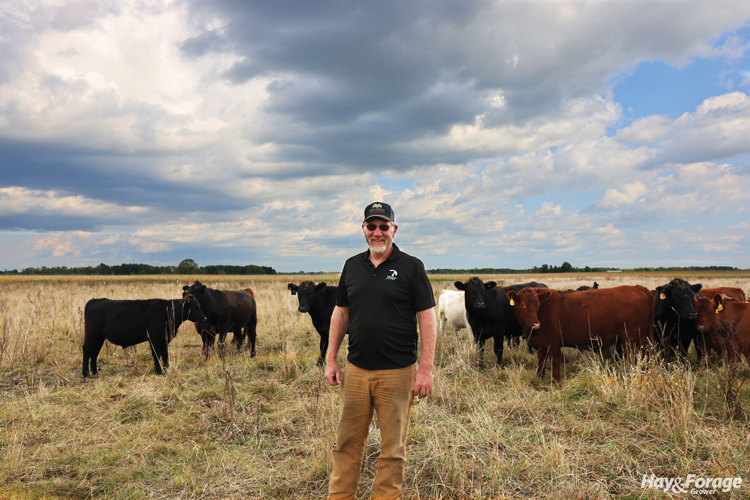
Today, Nelson’s grazing system encompasses 250 animals on about 450 acres of owned and rented land. In addition to his cow-calf herd, he finishes steers and markets beef directly to consumers through online sales and at his self-serve farm store. Nelson also recruits beginning farmers across the Mitten State who have similar interests in soil, forage, and animal health to contract graze about 130 cattle. His hard-and-fast rules for himself and contract graziers are no fertilizers, herbicides, vaccines, wormers, or tillage. Beyond that, different grazing strategies and regenerative management styles are subject to be explored.
“We work toward healthy soil to grow healthy plants to feed healthy animals,” said Nelson, who is currently the president of the Michigan Forage Council. “Since 2012, we haven’t put any fertilizer on our pastures, and we are raising a lot more forage than we ever did before.”
Seeding mindset shift
When Nelson began converting corn and soybean acres to grass, he started by planting a mix of cool-season perennials including timothy, orchardgrass, red clover, and perennial ryegrass. He’s since changed his pasture seeding philosophy.
Now, Nelson initiates stand establishment with a round of annual forages to kickstart the soil biology. Depending on when pasture renovations begin, he typically seeds cereal rye in the fall, oats and wheat in the spring, and sorghum-sudangrass in the summer.
“A lot of times, it’s whatever I can find cheap,” Nelson shrugged. “I’ll go to the seed companies and ask them if they have an overrun or a batch that they mixed up incorrectly. I’ve bought a lot of seed that way.”
After cutting and baling annual forages, or rotating cattle through the stand for a quick graze, Nelson sits back and lets the soil seedbank do the work. The perennial species he used to sow himself germinate and take root on their own, and he has noticed other forages like alfalfa, Italian ryegrass, and chicory have added themselves to the list. Nelson even counts burdock and thistle among his forage inventory because “weed” isn’t in his vocabulary.
“I used to try to get rid of burdock and thistle, but nature will promote those plants to get the soil covered,” Nelson said. Those otherwise weedy species serve the purpose of shading bare ground with their broad leaves during the early stages of pasture renovation. They also have extensive taproots that scavenge for soil nutrients and deliver those minerals closer to the surface, creating a more suitable environment for desirable forages. When perennial grasses settle in, Nelson says burdock and thistle phase themselves out. He enjoys watching forage composition change over time.
Monitoring moves
Nelson’s ideal cow has a low profile, wide frame, and is roughly 1,200 pounds. His primary breeds are red and black Angus in addition to some Red Devons and Speckle Parks. He rotates cows every one to three days, depending on the time of year. Cows calve in the spring, and after weaning, Nelson sends calves to a separate finishing herd at the home farm.
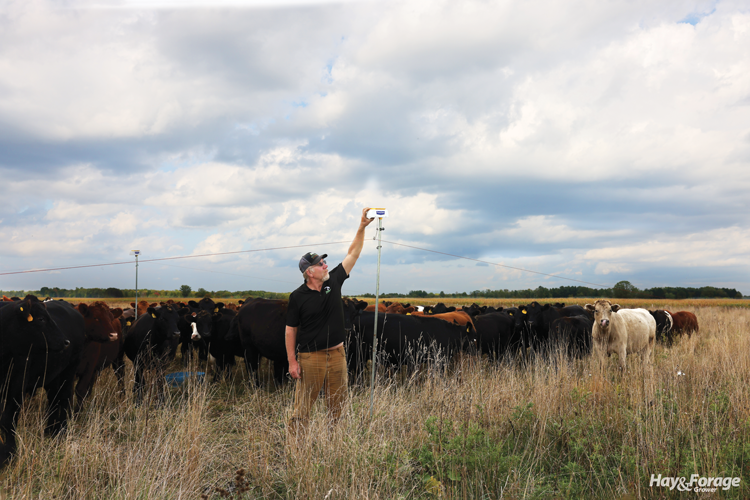
The finishing herd moves three times a day. Nelson starts cattle in a fresh paddock early in the morning and then programs solar-powered fence lifters to automatically raise the next two lines of polywire at specific times, giving animals access to new strips of forage at noon and 4 p.m. The size of the strips varies throughout the growing season to match forage yield with animal demand.
“We watch the cattle. How fast do they run into the next section? Are they hungry and rush in? Or are they full enough that they just wander in? We also watch the ground. We want the ground covered all the time. As we look at those two things, we adjust the paddock size as needed,” he said.
Nelson targets an 80- to 100-day forage rest period after grazing events. He previously managed pastures to maintain a vegetative state all season but has since changed his approach in letting plants go to seed in order to replenish the soil seedbank.
“We used to get three-plus rotations in a year, but then we started losing diversity in the pasture,” Nelson said. “Now, with a longer rest period, we’ve seen that diversity come back.” In some cases, he will set aside thinning stands for an entire year to reduce disturbance and encourage new seedlings to fill the gaps.
In addition to frequent moves and longer rest periods, Nelson aims to leave ample residual forage in grazed paddocks. “Of course, there’s some brown, dead grass left over, but there is also lot of green grass underneath,” he said about pasture condition during the following rotation. “I’ve found we have fewer disease issues, less pinkeye, and the cows’ manure is more consistent. The cattle look healthier, and they are growing just as fast.”
Nelson usually bale grazes his herds during the winter, but after selling all of his hay equipment last year, he's considering eliminating stored forages from his feeding program altogether.
“My next hypothesis is whether I can graze year-round,” Nelson said in spite of winter conditions in central Michigan. He believes regenerative management has extended pasture potential on both sides of his grazing season — grass greens up earlier in the spring and stays green longer in the fall — creating a wider window of opportunity for his animals to be on pasture 100% of the time. Nelson says more active root systems and greater biological activity below the surface produce heat in the soil when cooler temperatures would otherwise discourage forage production.
As he plots his approach to year-round grazing, Nelson plans on utilizing stockpiled forage to get animals through the coldest months; however, he may continue bale grazing the finishing herd to meet their nutrient needs.
Good years ahead
With some wholesale contracts and a steady stream of local business at his self-serve farm store, Nelson is content with the scale of his beef distribution. Instead of generating more of his own product, he wants to help others regenerate more of their own land.
“Rather than necessarily grow our farm, my goal is to increase the number of acres in Michigan that are regeneratively farmed,” Nelson said. “Our expansion in the future won’t come from buying land. It will be from more contract graziers and teaching them how to do what we do.”
He still enjoys monitoring pastures and making daily herd moves, but his priorities are shifting toward spending more time with family. With five sons living, working, and raising their own families between Michigan and Tennessee, Nelson said having a network of contract graziers and nearby farmers he trusts to take care of his cattle gives him more flexibility in traveling to see his grandkids. Although pasture rotations, farming philosophies, and animal management may change, the 59-year-old regenerative grazier hopes to continue raising grass-fed, grass-finished beef for many years to come.
This article appeared in the March 2026 issue of Hay & Forage Grower on pages 6-8.
Not a subscriber? Click to get the print magazine.