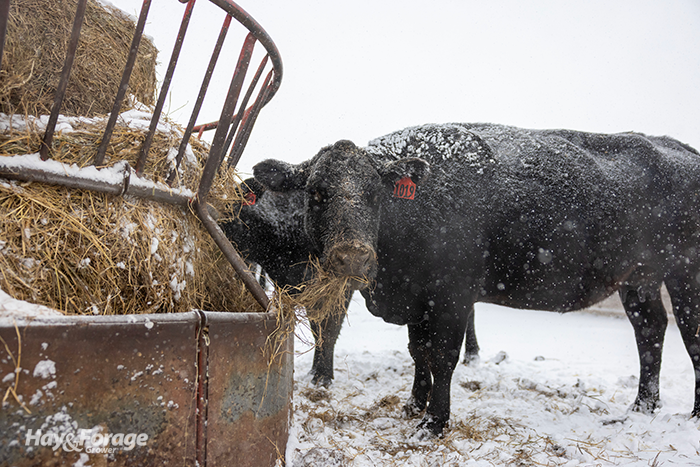
While writing this last weekend, the wind was whipping outside my window, and I was surprised it didn’t take some of the siding off the house. To make matters worse, the 30 mph winds — and up to 50 mph gusts — were carrying frigid air from the northwest, along with the first significant snowstorm of the season. It was one of those days that the temperature dropped with every passing hour.
The weather has finally flipped the switch to winter mode throughout the Midwest, and with falling temperatures, come rising energy demands from cattle. In winter hay-feeding systems, testing hay and knowing forage quality will ensure cows meet elevated nutrient requirements, and feeding high-quality hay will ensure those targets are hit more efficiently.
Don’t discount digestibility
When cattle get cold, they need additional feed. In fact, feed intake can surge higher than 20% to make up for energy expended to keep warm. The thermoneutral zone is the range of temperatures in which a cow can maintain body heat without burning extra calories. It varies with an individual animal’s stage of production and body condition.
For cows in good body condition, the thermoneutral zone threshold can be as low as 18ºF. Thin cows and those with wet or muddy coats experience cold stress at much milder temperatures. From there, energy requirements start to climb with every degree the thermometer drops. Wet and windy conditions will expedite energy expenditure even faster.
Depending on gestation or lactation stage, cows require roughly 60% total digestible nutrients (TDN) to maintain body heat without sacrificing body condition. High-quality forage offers larger concentrations of highly digestible fiber, which exits the rumen more rapidly and allows animals to eat more hay. On the other hand, low-quality hay contains less digestible fiber that slows digestion and curbs intake as cows reach rumen fill sooner.
Cows will also need 8% to 12% crude protein (CP). Results from an Oklahoma State University study show beef cows fed low-quality hay consumed it at a rate of 1.5% body weight per day on a dry matter basis, whereas high-quality grass hay was consumed at a rate of 2% body weight per day. Better nutrient composition coupled with the opportunity for greater forage intake makes high-quality hay a more valuable commodity.
Budget for bales
With that said, a greater intake of high-quality hay will affect how much forage needs to be fed. Considering the high-quality hay consumption rate of 2% body weight, a 1,200-pound cow would eat 24 pounds of dry matter per day. If that hay is 12% moisture, the cow will require roughly 27 pounds of forage per day on an as-fed basis. When energy demands scale up due to cold weather and/or during early lactation, cows may require even more.
Considering the rainy start to the growing season followed by drought conditions from midsummer through fall, there is a large spread in hay quality across the Midwest, making it that much more important to test forage and budget for additional bales or supplemental feed.
Anticipating cows’ increasing energy demands and calculating hay intake according to forage quality will dictate your needed winter feed inventory and help keep your cattle healthy despite the downturn in temperatures. It will only become more challenging to maintain — or boost — body condition as cold weather wages on, so setting cows up for success early in the hay-feeding season is critical.