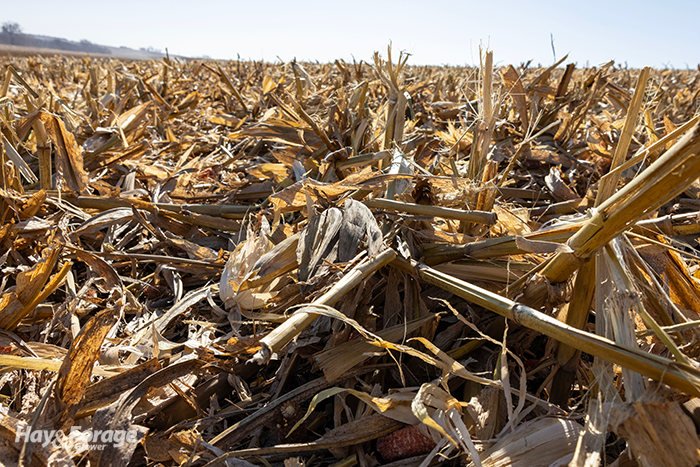
Despite the volume of corn residue leftover after grain harvest and the potential quality of that forage, cornstalk grazing is not as widely practiced as it ought to be. Those who do utilize cornstalks for forage know the key is to turn cattle out as soon as combines leave the field, but there are still opportunities to graze cornstalks as spring-calving cows enter late gestation.
Randy Saner and Mary Drewnoski with University of Nebraska Extension offer some advice for maintaining cow health during this stage of production as cow herds continue to graze corn residue. The extension educator and beef systems specialist suggest that when grazing cornstalks, 15% is the sweet spot for forage utilization, which may be in the rearview mirror for many fields this time of year.
“This 15% includes any remaining corn grain and 50% of the husk and leaf,” the extension specialists write in a recent BeefWatch newsletter. “Those parts are the most palatable and the highest quality nutrition for the cows. For every bushel of dry corn, the husk makes up 3 pounds, and the leaf makes up 14 pounds,” they add.
The opportunity for optimal cornstalk grazing fades as cows select for these high-quality and highly palatable components first, and as winter weather damages forage. Corn residue — especially the husk — is susceptible to degradation from trampling and wind. The extension specialists note that the longer cattle are left in cornfields, and the longer they are forced to eat cobs and stalks, the less likely they are to meet their nutritional needs.
A general rule of thumb is that one cow can graze for one month for every 100 bushels of corn produced. However, the specialists note recent studies show that high-yielding corn — more than 200 bushels per acre — offers less leaf and husk per bushel, and forage quality is generally less than it is in lower yielding fields. Therefore, researchers recommend that farmers reduce their cornstalk grazing time by 5% for high-yielding corn. They also suggest using the University of Nebraska Extension’s cornstalk grazing calculator to plug in production numbers and generate grazing parameters that are specific to your farm.
Quick tips
Saner and Drewnoski note that pregnant cows can typically meet energy and protein requirements on cornstalks without supplementation; however, heifers may require an additional feed source. With that said, all animals should have access to mineral that contains vitamin A to keep the grazing herd in good health.
“We suggest a 4-ounce free-choice mineral containing at least 300,000 international units (IU) per pound of vitamin A; 4% to 5% phosphorus; 1,500 to 2,500 parts per million (ppm) copper; and 3,000 to 5,000 ppm zinc,” Saner and Drewnoski write.
Dried distillers grains or modified distillers grains are two options to supplement late season cornstalk grazing. For cows in mid-gestation, the specialists recommend feeding 2 to 3 pounds of dried distillers grains or 4 to 6 pounds of modified distillers grains per cow per day. In late gestation, those rates increase to 3 to 5 pounds of dried distillers grains or 6 to 10 pounds of modified distillers grains per cow per day.
In summary, the extension specialists offer the following tips to optimize late-season cornstalk grazing:
• Cut grazing back by 5% in high-yielding cornfields
• Monitor husk availability in the field to gauge forage utilization
• Provide cattle with mineral that includes vitamin A
• If cows lose body condition, move them to another field and/or provide supplemental feed