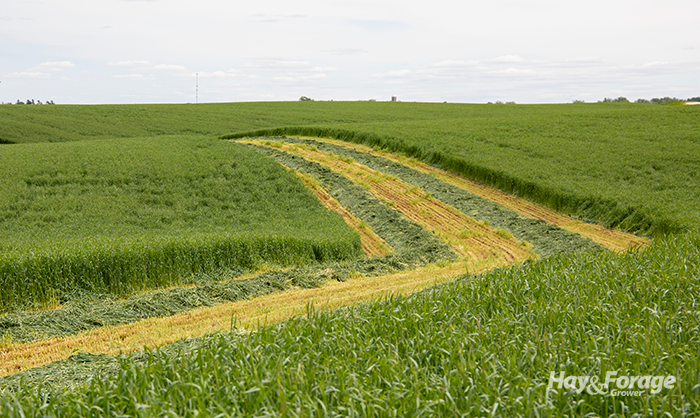
Harvesting winter cover crops — including triticale — can add a considerable cushion to forage inventories. Many dairies rely on cover crop silage for heifer and dry cow feed, but according to Sarah Morrison at the Miner Institute, early harvested triticale can be high enough quality to include in lactating rations.
Of course, the higher the inclusion rate, the better quality triticale silage needs to be, but it can be challenging to prioritize a timely cover crop harvest with several other springtime activities on the farm. In last month’s Farm Report, Morrison explains how relative maturity affects triticale quality and thus cow performance and milk production.
“In general, by harvesting at the boot stage, the forage has higher crude protein, lower neutral detergent fiber (NDF), and higher NDF digestibility. However, forage yield may be lower when harvested at this earlier maturity,” Morrison writes.
Research suggests that from a least-cost ration formulation standpoint, the harvest maturity of small grains has a minimal effect on total feed costs. Although this may be true as farmers and nutritionists balance rations with other ingredients, Morrison says it doesn’t mean cows won’t respond positively to higher quality triticale.
Four treatment groups
To demonstrate this, she shares results from a Journal of Dairy Science study in which researchers harvested triticale at boot stage and soft-dough stage. Both were added to high- and low-forage rations: The high-forage ration was 52% forage, and the low-forage ration was 37% forage. Triticale comprised 49% of total forage in all treatments.
Morrison says the boot-stage triticale had higher fiber digestibility than the triticale harvested at soft-dough stage. She also notes that researchers did a 1:1 replacement of the triticale maturity types instead of balancing the diets to be nutritionally equal.
Overall, cows fed the boot-stage triticale produced more milk than cows fed triticale at the soft-dough stage. This was true for both the high- and low-forage rations. Cows fed the boot-stage triticale also had higher milk protein content and better energy-corrected milk (ECM) yields.
Morrison notes there was a smaller variation in ECM between the two triticale maturity groups when cows consumed the low-forage diet; there was a bigger difference in ECM among the cows fed high-forage diets containing boot-stage triticale versus soft-dough triticale.
“Overall, feed efficiency was not impacted by stage of maturity of the triticale, but rather was impacted more by forage inclusion level,” Morrison writes. “Cows fed high-forage diets had higher feed efficiency compared to those fed low-forage diets.”
Even though the researchers reported that intake became a limiting factor for cows fed the high-forage diets, animals eating boot-stage triticale consumed 6.4 pounds more per day compared to those eating soft-dough triticale.
“With the higher undigested NDF (uNDF) content in the soft-dough triticale, it was likely that more gut fill was limiting the higher forage inclusion levels in the diet and overall uNDF intake,” Morrison writes. “Furthermore, total tract digestibility was higher for cows fed the boot-stage triticale.”
She concludes that triticale maturity can play a role in dairy nutrition and milk production when forage inclusion levels are compared 1:1. “However, if we are formulating around the quality of the forage in the diet, responses may be limited.” She adds that cost and inventory are critical considerations for the utility of small grain silage in lactating rations as well.