As the calendar turned to April this past week, it marked the start of alfalfa’s spring-seeding season in many regions. Spring alfalfa seedings must typically run a gauntlet of weather conditions before plants are firmly established. In a single year, they can experience excessive cold, heat, moisture, and snow. Moreover, wet-soil disease organisms thrive during this time of year.
“Establishment is one of the key factors that can influence yield, quality, and stand persistence for years to come, but our weather during planting windows has been less favorable in recent years,” notes Emma Matcham, a forage specialist with Ohio State University Extension.
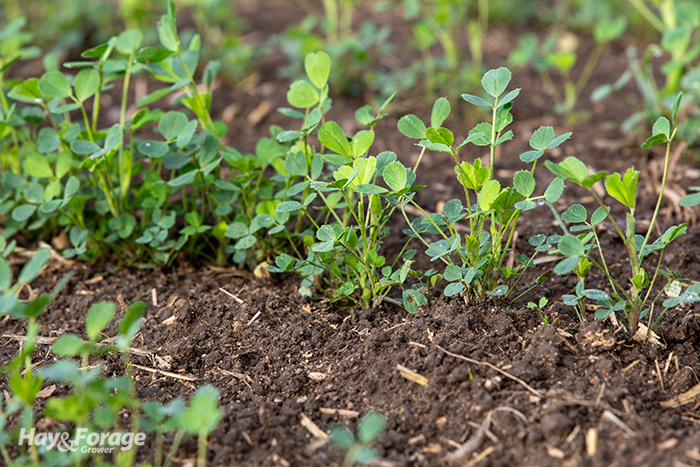
“Mature alfalfa plants and early seedlings are very cold hearty, but cold tolerance declines after the first trifoliate emerges,” Matcham explains in a recent C.O.R.N. Newsletter. “Since trifoliate leaves take around 15 to 25 days to emerge after planting, and it takes a while for our soils to dry out enough to be workable, it’s rare that we see frost damage as long as you’re planting within three weeks of the last expected hard frost.”
When looking for the optimum planting window, take into account soil temperature. Matcham says that modern alfalfa varieties can germinate down to around 32°F, but it takes over two weeks to reach 50% germination when the soil temperature is in the 30s. When soil temperature exceeds 40°F, alfalfa reaches 50% germination in about three days. “This means that soil temperature can swing the date to first trifoliate leaf by about five to 10 calendar days,” Matcham notes.
If the soil warms early in April and seeds quickly germinate, it doesn’t mean risk necessarily subsides. Early April plantings during periods of higher soil temperatures can be vulnerable to a hard frost later in the month because alfalfa becomes less cold tolerant after the trifoliate leaves emerge, the forage specialist cautions.
Have a weed plan
Your chosen planting date will also impact weed pressure.
“The critical period for weed control ends at or before the seven-trifoliate leaf stage, and it will usually take earlier plantings on cooler soils a bit longer to reach this stage,” explains Alyssa Essman, a weed scientist with Ohio State University Extension. “Many of the herbicides available for post application in new alfalfa seedlings are also in Group 2, which are less effective in cold weather.”
If seeding in cold weather, you might consider a companion crop like oats or barley to provide ground cover and reduce weed pressure. Annual grass companion crops have the added benefit of enhancing protection against a late-season frost, too.
Essman says that spring is also a great time of year to think about where you might be planting alfalfa in 2027 so that you can get ahead of any perennial weeds. “Quackgrass, sedges, and thistles can be tough to control in alfalfa, so it’s helpful to get ahead of them during the preceding crop, using a mix of mechanical control and well-timed herbicide applications.”
Consider formulating your weed control plan before spring plantings. “Managing tough-to-control weeds ahead of planting and during the first year should be a priority to prevent ongoing issues in established alfalfa,” Essman asserts. “Tillage or burndown applications prior to planting are needed to control winter annual weeds or early emerging summer annuals to create a clean seedbed.
Following alfalfa emergence during the seedling stage in pure alfalfa stands, there are several herbicide options available. These include alfalfa-labeled products containing imazethapyr, imazamox, 2,4-DB, pendimethalin, acetochlor, or glyphosate, if the alfalfa is a Roundup Ready variety. Always read and follow label directions before applications are made. Ensure the timing and rate are correct.
If you get rained out of the spring planting window, or a new seeding fails, Matcham suggests considering a high-biomass summer annual. A crop such as sorghum or millet can help provide needed feed and prevent weed issues from getting worse while you wait for the next opportunity to plant alfalfa.