-
Mining The Soil
Tour participants learn how alfalfa was interseeded into bermudagrass in a biosolids environment - at Rogers Pollution Control Facility in Rogers, AR.
-
Bermuda Beneath
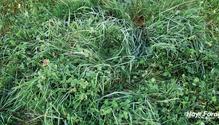
Bermudagrass peaks through alfalfa no-till seeded into its sod. The alfalfa doesn't need nitrogen, so saves on fertilizer costs. Also, the underlying bermudagrass sod isn't killed, reducing a producer's risk if the alfalfa doesn't establish or stands thin prematurely. The alfalfa also takes advantage of high soil phosphorus and/or potassium because of prior applications of poultry litter or biosolids.
-
Interseeding Decreases Soil Phosphorus Levels
Bobby Umberson, who contracts the Rogers Pollution Control Facility acreage, says interseeded alfalfa helped reduce soil phosphorus levels by 800 lbs/acre over five years of production.
-
The Buses Await
Tour-goers, a collection of University experts, company representatives and producers, trek back to busses during a hot, dry day.
-
Growing Bermudagrass In Colder Climates
In the red shirt, Larry Miser, Pea Ridge, AR, shows the typical height of Vaughn's bermudagrass variety at harvest. He says the grass variety, one of a fairly short list of bermudas that can grow in the hard, cold weather that comes to northwestern Arkansas, produces higher-quality and more forage than the tall fescue and orchardgrass normally grown there.
-
Propagating Good Production
Larry Miser points to a root of a Vaughn's bermudagrass clipping used to propagate the variety on 180 of his acres. "Using clippings of the Vaughn's variety allowed me to establish my own field, on my own time, using the equipment I had available." He has documented, over five years of production, 5,000 round bales/year on his original 13-acre field.
-
TDN At 65%
Tour participants hear Robert Seay, Benton County, AR, Extension agent, tell of quality results from a 14-year study. It showed average total digestible nutrients at 65% from 1,458 bermuda hay samples taken from first to fourth or fifth cutting.
-
Protein Improvement
Seay's data shows that crude protein of 1,458 bermuda hay samples tested from 1991 to 2011 averaged 15% across cuttings.
-
Plotting Those Herbicide Choices
Varying herbicides and rates, applied on Greenfield bermudagrass on the Dennis and Don Malone farm, Highfill, AR, were examined.
-
No-Herbicide Check Plot
Here's an untreated check of Greenfield bermudagrass.
-
Treated Plot
This section of the same bermudagrass had 1 qt/acre of Grazon P+D applied to it.
-
Varying Rates Compared
Cimarron was applied to bermudagrass at 0.3 oz/acre.
-
Bermudagrass Bale
Net-wrap has made a world of difference in helping retain bermudagrass quality in bales.
The May 17-18 American Forage & Grassland Council annual forage tour examined many aspects of bermudagrass. On May 17, the tour took 75+ attendees to three farms utilizing this warm-season perennial grass.