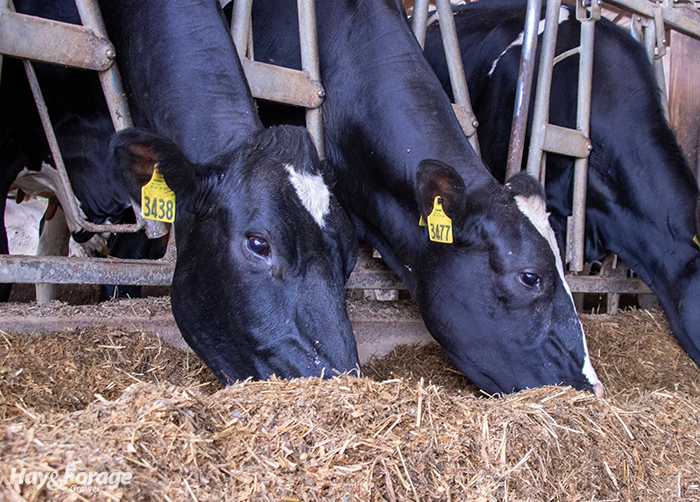
The ability of ruminant animals to turn forage fiber into milk and meat is the cornerstone process of livestock production, and it has a direct effect on the sustainability of human food systems. The way farmers grow and manage forage for livestock consumption creates a ripple effect that extends well beyond the farm.
In addition to field and storage management, forage harvesting and processing practices impact nutrient availability. Especially for dairy cows, forage particle size can affect eating behavior, feed efficiency, and overall rumen health, which Angela Breneman explains in an article from Penn State University Extension.
Stratification layers
Forage particles get sorted in the rumen according to dry matter content, fiber type, and surface area, leading to rumen stratification. Breneman says this stratification impacts rumen function, rumen motility, and it supports a robust microbial population.
“The stratification layers start at the top, or what we consider to be part of the rumen mat,” the dairy management extension educator writes. “Particles that float to the bottom are considered to be a part of the ruminal floor. Then, we have what floats around in the middle of the medium degradation area.”
The goal is to formulate rations with enough variation in forage particle sizes to create balance among those stratification layers and facilitate healthy rumen function and digestion. The ideal theoretical cut length for haylage and small grain silages is 1/2 to 3/4 inch. For corn silage, the ideal range is between 3/8 and 3/4 inch. Additionally, aim for at least a 70% corn silage kernel processing score.
Keep in mind that these are optimal benchmarks. “There are many other factors that may influence the length of cut, such as the type of crop, the moisture at harvest, and the objective during feeding,” Breneman reminds. She adds that forages can always be made shorter, but they can’t be made longer — be cautious when adjusting your chop length.
Basic feeding benchmarks
Breneman suggests using the Penn State Particle Separator to measure total mixed ration (TMR) samples and determine which forage particle sizes have potential to support rumen motility, alter rumen pH levels, or stay in the rumen. “When we analyze a diet in the particle separator, we are looking at percentages of forage on each sieve,” she writes.
Penn State University Extension recommends aiming for 2% to 8% of the TMR in the upper sieve, 30% to 50% of forage in the middle sieve, and 10% to 20% of the ration in the lower sieve. About 20% to 40% of the particles should fall all the way through to the bottom of the separator.
With that said, Breneman notes these recommendations are based on typical lactating cow diets from her region of the northeastern United States. While they may be good baselines to strive for when harvesting and processing forage, it may be necessary to reassess particle size distribution and ration formulation that is specific to your cows’ nutritional needs.
In general, diets with too many small particles can negatively affect rumination and result in milkfat depression. On the other hand, rations with too many long particles can cause poor silage fermentation in storage and encourage sorting by cows at the feedbunk, consequently reducing intake and total milk production.
Although good-quality forage is a product of diligent field management and effective storage protocols, Breneman suggests feed quality also depends on the way forages are presented to cows. Be mindful of the impacts that your forage harvesting and processing practices can have on ration formulation and rumen function.