Now that farmers have shifted from harvesting forage and grazing pastures to selling and feeding hay, forage analysis should be critical to marketing and purchasing decisions. But not all sellers and buyers test their hay products, even though knowing forage quality is essential to both parties.
On one hand, sellers can use this information to set their price and inform buyers, as well as to track production performance and identify areas for improvement. On the other hand, livestock producers must know forage quality to build winter feeding programs that meet their animals’ nutrient needs.
But to ensure those forage analysis results are useful, farmers must know how to take a proper hay sample. Luckily, the National Forage Testing Association (NFTA) provides a research-proven, standardized protocol to do so.
As stated by NFTA, hundreds of thousands of pounds of highly variable plant material must be represented in a single, thumbnail-sized sample. “This sample must not only represent the proper leaf-stem ratio and the legume-grass mix, but also the spotty presence of weeds. Sampling variation is a significant problem in hay testing and causes millions of dollars in lost revenue each year by either the buyer, seller, or in animal performance,” the association asserts.
It is impossible to eliminate all variation, but a large percentage of it can be controlled by following the steps below:
1. Identify a single hay lot. This is defined by a single cutting from a single field and is usually less than 200 tons. Combinations of different lots won’t be accurately represented in a sample, so different lots should be sampled separately. Do not mix hay from various cuttings, fields, or types of forage.
2. Sample hay close to feeding or point of sale. Dry matter content and other quality metrics are subject to change after harvest, so sampling hay soon after it is cut and before it is stored won’t yield accurate results.
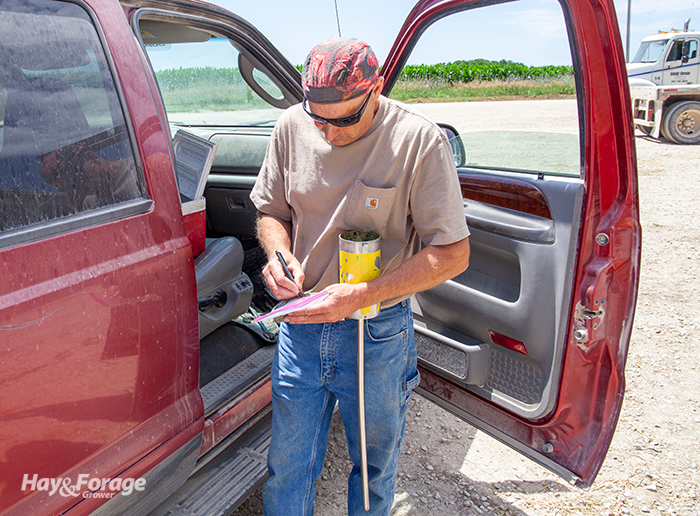
3. Use a sharp coring device. Take samples with a sharp probe that is 3/8 to 3/4 inch in diameter; do not send in flakes of hay or grab samples by hand. Probes that are too small can skew the leaf-stem ratio, and probes that are too large can generate more forage than is necessary. Hay probes should be 12 to 24 inches in length.
4. Sample at random. It is imperative to get cores from different bales. Even though access to bales in the middle of a stack can be limited, aim to randomize cores as much as possible. Don’t intentionally avoid bales that look bad or select bales that look good.
5. Use proper technique. Take cores from the butt end of bales, away from the edge. Coring bales from the sides or top of bales is also not advised, as these cores would only represent a single flake of hay. Position the probe at a 90-degree angle and insert it 12 to 18 inches deep. Do not sample from the same place twice.
6. Gather enough cores. NFTA recommends a minimum of 20 random cores for a composite sample that represents a hay lot. This is the same recommendation for large and small bales.
7. Create a half-pound sample. After bales have been cored and mixed, seal a half-pound — or roughly 250-gram — sample of forage in a ziplocked bag. Half-pound samples are most practical for analysis purposes and for handling by lab technicians. Keep the sample in a cool environment and away from sunlight. Submit it as soon as possible.
8. Use a NFTA-certified lab. Make sure the lab you send hay samples to participates in the NFTA proficiency certification program. These labs demonstrate commitment to good results.
For more information, read NFTA’s principles for proper hay sampling.