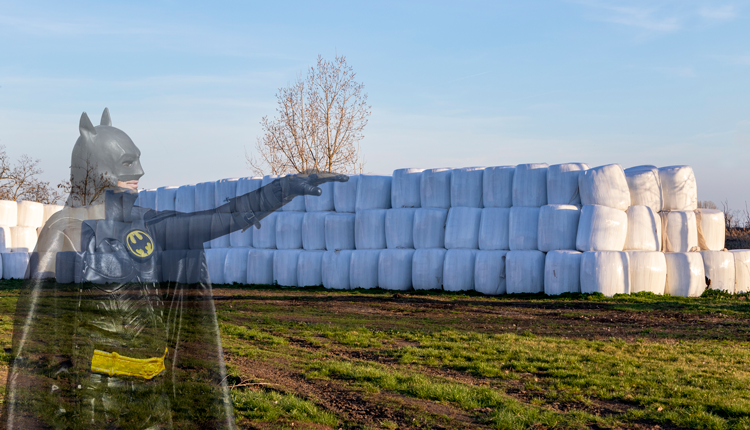
The other day, I received a question about using bale films to protect stored forage. Before responding, I decided to cross-reference my knowledge on the subject with whatever trusted sources I could find on the internet to ensure the insight I had to offer was fair and accurate. So, I made a quick Google search for “bale films.” The results were not what I expected.
Instead of finding statistics on storage loses or how-to guides for wrapping high-moisture hay, I was presented with a list of every movie actor Christian Bale has starred in since his breakout role in 1987.
I was inundated with articles about the Batman portrayer’s academy award nominations, red carpet appearances, and a definitive ranking of his greatest cinematic performances. Despite being the star in one of my personal favorites, the money-heist comedy “American Hustle,” I learned more about Christian Bale than I’ll ever need to know — all from that tiny, two-word Google search. Needless to say, that wasn’t the sort of bale film information I was looking for.
In a world with so much information available with such little effort, it’s easy to get lazy in our approach to access it. Typing a few keywords into a search engine — which may or may not be spelled correctly, let alone form a complete sentence — is all it takes to get answers to our questions, all within a fraction of a second. Sometimes, though, those impulsive inquiries lack the context needed to get the big picture. Or in my case, you get a major motion picture, but one that has nothing to do with the desired topic.
Context is key to understanding the niches and nuances of hay and forage, especially in an industry that gives farmers the freedom to think outside the box and go against the grain — literally. There is essentially an open playing field of opportunity when it comes to forage crop production, product marketing, and overall business management. No two hay growers, beef graziers, dairy farmers, or custom forage harvesters run their operations the same way.
Regional differences in weather patterns and consumer demands add to the variation of farming strategies and forage philosophies, and having this type of context is critical to compare and contrast farm-level experiences with what is happening in the forage industry at the national — and even global — scale.
Context is also key when we analyze how market trends impact farm income and break-even costs. Take average alfalfa hay prices, for example. Reports of month-over-month average price reductions seem relentless, but the momentum of that downward slide makes a little more sense considering the extreme height at which record-high alfalfa hay prices peaked just a few years ago. That doesn’t make it any easier for farmers to turn a profit, but it might provide some clarity to the situation.
Moreover, low hay prices are usually supported by low commodity prices. Ask any of your row-cropping counterparts about recent corn and soybean prices, and they will likely describe the commodity market with a few choice words that offer more context than you bargained for.
In addition to industry-wide issues, context is key to understand the ins and outs of individual operations, and I’ve learned that the best way to gain that understanding is by getting curious. What type of production are the farmers involved in? What skills are necessary to do each job on the farm? What does a typical hay cutting, grazing rotation, or day on the dairy look like? What challenges arise that cause these tasks to stray from business as usual?
The context of the ensuing answers is derived from more than verbal explanations. It is evident in a farmer’s daily routine; it is conveyed in the way they speak about their employees, whether those people are hired hands or a part of the family; and it evolves with a farm’s history. Without trying to, producers also provide context for their personal values and belief systems when they describe why they do what they do, because more often than not, they consider farming a lifestyle, not just an occupation.
With all that said, my hasty Google search may have been a failed attempt to learn more about bale films, but it was a good reminder about the responsibility we have to share relevant, research-based, and real-life content with appropriate context. Hopefully, that context is the key that unlocks ideas for forage improvements and opens doors for new connections to be made.
This article appeared in the January 2026 issue of Hay & Forage Grower on page 5.
Not a subscriber? Click to get the print magazine.