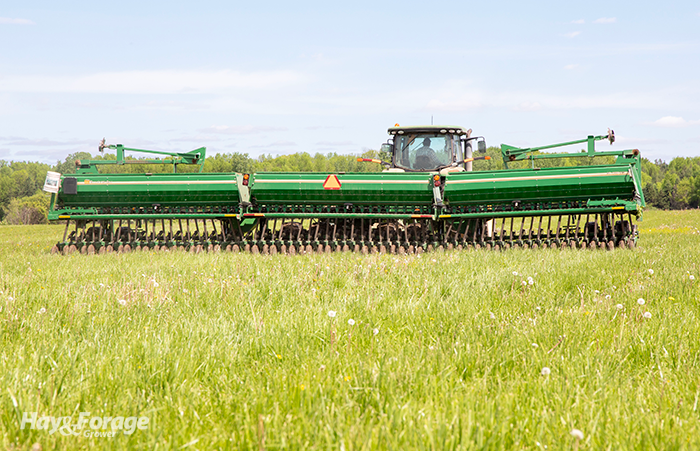
The winter months are often reserved for machinery maintenance and repairs, but even in the offseason, some of those to-do list tasks get pushed to the back burner. Spring planting season tends to sneak up on us faster than we think, so servicing seeding equipment now will save time when Mother Nature gives the green light to get in the field.
Drills are better suited for forage and cover crop establishment than row planters, and with a simpler design, they also have fewer maintenance points. Even so, there are several moving parts that need to be assessed and possibly replaced. Sjoerd Duiker with Penn State University says drill upkeep is especially important in no-till systems.
“A no-till planter or drill has to be able to plant through heavy crop residue, penetrate firm soil, open a seed slot, place the seeds in it, and close the seed slot so seeds have proper seed-to-soil contact,” Duiker writes in a Penn State University Extension article.
“Suboptimal planter or drill performance results in irregular seed depth, seeds at the soil surface, open seed slots, and compacted soil on top of the seeds,” Duiker cautions. The professor of soil management and applied soil physics offers the following maintenance checklist to ensure drills are in good condition for spring forage establishment.
Coulters. Measure coulter diameters and replace them as needed. Adjust the depth setting for coulters with some wear that are still usable to maintain uniform seed slots.
Disc openers. Refer to the manual for the recommended disc opener diameter and replace those that are worn. Drills can have single or double opener discs; makes sure double opener discs touch to form a proper V-shaped slot.
Depth control wheels. If your drill has depth control wheels next to opener discs, ensure that the wheels run tight against the discs. If they are loose, move washers on the inside of the depth control wheels to the outside, or vice versa. If that doesn’t solve the problem, you may need to replace the depth control wheel arm.
Press wheels. Press wheels typically control seeding depth and close the seed slot. Make sure springs are intact and that the press wheels are not damaged or significantly worn. Tighten loose bearings. Duiker says a press wheel arm cannot have too much play — if it does, new bushings might be required, or the entire arm may need to be replaced.
Seed tubes. Check seed tubes for cracks and clogs — Duiker notes that spider webs can accumulate in seed tubes during the offseason. Replace brittle tubes that show signs of damage.
Chains. Examine all chains and their sprockets. If chains are worn or chain links are stiff, replace them. Chains must have appropriate tension and be properly lubricated.