Who am I, and what is my mission?
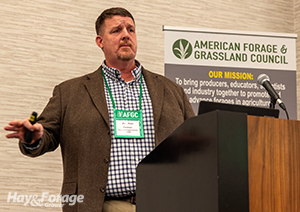
That was the question Jonathan Fordham challenged audience members to answer by the end of his first-place Forage Spokesperson presentation during the American Forage and Grassland Council’s Annual Conference in Asheville, N.C., last week.
Before Fordham answered that question for himself, he introduced two people who, despite having little else in common, have changed Fordham Brothers Farm in Blakely County, Georgia, for the better: a 94-year-old widow and a natural resources conservation service (NRCS) grazing lands specialist.
Miss Lemmie was Fordham’s elderly neighbor, and after she retired in her upper 70s, she started farming. Without the ability to make hay herself or access to sufficient pasture for her small herd of cattle, she began buying bales from Fordham. It was a business relationship that lasted almost two decades.
“She always called and placed the same order — she wanted 10 bales of hay,” Fordham recalled. “She’d meet me out in the field and would point to where she wanted me to place each bale with her walking stick.”
Once the bales were arranged to her liking, Fordham said Miss Lemmie set up temporary fence posts around the field and used electric wire to give animals access to one bale at a time.
“She was running a system that worked for her. She was resourceful, she was innovative, and it allowed her to do something that was very important to her — keep farming.”
A trusted adviser
Fast forward to 2022 when Fordham got a phone call from grazing specialist Phillip Brown who encouraged the beef producer to consider bale grazing.
“For the past 20 years, my brother Robert and I had always fed cows hay in the winter in a sacrifice area. We just put hay out in the same location year after year,” Fordham said. He told Brown he’d give it a try, but he had one question: What exactly was bale grazing?
Brown described a winter feeding system in which bales are set out on pastures in advance and farmers use temporary fence to give cattle access to a few at a time.
“A lightbulb went off in my head — that’s how Miss Lemmie fed hay,” Fordham said. “It really struck me that 20 years earlier I had been introduced to this practice by a little old lady down a dirt road.”
Inspiration and improvements
With Miss Lemmie’s wisdom and Brown’s expertise, Fordham adopted a bale grazing strategy of his own. “Instead of feeding hay every couple days in the same area, which is what we had done for years, we now use portable electric fence, step-in plastic posts, and battery-operated fence chargers to give cows access to enough hay for two to five days,” Fordham summarized.
Over the past three years, Fordham and Brown have teamed up to sample soil and assess how bale grazing has impacted soil fertility. They have also worked together to pinpoint areas for improvement.
“It was a priority for me to increase the density of the hay distribution — I didn’t think we were capturing all of the nutrient deposition that I thought we could,” Fordham said. “We’ve increased from feeding about 2 tons of hay per acre to 4 to 5 tons per acre.”
To make this work, Fordham condensed temporary paddocks and shortened each grazing rotation, resulting in a more compact grid of bales that are grazed on a tighter schedule. Some of the biggest benefits he has realized from doing so include:
Better nutrient distribution. “In a traditional sacrifice feeding scenario, wasted hay, urine, and manure are all deposited in the same location over and over again,” Fordham said. “With bale grazing, we can take all of that waste, spread it out over the pasture, and we are able to capture more of that nutrient load.”
Considering current fertilizer prices, Fordham estimated the value of wasted hay from a 1,000-pound bermudagrass bale to be roughly $40, and that’s without factoring in the value of excreted nutrients.
Better soil health. “Cows in a sacrifice hay-feeding scenario are very messy,” Fordham said. “When it rains, tractor tires and hooves turn up the soil, and all that urine and manure is in one place.”
By bale grazing, the runoff, erosion, and other damage that previously had a large impact in a small area are more evenly dispersed across the entire field, making the negative effects of those soil disturbances less intense.
Creep feeding. Creep feeding calves under a single strand of polywire is a benefit of bale grazing Fordham wasn’t expecting to gain.
“We put that polywire at a height that the calves don’t pay any attention to,” Fordham said. “They go and find the best hay and clover without competition from the adult cows. I think that translates to reduced weaning stress. We are also getting additional weight with no additional inputs,” he added.
Time and labor savings. Fordham, his brother, and his father all work off-farm jobs. “We are always looking for ways to minimize the time it takes to tend cattle, especially in the winter because feeding hay is the most labor-intensive portion of our operation,” he explained.
“Bale grazing allows us to plan for that in advance,” he continued. “I put out 120 bales in 24 groups of five on a 10-acre field. I do all of that in a seven-hour day, and I even get to pick the day I do it, when I have time, good weather, and the field is dry.”
With all that said, Fordham believes that necessity drives change, and without a motivation to do things differently, farmers can get stuck in their ways. He hopes that his story will be the motivation others need to take a leap of faith and try something new.
“If you go back to Miss Lemmie’s story, necessity drove her to come up with this bale grazing strategy, and that’s what kept her in the game of doing what she loved, having her own cow herd, even at 94 years old,” Fordham said. “For me, bale grazing is a tool that allows me to be a better farmer, and being a better farmer is part of my mission.”