 Photo by: Don Glen
Over half a century ago, W.D. Young made the decision to diversify his southern Georgia farming operation to include row crops, cattle, and a tractor dealership. As many readers will agree, diversification is a hedge against selling a product for which you don’t control the price and a marketplace that swings wider than the batter’s box. It proved to be a smart move.
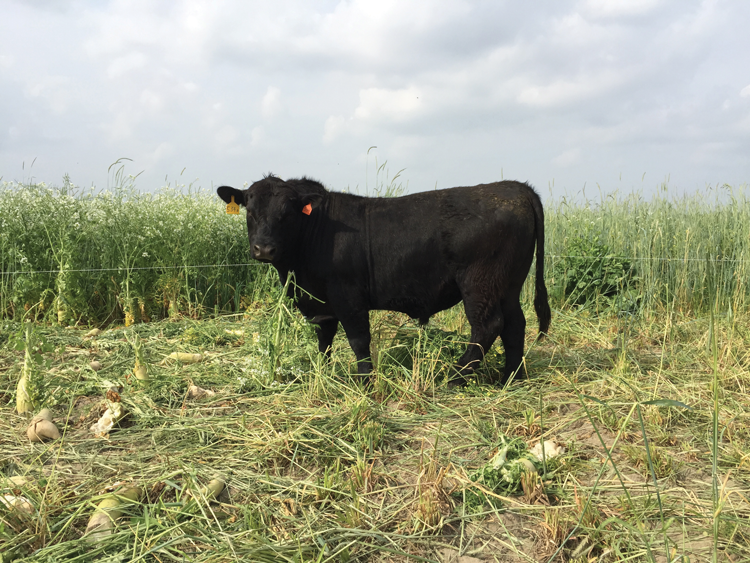
Young, also known as grandpa to me, dropped out of grade school to start working and help feed the family, and after decades of hard work, sacrifice, and savvy, built a diversified farm that still thrives today in the hands of his offspring. While we sold the ailing tractor dealership years after Ford became New Holland, cattle have continued to be an integral part of our our row-crop operation, with about one-third of our fields fenced for winter grazing. In the fall, we think ahead to determine what crops will be grown in our rotation the following year and decide what to plant for our cattle. We also take a look at the markets. Will corn break even? Will cattle prices be on the rise? Can annual forages pencil a profit?
Look for opportunities
Last year, we cut our corn acres in half and took advantage of record cattle prices by planting and grazing summer annuals. A pound of gain is worth nearly twice as much as it was a few short years ago.
We typically sow cereal rye, spring oats, spring pea, grazing radish, and hybrid turnip in mid- to late September here in climate Zone 9a, depending on temperature and moisture. We hope to be grazing by late November and are often done grazing in March. Usually, we get two decent grazing rotations and perhaps a clean-up graze prior to our cash crop preparations.
Peanuts have become the backbone of our row-crop rotation, and we know those fields must be prepped in April and planted in May. This allows for a longer grazing period, and these stands often include cereal rye, oats, triticale, hybrid turnip, and a small amount of ryegrass. Too much ryegrass creates a root structure that can be hard to deal with prior to peanut planting.
We sometimes include a small amount of crimson clover and hairy vetch in the seeding, but we keep forage legumes to a minimum in front of the row-crop legume. Many farmers are fearful of both ryegrass and hairy vetch as potential weeds; know your weed control mechanism prior to including those in your mix.
Summer annuals sometimes get stockpiled, and since frost doesn’t usually happen until November, we lean on heavy sorghum-sudangrass plantings as they retain good quality. Sunn hemp will provide a trellis for the late growing cowpea. An understory of crabgrass can provide a lower growing biomass, but it loses quality in October when it goes to seed.
Think a year ahead
The fields that will be planted to summer annuals the following year get the royal treatment: heavy ryegrass, crimson clover, and hairy vetch. That is usually punctuated with triticale, winter oats, spring oats, cereal rye, and a brassica or two. We try to be done planting these fields as soon as we finish peanut harvest, which sometimes goes into mid-November.
Our last winter plantings are in the pasture where the perennial grasses typically get in the way until the first frost. Normally, we graze pretty tight or clip the pastures. Then, we use a no-till drill to plant a mixture of both perennial and annual species: white, red, and crimson clovers; balansa clover; chicory; plantain; triticale; cereal rye; oats; and a little ryegrass. We will be overseeding alfalfa in 15-inch rows in a few pastures again this season to see if we can improve our success compared to our last attempt. A few years back, we left too much bermudagrass residual and it choked out the young alfalfa.
Even though just a couple species are the heavy producers in our mixes, we like to include four plant families — grasses, legumes, brassicas, and broadleaves — to mimic natural systems, promote soil microbial diversity, and create an entourage effect. We lean on the grasses and legumes, but we also intersperse our pastures with a few productive members of the other plant families.
Address the issues
In our tilled ground, wild radish has become a problem. Since we rarely use pesticides, weed control has proven problematic. I do think it’s nature’s way of trying to repair our tillage regime, but it has reduced our grazing days and become a challenge.
Our long-term goal is to reduce tillage in our row-crop operation so that less soil disturbance will limit wild radish infestations. Holistic approaches to weed management are key instead of being trapped in a cycle of fixing symptoms to the actual disease. We ask ourselves: Why does nature germinate a seed? What can we do differently to affect this process? We believe we must always be thinking about the big picture and not just applying Band-Aids.
We have irrigation on many fields, which allows us to plant on time. Moisture is necessary to have success, so we are circumspect about the reality of our opportunities. Overall, preparation and timing are critical to getting stands off to a good start and reducing winter feeding costs to get the most from forage investments. Diversifying your sward — like a business — and hitting those planting windows is a solid hedge against Mother Nature and the markets pitching outside the batter’s box.
This article appeared in the January 2026 issue of Hay & Forage Grower on page 10 and 11.
Not a subscriber? Click to get the print magazine.