When thinking about bolstering pastures with legumes, thoughts immediately turn to red or white clover — or perhaps alfalfa. Those are all good options, but there seems to be at least one other legume that’s gaining some slow momentum.
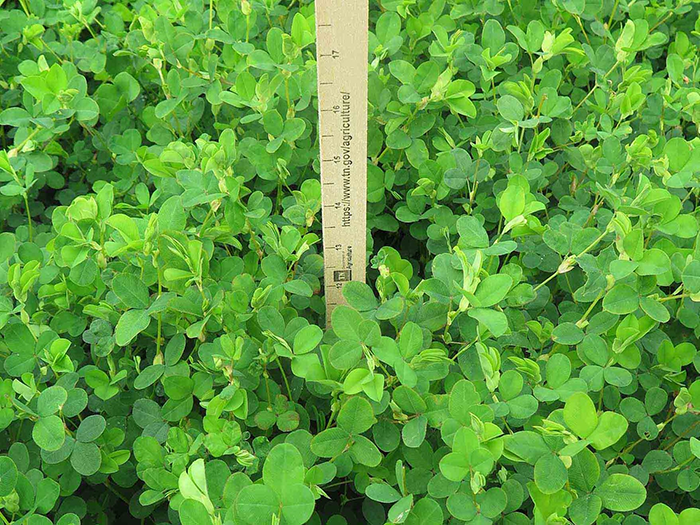
Annual lespedeza is a warm-season annual legume that, when managed correctly, will reseed itself and provide multiple years of grazing pleasure. I can’t say that most of the farmers I visit with use annual lespedeza, but I can say that the ones who do simply love the stuff.
“Annual lespedeza is a forage option that offers a simple, low-input way to help fill the summer slump while improving overall pasture performance and soil health,” says Caleb O’Neal, a University of Missouri Extension plant science field specialist based in Mt. Vernon. “One of the greatest advantages of annual lespedeza is its ease of establishment and adaptability. Unlike many legumes, it can be productive on soils with pH levels as low as 5 and on sites with marginal fertility,” he adds.
Although it does much better than many other species on marginal soils, its best production occurs where good fertility and soil drainage exist.
As a warm-season species, annual lespedeza is typically seeded in the spring, and there are several establishment options. It can be broadcast frost seeded, drilled into existing pastures, or established as a monoculture after a winter annual harvest or grazing. Current users often put it in their seed mixture to repair winter-damaged feeding areas.
Greg Halich, an agricultural economist with the University of Kentucky, is another of those strong proponents for incorporating annual lespedeza into a grazing plan. On his own farm, he’s found seeding later is better than earlier. Halich likes to broadcast lespedeza from mid-March to early April in Kentucky. Seeding dates can be slightly earlier in states like Tennessee and North Carolina. Being a warm-season annual, Halich notes that this legume doesn’t have much tolerance for a hard frost. If it establishes too early, and a frost occurs, the plants will be thinned or lost.
O’Neal notes that seed-to-soil contact is critical when establishing annual lespedeza, so if pastures have heavy residue, he suggests dragging a light harrow after broadcasting. In most cases, lespedeza seed will need to be inoculated. Use the same bacteria as that for the cowpea-peanut family of legumes.
Annual lespedeza possesses many of the positive attributes as other pasture legumes. It fixes nitrogen, boosts the forage quality of grass-dominated pastures, takes away some of the summer-slump pain, helps dilute the effects of toxic tall fescue, and enhances soil health. Although it’s an annual species, it can reseed itself for future production when managed correctly.
Both O’Neal and Halich note that the best time to let annual lespedeza reseed itself is in the fall. After haying or grazing in early to mid-August, allow the lespedeza to set seed. By late October, seed should be developed and the remaining forage can be grazed.
Variety options
Most seed companies selling annual lespedeza will offer either Kobe or Korean varieties. “While both are useful, key differences should be considered,” O’Neal notes.
Kobe lespedeza has smaller leaves, a lower growth habit, and matures a little later than Korean. It produces flowers that are closer to the ground, allowing for greater grazing tolerance, and it performs well on poor soils.
Korean lespedeza offers a higher yield potential than Kobe. It grows taller and is more adapted to rotational grazing or hay production. It flowers and sets seed earlier than Kobe but is more susceptible to disease pressure and heavy grazing.
“Selection should be based on management goals and site conditions,” O’Neal says. “For low-input pastures where persistence is a priority, Kobe lespedeza is often the better option. For producers aiming to maximize summer forage production under managed grazing or hay systems, Korean lespedeza is the preferred choice.”
Both Kobe and Korean are not “new” varieties in contrast to offerings made available from other forage species. Both annual lespedeza varieties were released in 1919, and the acreage planted to the species peaked during the 1930s.
If nothing else, annual lespedeza is proven in its utility as a grazing option. It will never nor should it exceed the utilization of clovers, but it seems that there is a place for this afterthought legume on many more farms than where it’s currently being used.