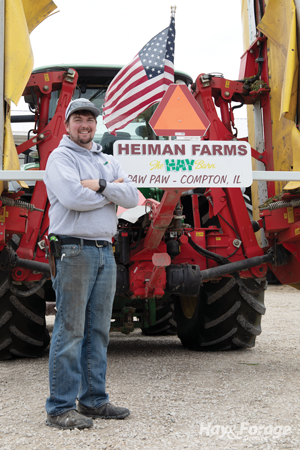
During his formative years, Heiman got the haymaking bug while working on his uncle’s Missouri farm in the summer. Then, at the age of 14, he bought a New Holland 575 baler and started custom baling for some of his Land of Lincoln neighbors. “I didn’t even have a driver’s license yet,” Heiman chuckled.
These days, the just-turned 26-year-old farmer harvests about 700 acres of hay on owned and rented land that dots the landscape within a mecca for corn and soybean production. Heiman has about 100 acres of straight alfalfa, 500 acres of an 80:20 alfalfa-orchardgrass mix, and another 100 acres of an orchardgrass-timothy mix. “We have a lot of small, rented fields that row-crop farmers don’t want to deal with and where landowners would rather look at hay instead of corn or soybeans,” Heiman explained. “I also have about 60 acres of what was left from my grandparents’ farm. Both of my parents worked off-farm jobs.”
Multiple packages
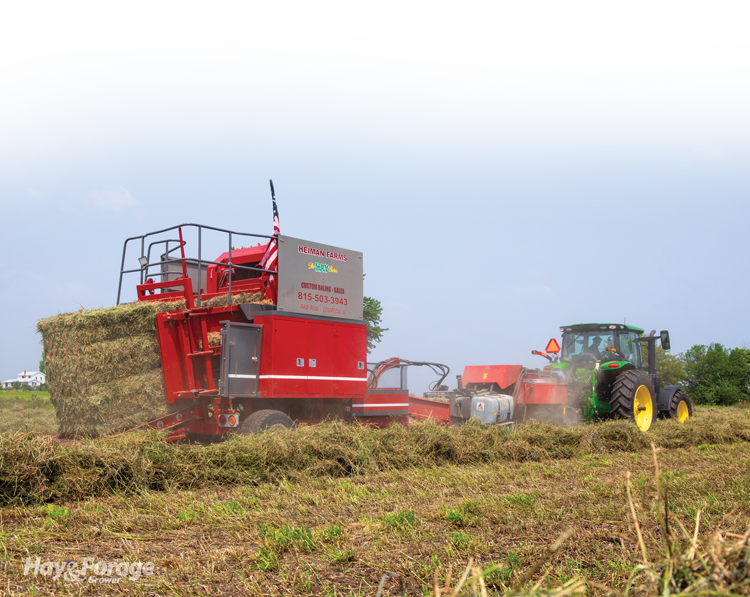
Heiman owns three balers and produces small squares, 3x3 large squares, and round bales. The small squares are bundled with a Bale Baron that he pulls behind his Massey-Ferguson in-line baler. Heiman decides which fields will be made into what type of bale by the quality of the hay. A lot of his first cutting goes into large square bales because they’re easier to market in the larger package. His first-cutting grass hay is made into round bales, as is hay that gets rained on. In the subsequent summer cuttings of alfalfa and grass hay, Heiman runs the small square baler as much as he can. He also does some custom round baling for neighbors.
The Paw Paw, Ill., haymaker cuts 100 to 300 acres at a time, depending on the weather window. “We can easily bale 100 acres per day if we’re running both the large-square and small-square balers,” he said. The full-time labor force consists only of Heiman, but he gets part-time assistance from his parents, two longtime friends from his high school days — Kaleb Ackland and Walter Barnickel — and a few current high school students.
Moisture mandate
Using a Pottinger triple mower with Circle C conditioners, hay is mowed in 10-foot swaths and allowed to dry. “I don’t like to ted hay because I think we lose too many leaves,” Heiman said. He has both a wheel rake and rotary rake. The wheel rake is used on any first cutting that is baled into small squares. The rotary rake, which he has found is better for drying hay faster, is used for large-square bales and during the summer cuttings.
Heiman doesn’t like to bale alfalfa above 15% moisture or grass above 13% moisture. If he pushes that limit to 18%, then he will apply propionic acid; he bales a little wetter if the hay had previously dried down and only is picking up moisture from higher humidity. “Bundling small squares makes it more difficult for bales to cure and lose moisture, so applying acid offers some cheap insurance against heating and mold growth,” the haymaker said.
Heiman shared that he usually only takes three cuttings off his fields, but that conservative management yields him longer stand lives — as many as seven to eight years. He said his alfalfa stands yield about 5 tons per acre. When choosing his alfalfa varieties, Heiman focuses on winterhardiness and yield potential. On about 50% of his hay acres, he carries Pasture, Rangeland, and Forage (PRF) crop insurance, which is based on area precipitation historical averages.
Fertilizer is applied to hayfields in the fall and after first cutting. “If you skimp on fertilizer, you may not see the impact immediately, but you’ll see it down the road,” Heiman asserted. Soil tests guide the fertilizer program that includes phosphorus and potassium twice per year and sulfur and boron for alfalfa in the fall. Grass fields get two 50-pound applications of urea fertilizer — one in March and another after the first cutting is taken.
Consistent markets
Heiman’s hay enterprise is appropriately named “The Hay Barn.” Initially, he used Facebook as his primary marketing tool. These days, word of mouth keeps hay inventory moving out of his two hay barns, one of which was just recently built. Most of Heiman’s hay is purchased by brokers who are reselling into the horse markets of Tennessee and Kentucky. He also ships hay into the southeastern states of Georgia and Florida. Round bales are mostly sold into the local beef market.
To avoid payment negligence, Heiman requires that new customers pay before the truck gets loaded. For established customers with a good payment history, the reins get looser, and he’ll ship without cash in hand. Heiman tries to maintain a consistent hay price from year to year, even if the market may be a bit higher or lower. However, if the growing season turns dry and he sees that his own production will be compromised, he informs customers that the original quoted price may go up.
As for the future, the young haymaker said he has room to grow his operation a little bit more, but additional hay acres would require the purchase of another small-bale line of equipment. Last year, he put 85,000 bales through his current baler. Based on current client requests, Heiman is contemplating seeding teffgrass after his winter wheat is harvested. This would allow him to enter the low-carbohydrate hay equine market.
Ten years into carrying a driver’s license, the still young haymaker has carved a notch in the hay industry at a location where combines and grain wagons dominate machinery dealer lots. It’s because of Heiman — and other entry-level hay farmers like him — that the future of hay production remains bright.
This article appeared in the February 2026 issue of Hay & Forage Grower on page 6-8.
Not a subscriber? Click to get the print magazine.