The adoption of cover crops offers several benefits to agricultural systems, such as reducing weed pressure, soil nutrient losses, and soil erosion. A successful cover crop strategy aims to minimize trade-offs with other primary crops grown in the rotation. In other words, the goal is to maximize the benefits while minimizing — or even eliminating — any detrimental effects with the subsequent crops being grown.
Many cover crops can also be harvested for forage, providing additional biomass to livestock farmers. When harvested at the right time, forage from cover crops will have good nutritive value to support high performance in various animal categories.
Cover crop acreage has been growing in the U.S., with cereal rye being the most popular choice. This annual cool-season grass and small grain species is used in both grain and forage systems. Recently, some producers have reported concerns with the establishment of primary crops — like alfalfa — after cereal rye termination. The negative effects could not be explained by competition for water or nitrogen, and this has led to the question: Could allelopathy be the cause?
What is allelopathy?
Allelopathy is the plant’s ability to produce substances that can reduce germination and growth of other plant species around it. This ability occurs naturally in many species, including cereal rye, and helps these plant species outcompete their neighbors.
The capacity of producing allelopathic substances is genetic and ranges from zero to highly allelopathic. Consequently, we may be able to select for cereal rye varieties with or without allelopathy, depending on our needs and production goals.
There are several ways researchers have evaluated the allelopathic level of cereal rye varieties. Many methods use lettuce to detect allelopathy because lettuce is very sensitive to allelopathy. In the laboratory, a common method is to produce a water-based solution from the roots or shoots of a cereal rye variety and apply it to a Petri dish with lettuce seeds. Lettuce germination rate and seedling growth are evaluated in comparison to lettuce growing with pure water. If germination or growth of lettuce are smaller with the cereal rye solution, there is an indication that the cereal rye is allelopathic.
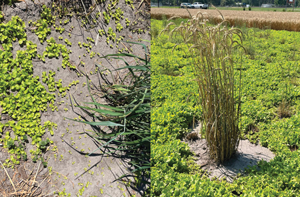
Analyzing the plant material itself or the soil where an allelopathic plant grew to estimate the concentration of allelopathic substances is also possible in laboratory settings, but it’s not common. Evaluating allelopathy in the field, rather than the laboratory, tends to offer a better estimate of how cereal rye would suppress weeds in a farm field. In the field, the Cover Crop Breeding Network (www.covercropbreeding.com) evaluates allelopathy by planting lettuce at a high seeding rate around cereal rye plants. If the plant is allelopathic, lettuce will not grow near the plant, forming either a halo of bare soil around it or a gradient of stunted lettuce plants in relation to their distance from the cereal rye plant (see photo). It is unknown whether results from tests using lettuce will translate to similar allelopathy damage in other crops such as alfalfa.
Many factors involved
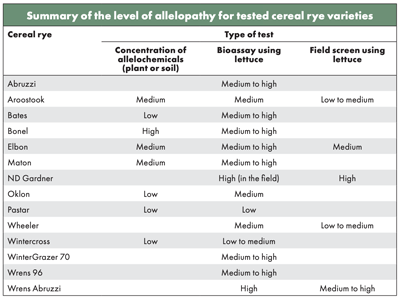
There is no exhaustive list of cereal rye allelopathic varieties; however, we looked extensively through the available literature and came up with a rough list in the accompanying table that summarizes the level of allelopathy for tested cereal rye varieties. This table does not yet have confident data, as not many studies have evaluated allelopathy among cereal rye varieties. Moreover, each study differs in its testing approach, and some methods are less accurate than others.
We emphasize that these tests either measured concentration of allelochemicals or evaluated the response of lettuce — so we cannot say with confidence how primary crops will be affected. More research is needed to understand which varieties of cereal rye produce allelopathy that affects alfalfa, corn, or weed species.
Allelopathy can also vary by soil type, weather, and termination timing, so work is also needed to understand which varieties of cereal rye might be ideal for different types of soil, termination, and cropping systems.
There is limited information available from field work with crops of interest. One study in the Southeast evaluated the performance of 10 alfalfa cultivars established after cereal rye or after no cover crop. In the seeding year, researchers reported a 35% to 64% reduction in the number of alfalfa seedlings and a 5% to 43% reduction in biomass production compared to alfalfa established on fallow land. This variation in response occurred because some alfalfa cultivars appeared to be more sensitive to allelopathy than others. However, when researchers returned to the experimental site in the third year, alfalfa production was similar for stands established after cereal rye or where no rye was seeded, indicating that alfalfa was able to recover from the stress in the first year.
Some bioassays show that allelochemicals from cereal rye can reduce germination of weeds, particularly broadleaf (dicot) species. However, it is important to remember that cover crops also reduce weeds by forming a physical barrier to weed seedlings, shading the soil surface, and reducing the soil temperature. Since cover crops offer various avenues for weed control, it is difficult to identify how much of the weed suppression is specifically related to allelopathy compared to other mechanisms.
Looking for answers
There are many unknowns about allelopathy and its practical use in grain and forage systems. To help understand the implications and applications of allelopathic cover crops, a collaborative effort between University of Wisconsin-Madison and the U.S. Dairy Forage Research Center (ARS-USDA) is underway with field trials to investigate the effect of allelopathic cereal rye varieties on alfalfa and corn grain performance.
The team of researchers is also using a nonallelopathic cover crop in their studies to see if weed suppression and cash crop performance are being affected simply by the presence of a cover crop, or if an allelopathic cover crop is impacting changes in yields. Additionally, we are evaluating different termination strategies to identify practices that may reduce or intensify allelopathic effects.
This article appeared in the February 2026 issue of Hay & Forage Grower on page 16-17.
Not a subscriber? Click to get the print magazine.