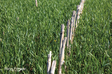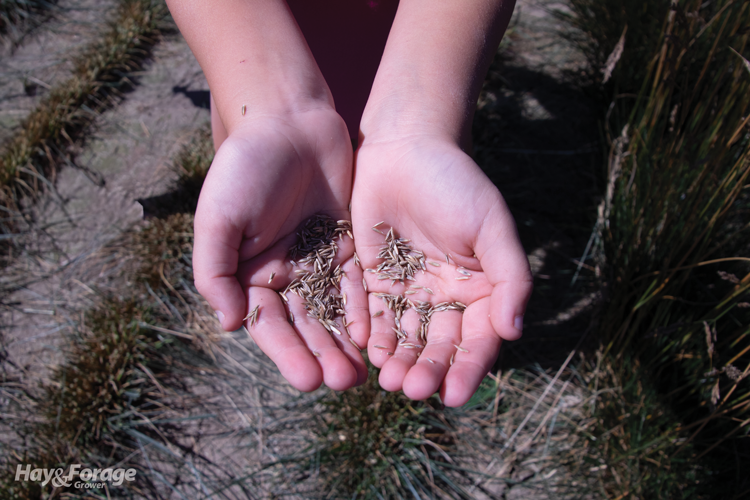
Dave Goracke owns and operates Cala Farms Inc. with his wife, Lisa, on the outskirts of Shedd. Forage grass seed is the farm’s number one product, and using regenerative practices to protect soil health is Goracke’s number one priority.
Unlike most hay and forage growers who typically cite unruly weather as their biggest challenge — drought-stressed plants, moisture-induced harvest delays, and rained-on hay — grass seed producers in the Willamette Valley are usually granted sunny skies during their summer harvest season, considering their position between the Cascade and Oregon Coast Ranges.
“Our distinct rain season, dry summer, and low humidity make it the perfect environment for seed harvest,” said Goracke, who is the first vice president of the Oregon Seed Council. “We don’t typically have to dry our seed. Mother Nature does that for us.”
That distinct rain season is between September and June, with the majority of their 45-inch annual precipitation falling between December and April. This provides dry forecasts when cutting starts in late June and prevents swathed forage from being rained on before grass seed is combined in early July. Grass seed harvest is usually completed by mid-August.
“Our rule of thumb is always combining 10 days after cutting. With western Oregon weather, I don’t even test seed moisture — we just go,” Goracke said. “If we do get a rain, it might keep us out of the field for half a day to a full day, but it’s not typical.”
Goracke produces tall fescue and annual ryegrass seed on about 2,500 acres. Additional acres are planted to various other forage crops, such as white clover, hairy vetch, chicory, and brassicas like mustard, kale, and radishes, which are also harvested for seed.
His crop rotation begins with an annual forage seeding before he establishes annual ryegrass and tall fescue. Volunteer seeding from annual ryegrass sustains those stands for two to three years, whereas tall fescue fields stay in seed production for several. Goracke accounts for varied soil conditions during stand establishment, assigning annual ryegrass to wetter ground and planting tall fescue in well-drained soils.
Big on soil health
Goracke knows he’s playing the long game when it comes to restoring soil health in the grass seed business. Even so, his passion and patience for regenerative practices have yielded positive results, even if those practices are not status quo.
“We are a little different than the rest of the industry because we return pretty much all of our straw back to the farm. We have been doing that for more than 30 years,” Goracke said.
After combines spread the chaff, the harvest crew makes another pass over it with flail choppers to level residue on the soil surface and expedite decomposition. Doing so not only limits habitat and breeding ground for the region’s most prolific forage pests — voles and slugs — but it has also reinforced soil health and stand resilience.
“We are seeing some distinct soil-building qualities from leaving our residue out there. The only thing we are removing is the seed,” Goracke said. “The soil moisture we are conserving by having that organic matter on the ground is really helping, especially as we are seeing more dryness than usual in late spring into June.”
In the past, it was common practice to burn straw, but after a severe smoke accident on Highway 15 in the late 1980s, farmers sought other solutions to manage forage residue. Some started chopping and plowing straw into fields while others began baling it. But straw bales that are removed from a field take soil nutrients along with them, and Goracke believes the value of those nutrients is too important to part with.
“I look at the soil as more than just a growing medium — it’s really the life of what we are growing,” he asserted.
Along with leaving residue, Goracke implements no-till seeding on about 75% of his acres. “Some of the really small seed — like clover and some of the brassica species like kale and mustard — get planted into tilled ground,” he said. “They just don’t have the energy to get out of the ground and up through all of the straw residue that we have to plant through.”
Another no-till advocate
Orin Nusbaum feels similarly about no-till for soil health, as well as for cost savings. The sixth-generation grass seed farmer implements no-till in his annual ryegrass fields every other year but has long-term goals to phase tillage out more completely. In addition to annual ryegrass, the Nusbaums grow tall fescue and clover seed on 2,500 acres across land that is owned, rented, or cooperated with the William L. Finley Wildlife Refuge near the small town of Bellfountain, which is only a short drive southwest of Shedd.
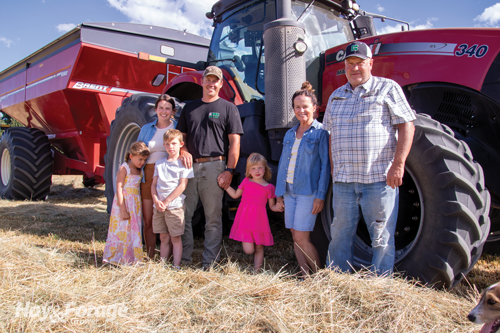
“My tolerance for burning diesel fuel for tillage is just not what it used to be — the cash register in my head is running any time we use a tillage tractor,” Orin said. “No-till is just better for the soil.”
Orin farms alongside his parents; his wife, Mandy, who operates a combine; and his 17-year-old son, Van, who is the chief bankout wagon driver. Other members of the crew include family, friends, and members of the community who are available and eager to log long hours in the field when it’s go-time for grass seed harvest.
Annual ryegrass comprises about two-thirds of the Nusbaums’ total acreage. Tall fescue is the next largest slice of the grass seed production pie, followed by white clover, and a small percentage of their land is used for rotation crops.
“We don’t grow any turfgrass seed — it’s all forage,” Orin said. “Forage is our comfort zone.”
An affinity for 100% forage seed is partly due to their production preferences, and partly due to their marketing strategies. The Nusbaums used to market all of their seed to Willamette Valley dealers, who then sold product to retailers primarily in the Gulf States. Despite the convenience of this system, the Nusbaums felt a void without any connection to their end-consumers. So, they began selling forage seed directly to co-ops and independent dealers down South, which has opened doors to better business relationships and has saved them a few extra dollars in lieu of a middleman.
“It’s been a neat thing to get to know some of our customers on a personal basis,” Orin said. “Over the years, we’ve taken trips to Texas, Mississippi, Louisiana, Alabama, and Georgia to stop and talk to people one-on-one rather than just knowing them by a shipping label.”
Baling straw, bagging seed
The Nusbaums hire the co-owned Boshart Trucking and BOSSCO Trading companies to custom bale and market the majority of their grass straw to export countries like Japan and South Korea. At the same time those rakes and balers are busy gathering straw in the field, seed is being cleaned and bagged at the cleaning facility on the home farm.
“The four weeks or so of harvest is what drives our company for the rest of the year,” Orin said.
The family recently installed a palletizer to expedite their cleaning process. After seed is cleaned and bagged, those bags ride a conveyor belt to the top of the machine and are stacked onto pallets like Jenga blocks. Since the layer palletizer was installed, their crew is able to bag the same amount of seed across three, six-hour shifts per day instead of operating around the clock like they used to.
“We clean all of our own seed, unless there are varieties that specifically need to be cleaned in a certain way,” Mandy explained. “We have a lot of good employees here — we’ve got good longevity,” she added.
Cleaning seed at C&L Farms
C&L Farms is yet another nearby grass seed operation stationed in the Willamette Valley that is a mere 10-minute drive southeast of the Nusbaums outside the town of Monroe. After graduating from Oregon State University and working in the industry at a corporate level, Emily Woodcock and her husband, Brian, returned to the home farm where they both work today. Instead of a conventional palletizer at the end of their on-site seed cleaning system like the one at Nusbaum Farms, they have a robotic one that picks bags up with a clawed arm and arranges them on pallets, which is much more efficient than stacking the 50-pound sacks by hand.
Emily is the fifth generation on C&L Farms, which has a history in vegetable crop production. But when industry demand changed and canning facilities relocated in the 1990s, the family shifted their focus to tall fescue seed for both the forage and turfgrass industries.
“Farming has always been a part of my life,” Emily said, recalling her high school summers spent driving a combine during grass seed harvest. Now, when harvested seed arrives at the home farm, it is dumped into one of several bays outside the cleaning facility according to crop variety. Then, seed gets scooped into the pit.
“From the pit, it goes up the elevator and then it runs through the feed roll, which just spreads it out evenly throughout the machine. That is basically what the combines do, but at a finer level — it’s separating the seed and everything else out by size and weight,” Brian explained from the cleaning facility floor.
“There are a bunch of different screens in there — some are scalping, so the seeds will fall to the bottom and the debris will run off the top, and other screens are sifting, so the seed runs off the top and the small stuff runs to the bottom,” Brian continued. From there, the seed fills bags stamped with lot numbers, gets stacked onto pallets by the robot, and is stored in one of the farm’s warehouses before it is shipped across the country.
So, the next time you rip off the top of a grass seed bag and pour its contents into your preferred piece of seeding equipment, consider where those seeds came from. Producing grass seed is a mighty undertaking to maintain the forage industry at large, but it really is a small grass seed world.
This article appeared in the February 2026 issue of Hay & Forage Grower on page 22-25.
Not a subscriber? Click to get the print magazine.