Little is known about insect-transmitted viruses’ effects in alfalfa. Erik Wenninger, an extension specialist and Integrated Pest Management coordinator at the University of Idaho, set out to address that gap by examining how virus pressure, insect vectors, and insecticide use interact, and whether managing vectors makes economic sense for alfalfa farmers. Apekshya Senchuri assisted him on this project as part of her master’s degree thesis.
“Alfalfa serves as a sentinel crop for pathogen accumulation,” Wenninger explained. “It is grown over multiple seasons and cut several times each year, which can influence insect movement and pathogen spread.”
Despite these characteristics, insecticide applications in alfalfa are rarely targeted specifically at managing virus transmission. Wenninger found limited prior research evaluating how viruses affect alfalfa yield, forage quality, or whether managing insect vectors could provide measurable benefits.
Aphid-vectored viruses, including alfalfa mosaic virus (AMV), bean leafroll virus (BLRV), and pea streak virus (PeSV), are known to infect alfalfa. Moreover, Snake River alfalfa virus (SRAV) was a previously undocumented virus they found to be prevalent in some Idaho fields. Subsequent surveys showed the virus was widespread across the Pacific Northwest.
The primary objective of the study was to determine whether reducing insect vectors could lower virus infection and improve alfalfa yield or forage quality. Over two growing seasons, insecticides targeting aphids and thrips were applied throughout the season and compared with untreated check plots.
Weekly stem samples were collected to monitor aphid and thrips densities, which were used to guide insecticide application decisions. Yield and forage quality were measured across multiple cuttings, and the prevalence of AMV, BLRV, PeSV, and SRAV was evaluated each year.
The research was conducted over two years using newly seeded alfalfa planted each year, with the first year’s seeding also evaluated during the second year. In addition to field trials, greenhouse experiments were conducted to evaluate whether western flower thrips could transmit SRAV. Their previous work detected SRAV in thrips, suggesting these insects might be involved in transmission of the virus.
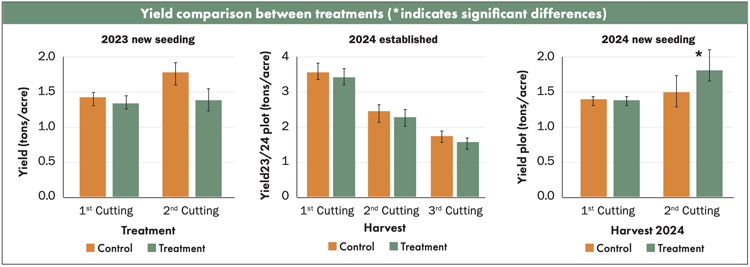
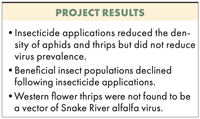
Insecticide applications reduced the densities of aphids and thrips in treated plots, but the effects were short-lived. More importantly, lower vector populations did not result in reduced virus prevalence, nor did they improve alfalfa yield or forage quality.
“It was surprising that even with a proactive insecticide program targeting vectors, we were not able to reduce the prevalence of insect-vectored viruses,” Wenninger said. “At least during the first two years, alfalfa appeared to tolerate insect pest and disease pressure without measurable effects on yield or quality.”
Practical implications
Another key finding was the impact of insecticide use on beneficial insects. Predators and parasitoids declined following insecticide applications, raising concerns that repeated treatments could disrupt biological control and raise the risk of secondary pest outbreaks.
Greenhouse studies did not support the hypothesis that western flower thrips are a vector of SRAV. Both inoculated plants and thrips tested negative for the virus, suggesting thrips are not responsible for SRAV transmission. From a management perspective, the results suggest that targeting insecticide applications solely to manage virus vectors in alfalfa may offer limited economic benefit. While insecticides temporarily reduce the populations of aphids and thrips, those reductions did not translate into improved crop performance.
“Our study showed no benefit in terms of yield, quality, or virus prevalence from managing aphids and thrips with insecticides,” Wenninger noted. He cautioned that insecticide use can disrupt beneficial insect communities, and thrips and aphids can rapidly recolonize treated fields. However, insecticide applications may still be justified when pest densities reach levels that cause direct damage.
This two-year project has concluded, but Wenninger sees value in longer-term research. Evaluating virus prevalence and severity over a typical four- to five-year alfalfa rotation could help clarify whether virus pressure contributes to gradual yield decline or stand persistence issues as alfalfa ages. “Not surprisingly, we generally see higher virus prevalence in older fields, and this pathogen accumulation might contribute to stand decline over a longer time frame,” Wenninger added.
A full copy of the final report can be found at alfalfa.org.
This article appeared in the February 2026 issue of Hay & Forage Grower on page 26-27.
Not a subscriber? Click to get the print magazine.