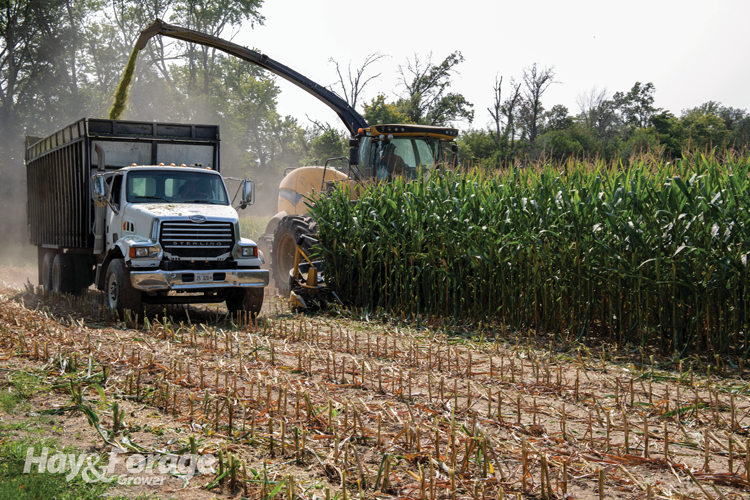
I have been asked what ideal corn silage looks like quite a few times over the past 15 years. With dairy and beef producers feeding greater amounts of corn silage to their herds, yield and quality are increasingly important to a farm’s bottom line. Hence, it’s logical to spend more time and effort understanding what comprises ideal corn silage and how to value the feed.
In 2024, the University of Wisconsin updated the MILK equations for corn silage evaluation to include the latest National Academies of Sciences, Engineering, and Medicine (NASEM) dairy diet energy model. Using test silage in a total diet model, the MILK2024 projects corn silage milk yield potential per ton and per acre. The model is responsive to current feed analysis measures, and then the user is presented with a theoretical milk yield output per ton or per acre of silage.
The milk yield prediction presents a few challenges. One is understanding how the silage may affect beef producers’ output. Further, milk yield potential may not always be the best silage evaluation metric for dairy producers. Moreover, different market conditions can affect how we value silage.
Intended consumer
As dairy and beef farms grow larger and may specialize in different stages of the cattle’s life cycle, the ideal corn silage for these operations can vary widely. Dairy farms tend to value and seek greater calorie density and high fiber digestibility in their corn silage for lactating cows. However, heifers and dry cows have different ration and nutrient needs, with functional fiber and less starch being desirable in many cases. The ideal silage for heifer farms and transition cow facilities will be the high-yielding hybrids with above-average fiber digestibility, but not necessarily the hybrids with the highest starch and grain yield.
Beef producers also seek different attributes in their corn silage relative to dairy farms. Finishing cattle are fed high-energy, starch-rich diets at feedyards. Corn silage can fit in these diets as roughage, with the ideal silage bringing functional fiber along with excellent grain yield. For backgrounding rations with more forage, above-average corn silage fiber digestibility can often bring added value to the ration and put these cattle in a better position to gain.
Commodity market
There are different commodity and ingredient market conditions that can shift how we value silage. For example, with high corn prices, the grain and starch value in corn silage can carry an oversized value relative to the fiber. Alternatively, if corn is cheap but digestible fiber sources such as premium hay, soy hulls, or almond hulls are expensive, then the fiber carries more value.
Commodity and nutrient market conditions will shift across the different regions of the U.S. and over time. We can’t adjust silage value monthly; however, our definition for ideal corn silage can reflect longer term market trends by assigning an economic value to the digestible starch and the digestible fiber within corn silage, if warranted.
Land and water
The cropping side of dairy or beef farming can change how we define ideal corn silage. If water is a concern — not to mention an expensive one — yield and water-use efficiency become increasingly important. Hybrids that offer excellent nutrient density per ton but lag in tonnage often aren’t even an option. This has been the case for brown mid-rib (BMR) corn for Southern and Western growers.
Limited cropland can also redefine the ideal corn silage. If your dairy is short on land, the ideal silage likely becomes the one that yields the most digestible nutrients per acre. We often need to double or triple crop to optimize the calories harvested per acre each year. Then, the ideal silage is not only the one that yields the most digestible nutrients per acre, but may also be one that responds well to later planting.
Don’t forget about seed and crop costs. I’ve been coaching producers to not only value corn silage digestible nutrient yield but to also consider production costs per acre. Just like we optimize feed costs per hundredweight, we can improve our bottom line by evaluating and reducing the cost per ton of digestible nutrients in our silage.
Lastly, remember that the ideal corn silage must be hygienically clean. There is less room for error in cattle health with today’s margins. Recognize that disease resistance and crop protection are important components to ideal corn silage for your operation.
This article appeared in the February 2026 issue of Hay & Forage Grower on page 30.
Not a subscriber? Click to get the print magazine.