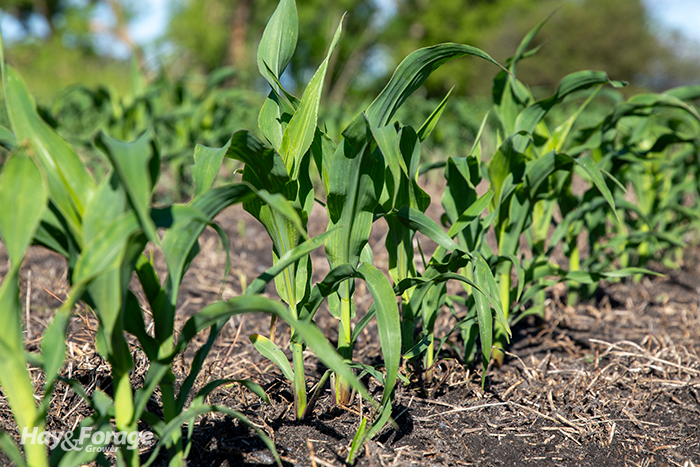
Brown midrib (BMR) corn has been a key player in the starting lineup of many dairy farmers’ feed crop rotations. But now that BMR hybrids are being called off the court and phased off the market, farmers will have to sub in a bench warmer.
Two of those potential substitutions are high-cut corn silage and short-corn hybrids. Both have potential to reduce lignin concentrations and boost fiber digestibility in total mixed rations (TMR); however, neither fully match the quality attributes of BMR corn silage.
At last week’s Midwest Forage Association Symposium, Luiz Ferraretto with the University of Wisconsin-Madison explained the advantages and disadvantages of raising the chopping height in conventional corn and planting short corn hybrids for silage. But before a different game plan can be drawn up, Ferraretto said farmers must understand the significance of fiber digestibility and why BMR corn silage excelled from a nutritional standpoint in the first place.
Slam dunk digestibility
A five-year study of BMR corn silage grown across the United States showed that in vitro neutral detergent fiber digestibility after 30 hours (ivNDF30) was about 7 percentage units higher than conventional hybrids, and historic data suggests that can range up to 10 percentage units. On the flip side, BMR corn silage routinely ranked lower for undigested NDF after 240 hours (uNDF240), which is a key metric used to formulate and balance dairy rations.
“That’s why we care about BMR,” stated Ferraretto, a ruminant nutrition extension specialist. The cows care, too. When fiber digestibility improves, so does animal intake and energy-corrected milk production. According to a review of BMR corn silage feeding trials, on average, four out of six trials resulted in an uptick in intake, and 100% of the long-term trials showed higher milk production.
“It’s hard to compete with that from a production performance perspective,” Ferraretto said. However, low yields and lodging issues are two of the agronomic trade-offs of BMR corn, in addition to lower starch concentration in silage.
“Long story short, BMR is a great tool to improve fiber digestibility and increase intake and performance, but you need to be able to afford having less starch and lower yield,” Ferraretto said.
High-cut corn
Without that tool, Ferraretto said the options to boost fiber digestibility in silage depend on harvest maturity and/or management. Farmers can either chop silage sooner to limit total lignin concentration, or raise the chop height to eliminate the lower, less digestible portions of the stalk.
“When we increase chop height, all we are leaving in the field is extra stalk — maybe we are leaving one leaf,” Ferraretto said. “We are diluting the undigestible material and consequently have more fiber digestibility in the silage.” The question is, how much more?
It depends, Ferraretto said, and there is limited research on feeding high-cut corn silage to refer to. Even so, an added benefit of raising the chop height in conventional corn compared to BMR silage is that farmers capture higher starch concentrations and greater energy density since kernels comprise a larger percentage of the harvested plant. But the trade-off of lower yields still exists.
“I’m not trying to convince you that raising the chop height is not a good thing. I think it’s quite good, but it’s not BMR,” Ferraretto said. “It’s different, and farmers have to realize that.”
Short corn
Short corn silage may be another option. “Basically, short corn has potential to have higher NDF digestibility because of the shorter internodes,” Ferraretto said.
He collaborated with Italian researchers to evaluate milk production and animal response when cows were fed short corn silage versus conventional corn silage. In the study, dairy rations contained about 40% corn silage, and nutrient analyses showed NDF digestibility (NDFD) and starch were slightly higher for short corn. Those numbers resembled BMR silage analyses, Ferraretto said.
“The question is, are cow responses similar to BMR? The answer is no,” he asserted. Total milk production still improved when cows were fed short corn silage, but there was not a statistical difference in feed intake. Therefore, Ferraretto purported there is a different biological mechanism responsible for the results.
One important difference between the treatments in the study was that conventional corn was planted at a rate of 32,500 seeds per acre, whereas short corn was planted at a rate of 54,600 seeds per acre.
Ferraretto also collaborated with the Italian researchers to compare silage nutrient values of two conventional hybrids and three short corn hybrids. “What’s intriguing is that in vitro NDF digestibility was higher, and uNDF was lower, and we are seeing more starch,” Ferraretto said about the short corn hybrids. “If I stop here, you might think short corn is a great thing, but that’s not what I’m saying. It’s very promising, but we have a lot to learn about it,” he stated.
Overall, there is not a one-to-one replacement for BMR corn, and any alternative will have trade-offs. “Everything we can do to change fiber digestibility in corn silage reduces biomass that you bring to the silo. There is nothing out there that can increase fiber digestibility and keep — or increase — biomass,” Ferraretto said.