The author is a dairy nutrition consultant with GPS Dairy Consulting LLC, and is based in Malone, Wis.
IN 1996, Dolly the sheep was cloned, Google was launched, and Cargill Seeds introduced its first brown midrib (BMR) corn hybrids for silage. At that time, BMR corn for silage was an outlier, a genetic mutant that dramatically enhanced fiber digestibility.
The high price of seed and the compromised agronomic traits (yield, standability, and susceptibility to disease) slowed the early adoption of BMR corn and has remained an Achilles heel since then. But many nutritionists —including me — and dairy producers find immense value in feeding BMR corn silage to high-producing cows. The improved fiber digestibility leads to higher intakes and subsequently greater milk production — often as much as 4 to 7 pounds per cow per day. It has been a staple in many dairy herds for more than two decades.
The recent slow “death” of BMR was dramatic but not entirely unexpected. In 2025, the primary supplier of BMR hybrids announced it would end its availability by 2030. Declining sales and a lack of appetite for marketing BMR corn led to this demise; however, it did outlive Dolly the sheep by 25 years.
Three decades from BMR’s inception, we now find ourselves in an age of artificial intelligence (AI), quantum computing, and short-statured corn.
Wait, short corn?
Looking for answers
Many BMR enthusiasts have been forced into “gut check” mode. What will replace BMR? My general recommendation for producers has been to experiment with other hybrids on their farms. Continue growing BMR until the seed is no longer available but use the next four years as a period of exploration to evaluate other options. While continuing to grow BMR, I tell them to plant 10% to 25% of their acres to other hybrids, then evenly spread that silage in the BMR pile.
There are many questions that need to be asked to avoid reaching a flawed conclusion. These include:
1. Will the hybrid perform in drought and wet conditions?
2. How does the hybrid perform on various soil types?
3. Was this an outlier year? Are the results repeatable?
4. How does fertilization and disease pressure affect the hybrid?
An overriding challenge is the criteria to evaluate hybrids. Some seed companies want to use a single blanket criteria. A common metric that some like to use is milk per ton. I am not a fan of this metric. Using milk per ton, you usually end up with a hybrid that is really high in starch. Even if fiber digestibility is close to bamboo, a hybrid may still rank high.
So, how do we choose?
I still value fiber digestibility and like to use neutral detergent fiber digestibility at 30 hours (NDFD30) and undigested NDF at 240 hours (uNDF240). Better fiber digestibility leads to more milk — but I don’t want to ignore starch or yield per acre. The low starch values in BMR really hurt during periods of high corn prices, and that situation a few years ago might have been the proverbial nail in its coffin.
So, what do I want? Balance — a hybrid that is in the top 25% for NDFD30 is my starting point. Next, it needs to be above 34% starch and yield in the top 30% of hybrids.
A new option
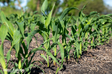
Short corn is another genetic mutant, a brachytic gene that results in a plant with shorter internodes. Essentially, you get the same number of leaves and — hopefully — the same grain ear in a more compact plant. This development was pushed along dramatically in the past couple of years in response to derechos that caused severe corn lodging across Iowa. Grain producers hope to maintain yield with better standability, especially after a wind storm.
The data on short corn for corn silage is limited. One recent trial from Michigan State University offered some promise for short corn as a forage resource. The whisper is that it might be better than conventional corn silage but not quite as good as BMR. A shorter, thicker stalk is expected to result in less lignin and better digestibility than conventional corn.
Nutritionists do listen to whispers — and we whisper to producers, “Hey, maybe try a bit of this short corn; let’s see what it does.”
One of those listening was Wayside Dairy in Greenleaf, Wis., which is co-owned by Jesse Dvorachek. The last couple years he has been putting in a corn plot with several hybrids. Each 0.8 acre-variety plot was harvested individually, weighed on a truck scale, and sampled in triplicate. The triplicate sample was critical to avoid an outlier and an unrealistic result for any one hybrid.
In the table are the results from Wayside’s 2025 trial, ranked by fiber digestibility. Brown midrib hybrids topped the list, which was not unexpected. But I was surprised by the short corn. Those hybrids finished in the top 50% for fiber digestibility, starch, and yield, which is encouraging. The short corn was planted at 38,000 seeds per acre on the recommendation of the seed company. It was a fantastic year for corn silage. Yields across northeast Wisconsin were up 20% due to exceptional growing conditions.
Conclude with care
How do we interpret this type of data and what conclusions do we make?
First . . . don’t convert 100% of your acres to short corn based on one plot year. What happens when the weather is dry? Will even “shorter” drought-stressed corn go through a chopper?
These were mostly experimental short-corn hybrids that may not be commercially available. I suspect the specific commercial hybrids will be quite different and not all perform similarly (as is the case for BMR corn hybrids). Other companies will come out with slightly different short-corn hybrids with higher-placed ears. Maybe these will be preferred for corn silage. Would the quality be better if they were planted at a lower population? How would this effect yield? Answers are still to come.
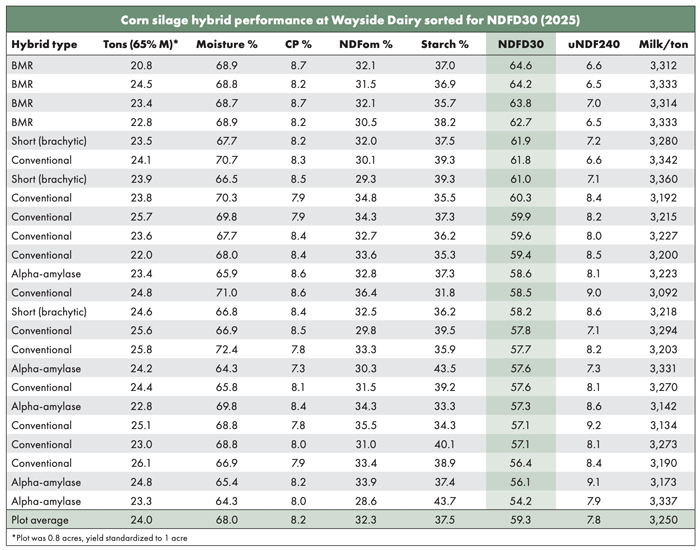
Farm plot data is not research. It usually doesn’t have enough replication to pass the scientific standards of academia, but it is farm specific. Most seed trial data is done across a broad region and doesn’t always apply to a specific geography. On-farm testing can give you insights that are not achievable in any other way. There are conventional hybrids that also perform well. I am hopeful that there is a renewed focus on corn silage quality and hybrid selection by many seed companies.
For Wayside Dairy, next year might include another plot and likely 10 to 20 acres of short corn planted at variable densities. Most innovation is a step-by-step process. In 30 years, when we look back at 2026, will short corn be the next BMR, or will it disappear like Dolly? I don’t think even Google or AI currently knows the answer.
This article appeared in the March 2026 issue of Hay & Forage Grower on page 12.
Not a subscriber? Click to get the print magazine.