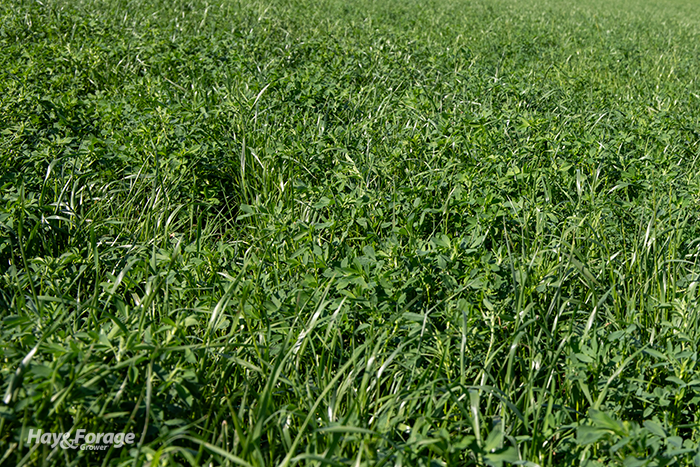
Alfalfa generally gets along just fine when seeded alone, but adding a perennial grass dance partner offers some benefits, especially on soils where pure alfalfa stands are challenged by drainage or fertility. Even where this isn’t the case, a little grass may also offer some feeding advantages.
At last week’s Midwest Forage Association Symposium, Josh Gamble outlined some of the benefits of seeding alfalfa-grass mixtures. The USDA Agricultural Research Service scientist based in St. Paul, Minn., first noted the agronomic perks of a mixed stand.
“You tend to get better seasonal yield distribution with alfalfa-grass mixtures,” Gamble noted. “Grasses also offer a wider window for harvesting on second or later cuttings. Most cool-season grasses won’t head out after the first cutting, and we also typically have faster dry down when grasses are included with alfalfa.”
Additional agronomic benefits for seeding grasses with alfalfa include the former’s ability to better tolerate saturated soils and wheel traffic. Grasses also help protect the alfalfa from winter injury and excessive pest pressure. Gamble cited research showing that grasses helped to reduce the populations of both alfalfa weevil and potato leafhopper.
“When you have grasses in the mixture there is a lot more root biomass,” Gamble said. “The fibrous grass roots help to improve soil health. In one recent study, soil carbon in an alfalfa-tall fescue mixture was shown to be higher than where alfalfa was grown in monoculture.”
Feed value enhanced
Beyond the agronomic benefits that grasses provide, Gamble noted there are feeding advantages as well. Although grasses have a higher total fiber concentration than alfalfa, it is more digestible. This results in a feed that is higher in neutral detergent fiber digestibility (NDFD), which enhances intake.
It doesn’t take a lot of grass to realize the feeding benefits of the more digestible forage. Based on research from Cornell University, as low as 5% observed grass in a mixture will raise the NDFD by 1 percentage unit. Both the grass species and variety chosen can be important, but whatever grass is seeded, the optimum harvest maturity must be matched with alfalfa. For example, don’t choose an early heading orchardgrass.
Grasses also have the potential to reduce nonfibrous carbohydrates (NFC) in dairy rations. This is especially beneficial in high-corn silage rations where rumen acidosis is a concern.
Making it work
Nick Fitzgerald is a dairyman from Newton, Wis., and helps operate Soaring Eagle Dairy along with other family members. The dairy milks 1,300 cows and farms 2,300 acres. They produce corn silage, corn grain, alfalfa, and soybeans.
Following Gamble’s presentation, Fitzgerald explained that their farm consists of heavy, wet clay ground where alfalfa struggles to persist. Through the years, winterkill was a common occurrence.

“After years of low forage inventories and frustrations, our agronomist put in a field plot of different clovers and grasses to test performance and feed value,” Fitzgerald explained. “We found that some of these species compared favorable to alfalfa.”
These days, Fitzgerald seeds 15 pounds of alfalfa, 3 pounds of Bearcat red clover, 2 pounds of Legacy white clover, and 60 pounds of forage oats per acre at seeding. The initial cutting is harvested for dry cows or heifers, and then the oat regrowth is terminated. After taking the third or fourth cutting during the year after establishment, 2 to 3 pounds of meadow fescue seed is drilled into the stand.
Fitzgerald is pleased with the current system. He cited the benefits as having thicker stands with improved yields and quality, having longer-lasting stands, and having more plant diversity. He also noted that the thicker, more diverse stands are more challenging to dry after cutting.
Yields at Soaring Eagle the past three years have averaged over 6 tons of dry matter per acre on five cuttings, which was over a 1-ton improvement from their former all-alfalfa fields. Fitzgerald noted that many of his neighbors have begun a similar program and that seed suppliers in the area are now willing to provide mixed and bagged mixtures based on customer preferences.