Winter cereals are grown for a variety of agronomic and nutritional reasons. Moreover, cereal silage is utilized as feed for just about every large ruminant animal type and class, but no group demands a higher quality than the high-producing dairy cow.
If winter cereals are being used to meet the nutritional demands of early lactation cows, harvest timing is nonnegotiable, according to Tom Kilcer. The independent crop consultant and former Cornell Extension crops and soils educator has done extensive research with winter cereals throughout his long career of advising farmers.
“For high-producing cows on high-forage diets, harvesting winter cereals in the boot stage is about a week too late,” Kilcer asserts. “You want to harvest at the flag leaf stage for optimum quality while still achieving high yields. At this stage, the head is only about 1.5 to 2 inches down from the top of the stem. It is better to be too early than too late to produce forage for the high-group dairy cow.”
For farms with a lot of winter cereal acres, hitting the narrow harvest window can be a challenge, and Kilcer offers some guidance. “The earliest planted fields will be ready first. A week earlier planting in the fall gains three days earlier harvest in the spring. Cereals planted on south-facing, well-drained soils will be ready sooner than north-facing, poorly drained soils. You can open the harvest window further by planting an early maturing variety first and a later-maturing variety later,” he adds.
Cut a wide swath
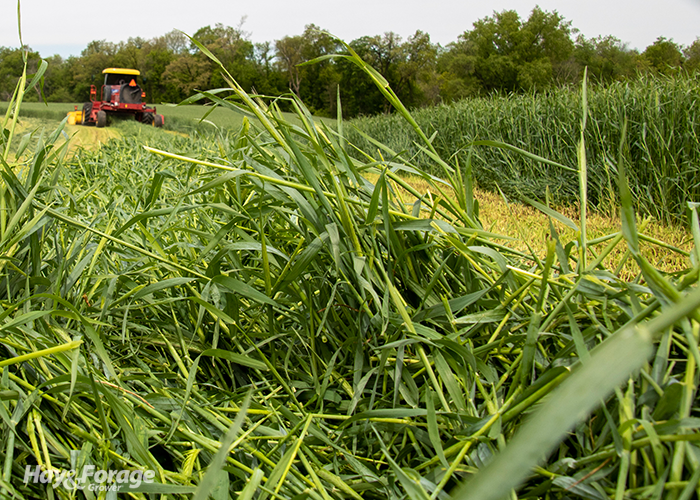
Kilcer notes that optimum quality doesn’t start and end with the harvest maturity. A fast dry down is needed to preserve valuable sugars in the crop. To achieve this, he implores growers to lay a wide swath when cutting. Winter cereals, even at the flag leaf stage, can yield 3 to 4 or more tons of dry matter per acre. Spreading that mass of forage as wide as possible exposes the greatest amount of cut forage to sunshine and enhances drying.
“Photosynthesis simultaneously dries the crop and increases the digestible components of the forage,” Kilcer explains. “Rear shields on some mowers will need to be raised or removed to achieve the widest swath possible. There is no need to use conditioners when making winter cereal silage.”
About two hours after cutting, the top of the swath will be dried while the lower portion will still be wet. For this reason, Kilcer advises running a tedder over the crop. This will restart the drying process — but be careful that the ground speed isn’t creating nondrying lumps in the swath. Some tedder types are less prone to creating lumps than others. The goal is to simply invert the swath.
Once winter cereal silage has dried to an acceptable moisture, which is usually considered below 70%, Kilcer advises growers to chop at a minimum ¾-inch cutting length, with 1 inch preferred. “Cutting at this length will have a major impact on reducing or eliminating leachate,” he says.
Finally, the crop consultant encourages applying a homolactic inoculant, which will use the crop’s sugars for rapidly dropping the pH to below 4. This will help curtail the growth of spoilage organisms.