The author is a dairy scientist at the U.S. Dairy Forage Research Center in Marshfield, Wis.
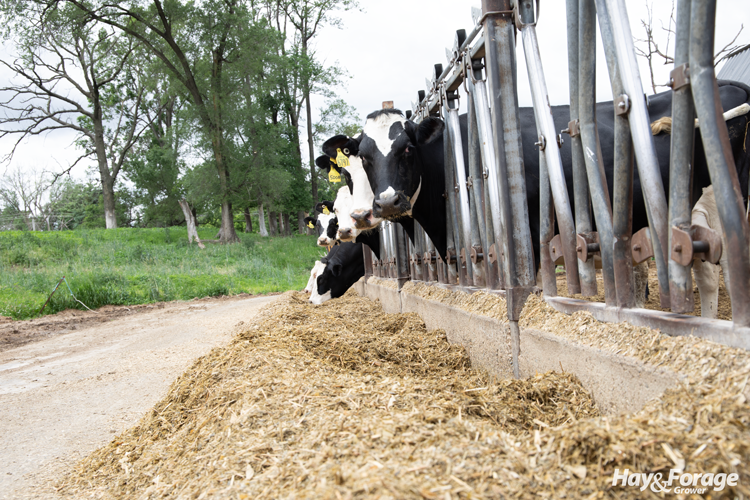
Baled grass or alfalfa silage requires similar management to chopped silage for optimal fermentation and stability during feedout. Both need proper moisture at harvest for bacterial fermentation, good packing density to remove air, and a well-sealed silo or wrapped bale to effectively inhibit air entry.
The use of inoculants is also common for chopped silage to improve fermentation efficiency with homolactic bacteria, and to reduce heating at feedout using heterolactic bacteria such as Lactobacillus buchneri. However, inoculant use in baled silage is fairly limited for several reasons, including cost, application equipment needs, and the slower, more limited fermentation of baled silage that may hinder the usefulness of inoculants to improve fermentation.
Little research
There are limited data that show inoculant effects on baled silage fermentation. On one hand, data from Florida show benefits of applying bacterial inoculants and fibrolytic enzymes to bermudagrass with improved fermentation, longer stability after opening, and reduced neutral detergent fiber (NDF) concentration.
On the other hand, data from Georgia was not as conclusive, with a homolactic and heterolactic inoculant applied to alfalfa and bermudagrass baled silage not showing an effect on fermentation. Therefore, there are still unknowns of the utility of bacterial inoculants in baled silage.
To address the limited work with inoculants on baled silage, and to demonstrate the potential use of inoculants to improve fermentation in forages at risk of clostridial fermentation, we conducted a study using a combination inoculant, for which the homolactic bacteria was Lactococcus lactis and the heterolactic bacteria was Lactobacillus buchneri. We applied this on a baled grass-legume forage, which was comprised of approximately 52% cool-season grass and 44% legume, mainly alfalfa.
Researchers applied roughly 6,450 gallons of liquid dairy manure per acre to field plots at different times after harvest to encourage clostridial bacteria on forage and create difficult fermentation conditions. The treatments were no application, application immediately after harvest on forage stubble, and application after one week of regrowth.
We also evaluated how forage moisture levels at baling — ideal moisture at 48% or high moisture at 64% — may interact with the way inoculant impacts fermentation, especially for the high-moisture treatment, which may favor a potential secondary clostridial fermentation.
Fieldwork
Forage was cut in late July 2021 during the afternoon and then allowed to wilt overnight. Baling of the high-moisture bales started in late morning the next day after dew evaporated, and then the ideal-moisture bales were baled the following morning.
All bales were sampled shortly after baling and then wrapped with seven layers of plastic and stored for 100 days before opening in late October. After opening, bales were sampled for fermentation measures and then left open to measure temperature change over 34 days.
Although manure application was intentionally managed to encourage clostridia on the forage, there were low or undetectable clostridia counts. This was likely due to several rain events that occurred after application, which removed manure from growing forage. As a result, researchers found no indications of clostridial fermentation from manure application. An interesting observation for plots with manure applied was that forage moisture at harvest went up due to greater forage mass in the windrow, which slowed drying time compared to the control plots. The higher moisture of forage from manure-treated plots then allowed for fermentation with greater lactic acid concentrations and lower pH.
Fermentation results
The inoculant treatment had limited but positive effects on fermentation (Table 1), with slightly lower pH and higher acetic acid and 1,2 propanediol concentrations compared to the control, which are common results observed when using the heterolactic bacteria Lactobacillus buchneri.
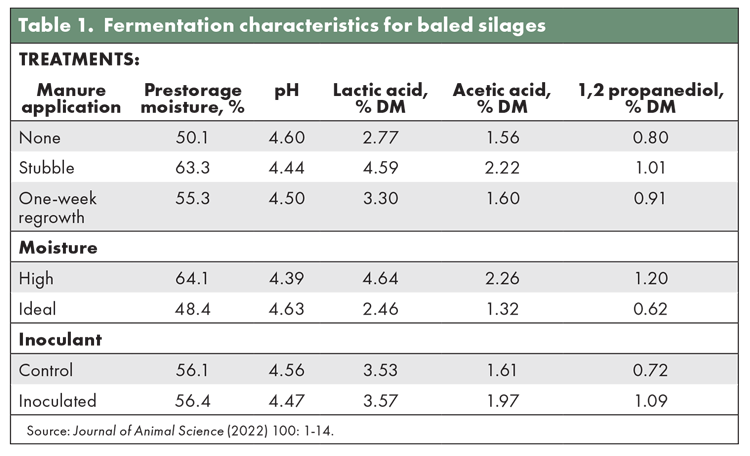
As expected, the high-moisture bales had significantly more fermentation than the ideal-moisture bales with lower pH and higher lactic acid, acetic acid, and alcohol concentrations. Butyric acid was also greater for the high-moisture bales at 0.11% compared to none detected in the ideal-moisture bales, but this was still below the threshold of 0.5% that can affect livestock feed intake.
As a result of the increased fermentation, the dry matter (DM) recovery of the high-moisture bales was down 2.3 percentage units, and there was also a 3 percentage-unit reduction in water-soluble carbohydrates.
Stability after opening
In an effort to test stability during hay feeding periods in the Midwest, bales were opened in late October and tracked through early December. The ambient temperatures were cool, with an average low of 26.2°F and an average high of 43.3°F, which minimized potential microbial activity and heating during the 34-day period.
However, after the aerobic stability test, we did observe the number of high-moisture bales with detectable yeasts in the outer 6-inch surface layer was lower when bales were inoculated (zero bales) compared to the control treatment (five bales).
For the ideal-moisture bales, inoculation didn’t appear to affect the number of bales with detectable yeasts, but it did reduce the level of yeast in the surface layer, which was equivalent to about 25,000 colony forming units (cfu) of yeast per gram for the inoculated bales and 1.25 million cfu of yeast per gram for the control bales.
The suppression of yeast — which often initiates deterioration of stored forage — suggests a potential positive effect that the combination inoculant may have on stability.
Final thoughts
Overall, our research demonstrated that the use of the combination bacterial inoculant in baled silage showed positive results on fermentation and the control of yeast formation after aerobic exposure with potential to improve stability after opening.
However, the manure applications during forage growth did not result in the intentionally planned negative effects on fermentation, so the efficacy of using the combination inoculant to mitigate clostridial activity in baled silage is inconclusive and further evaluation is needed.
This article appeared in the March 2026 issue of Hay & Forage Grower on pages 10-11
Not a subscriber? Click to get the print magazine.