Searching For Organic Hay

Low supply, high prices shrink profits
Photo: Julia Tagliere

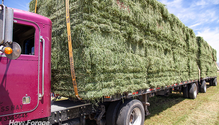
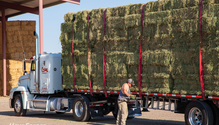
Tim Zweber recently agreed to buy a few truckloads of 150-RFV organic alfalfa hay for a reasonable price. Before the purchase was finalized, however, someone else “bought it out from under me” for $275/ton, he says.

Now this organic dairy producer, of Zweber Farms, Elko, MN, is scrambling to find enough hay to make it through winter.

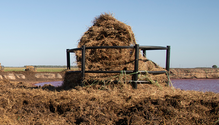
Some of the organic-hay acreage in his area has been converted to row crops, and his usual suppliers are sold out. So he’s buying almost anything he can find, regardless of quality. he bought swampgrass, for example, and first-cutting hay from new seedings harvested after a small-grain companion crop was removed.

“You get a lot of weed growth along with a little bit of alfalfa or red clover or whatever was under it,” he says.

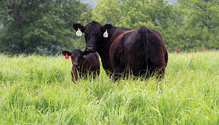
Although the 100-plus-cow dairy herd is their primary enterprise,Zweber and his dad, Jon, also raise beef cattle, hogs and chickens organically and sell the meat direct to consumers. Their strategy has been to buy grain and use their land for growing forages. Yet they expanded the herd without adding land, so they’re buying more of both types of feed.

Traditionally, grain and forages could be bought for a little more money than it cost to produce them, says Zweber. That has changed, and their profit is squeezed.

They sold cows last fall, shrinking the herd to 100 cows, then built it back to 120 cows as heifers freshened. They’re planning to reduce herd size even more this fall.

“I’m glad that we don’t just rely on milking cows for our income,” he says.

Lowell Rheinheimer, farm resources manager for CROPP Cooperative, a large organic dairy co-op, sympathizes with Zweber and other dairy producers. His co-op has increased its members’ pay price by $3/cwt over the last 18 months to offset increased hay prices due to lack of supply.

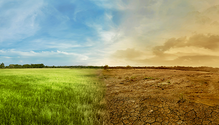
Because of the drought, organic dairy producers who normally grow all their own feed are buying hay, he says. “So we’re really worried about adequate supplies through the winter. I don’t think this is a year when people can be as fussy about quality as they’ve been in the past, and I think they’re going to pay more than they’d like to pay.”

When conventional hay prices rise, premiums paid for organic hay shrink, Rheinheimer says.

“I think the premium has virtually disappeared at the moment. There’s so much demand on the conventional side. And of course, the conventional guys can use organic hay but organic guys can’t use conventional hay.”

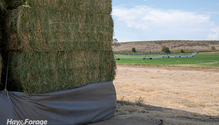
The situation looks better in south-central Idaho, where Lou Andersen grows 6,500 acres of organic alfalfa and barley and annually brokers several thousand tons of additional organic hay.

“We’ve been able to find enough hay for the people I deal with,” says Andersen.

Prices for good-quality organic alfalfa are running mostly in the $220-240/ton range, down slightly from year-ago levels, he says. Organic premiums, at $30-40/ton most of the summer, dropped recently as prices for non-organic hay increased. But they remain high enough to keep growers producing an adequate supply, Andersen believes.

Weeds are becoming an issue in some organic hayfields, so a few growers have switched to Roundup Ready alfalfa. But he doesn’t see much of that happening if organic premiums hold.

The outlook for organic dairies and the hay growers who supply them looks positive for now, but it can change quickly, he says. If the economy continues to improve, consumer demand for dairy products will grow, and more milk and hay will be needed. If it falters, organic milk production will drop and less organic hay will be fed.

“In six months it could be a whole different story we’re talking about,” says Andersen.

Discuss this Article 2

GrowMap
on Jan 17, 2013

In reading your site it appears that growers and dairy owners are unclear on why people like me are willing to pay a premium for organic. We avoid GMO, BGH, and all other man-made chemicals so who is your market for what some on this site refer to as "organic" if you use GMO seed or treat your cows with BGH? I also fail to understand why higher conventional hay prices would reduce premiums for organic hay. My thought would be if you're going to pay hay prices that are 4x higher than they were in 1990 why not spend more and buy hay that is actually organic? Many of us consider GMO alfalfa a nightmare that once unleashed can not be stopped. We will have to either stop feeding it or find growers isolated from commercial farms - which is the same challenge we already have with finding food we are willing to eat. By the time more growers realize how many people have stopped buying commercially produced food, feed, and hay it will be too late for them because all their land will be contaminated with GMO.

GrowMap
on Jan 17, 2013

One other thing. The economy is not improving and can not improve because so many are unemployed and underemployed, but especially because the value of the dollar will continue to decline. Look at what your money buys today. Look at your records on the price of corn, hay, feed, food, fuel and explain how in the world the economy could possibly be "improving".

Consumer demand for organic is growing because more people realize the "food" in the stores is unhealthy. Many are changing their priorities - either voluntarily or involuntarily - and spending more on food and less on everything else. The demand for food grown by individuals and small farms will greatly increase and most won't care about whether it is certified organic or not because the standards are already a joke. GMO and organic are mutually exclusive - except by government standards. When people realize that "organic" foods contain GMO and "organic" dairy contains BGH they will find alternative sources locally in self-defense. Growers really don't understand what buyers want and how many are willing to pay for unadulterated food sources.

Post new comment
Sign In or register to use your Hay & Forage Grower ID
(optional)

Newsletter Signup