There are essentially as many solutions to rotational grazing as there are pastures to graze in. These solutions can vary by forage species, stocking rate, pasture topography, and time of year. The constant factor in all situations is that a larger area is divided into smaller paddocks, which takes some trial and error to get the hang of.
In an article from Ohio State University Extension, Victor Shelton suggests that stockpiled forages and bale grazing are the best solutions for winter grazing in the eastern United States, and the backbone of both of those grazing strategies is temporary fence.
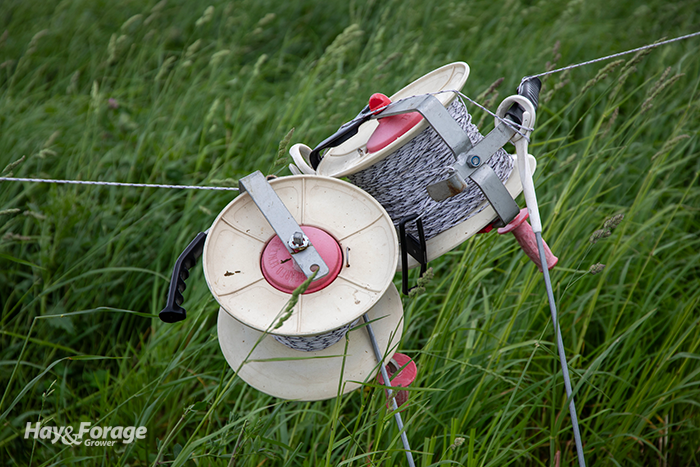
“Temporary fencing continues to make both stockpile grazing and bale grazing more efficient,” writes Shelton, a retired Natural Resource Conservation Service (NRCS) agronomist and grazing specialist. “Good reels, strong polywire, and durable step-in posts with steel tips make life easier when the ground starts getting hard.”
Control consumption
Tall fescue is the gold standard species for many forage stockpile systems across the country. Shelton says the ability of tall fescue to maintain nutritional value and withstand repeated freeze-thaw cycles is unmatched by any other forage; however, stockpiling other species can help stretch the winter grazing season.
“Good orchardgrass is worth having, but it should be used first; it doesn’t hold together once winter sets in,” Shelton states. “Fescue, on the other hand, ages gracefully, and a well-managed fescue stockpile often beats hay that could have been cut from the same field at the same stage.”
No matter the species, strip grazing is the key to unlocking stockpile potential. Shelton recommends using temporary fence to create long, narrow paddocks that provide one to three days’ worth of forage. Strip grazing offers greater control over stockpile consumption and facilitates a more uniform distribution of excreted nutrients compared to what would occur if animals had continuous access to the entire stockpile.
“During winter grazing, water access is more important than back-fencing, and a single water point often suffices since trailing is reduced in cold weather,” Shelton adds.
Grazing dormant, stockpiled grass helps prevent root reserves from being depleted — which slows green up come spring — but forage residual is still important for ground coverage in the winter. Monitor paddocks and move livestock to the next strip of stockpiled forage before they overgraze. “Leaving a few inches protects the soil surface, reduces erosion, enhances water infiltration, and helps catch moisture from snowmelt or winter rains,” Shelton writes.
Strip graze bales
Using temporary fence to strip graze bales is another solution for winter pastures. Shelton recommends farmers can bale graze where stockpiles are thin or on other weakened parts of a pasture to boost animal intake and add organic matter back to the soil.
“Placing bales strategically across weaker areas, thin soils, or areas needing organic matter turns each feeding location into a nutrient deposit and facilitates a soil-building event,” he states. “As animals work through each bale, they leave behind a mix of trampled hay, manure, and urine that feeds soil biology and improves water-holding capacity.
Similar benefits can be gained by strip grazing bales compared to grazing stockpiles. First, set bales in a grid pattern before the winter grazing season begins, placing them several yards apart. Then, when it’s time to graze, use temporary fence to give animals access to select bales at a time. This encourages better forage utilization and limits hay waste. Moreover, rotating livestock in this way distributes nutrients more evenly and reduces heavy hoof traffic in any one area.
“Once bales are consumed, it’s time to move on to start pasture recovery,” Shelton states. “Bale grazing has repeatedly shown through university and producer trials to be one of the most cost-effective ways to distribute nutrients and improve weaker ground.”