Living vicariously through someone or something is usually associated with reliving the glory days, albeit indirectly. I often find myself living vicariously through stories and photos of my parents and grandparents in the 1980s when my mom drove a Ford Thunderbird; everybody wore round, wire frame glasses; and perm hairstyles somehow defied gravity.
Of course, there are other accounts from that era that aren’t remembered so fondly. The 1980s farm crisis twisted the plot and rewrote the narrative for many farmers across the country. No one lives vicariously through those hardships, but they are still stamped on family histories.
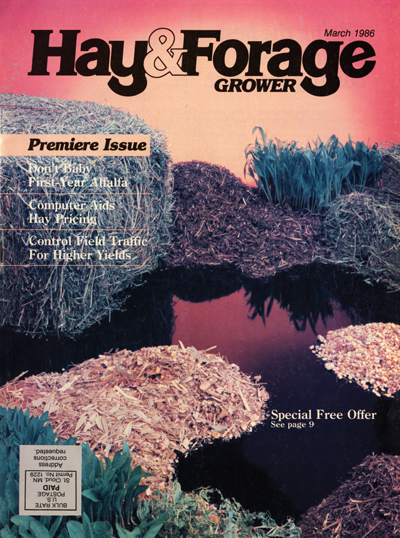
Hay & Forage Grower is also a product of that decade, with our first issue published in March 1986 — see the photo of our first magazine cover. In the spirit of celebrating our 40th anniversary, I spent some time living vicariously through the articles of the original publication. Those articles are living proof of how forage research, technology, and machinery have changed over the past 40 years, and yet, the heart of many production practices, challenges, and successes has stayed the same.
For example, one article in the March 1986 issue titled “Traffic lanes keep alfalfa moving” provides recommendations to reduce widespread injury to alfalfa hayfields and preserve forage yields long term — a call to action that is still shouted from the rooftops today. Other big-picture production trends were noted in the inaugural installment of the Hay Market Update, which continues to be a regular column in every magazine, offering a bird’s eye view of national market dynamics and state hay prices.
Even as new topics have surfaced and the market tides have turned time and time again, our articles are still backed by research like they were in the first issue — oftentimes through the lenses of scientists, professors, and extension specialists themselves. But farmers resonate with other farmers, which is why their stories have a reserved seat at the table of every magazine. Our hope is that readers take something away from those features, whether that takeaway is a shared experience, a new idea, or simply a feeling of validity.
I would be remiss if I didn’t mention the one problem that has been addressed in some way, shape, or form in every issue since our beginning: the weather. In March 1986, both excess rain and prolonged drought were to blame for different circumstances of harvest delays, yield variations, and forage supply and demand disruptions.
The weather continues to be cited as the biggest challenge for farmers of all kinds and in all places; it simultaneously informs decisions and ruins plans. Perhaps the only real difference in our weather-related reporting between 1986 and 2026 is the spelling change from “drouth” to “drought” — something the editor in me couldn’t help but notice.
Each year presents its own set of conditions that uniquely affect fieldwork and forage quality, but luckily, we can live vicariously through these experiences that are forever preserved on paper. That’s the beauty of a print publication. Those firsthand accounts and tangible memories carry immeasurably more value than any fleeting moment that is posted, shared, or swiped past online. It’s the same reason why old photos and stories have a way of taking up permanent residence in the storage closets of our homes and in our minds.
It’s inspiring to see how far our industry has come in an effort to become more precise, efficient, and sustainable over time, but it’s just as reassuring to know that many of the same principles of hay and forage production from 40 years ago remain the supportive taproots for crop and livestock operations today. Here’s to appreciating the past four decades and looking forward to many more.
This article appeared in the March 2026 issue of Hay & Forage Grower on page 4.
Not a subscriber? Click to get the print magazine.